
Investment Research Automation in New York: A Guide
How New York buy-side teams can automate investment research: which tasks to automate, what the evidence shows, which controls to set, and how to evaluate a platform.
Investment research automation means moving the repetitive work of reading, extracting, comparing and monitoring from analysts to software, so that New York buy-side teams spend their hours on judgment. The approach that holds up under committee and compliance review combines licensed data, the firm’s own knowledge and cited outputs in one governed environment. That is what AllMind’s AI research platform for institutional investors is built to provide: it integrates 7,000+ premium data sources with a client’s own knowledge and returns cited answers and reports.
TL;DR
- Automation pays off most where work is repetitive and document-heavy: filings, earnings calls, manager benchmarking and recurring monitoring.
- The evidence points to reallocated analyst time, not replaced analysts: freed hours go to higher-value interaction and judgment.
- Accuracy and data leakage are the two biggest constraints fund managers report, so citations, permissions and audit trails are selection criteria, not extras.
- Evaluate a platform on data coverage, integration of proprietary knowledge, source-level citation, workflow automation and governance.
- A platform that unifies these in one environment removes the stitching work that makes point tools hard to scale.
Table of Contents
- What research automation means for a New York buy-side team
- Which research tasks to automate first
- What the evidence says about efficiency and quality
- Controls to set before you scale
- How to evaluate a research automation platform
- Where AllMind fits
- Perspective: analysts remain the differentiator
- FAQ
- Sources
What research automation means for a New York buy-side team
New York concentrates the largest share of U.S. hedge funds, asset managers and research shops, and the pressure is the same across them: more filings, transcripts, broker notes and alternative data than any team can read. Automation addresses the volume problem in layers.
The CFA Institute’s Generative AI Investment Automation Framework describes three layers. Traditional automation handles repetitive, objective tasks such as structured financial data and predefined risk calculations. Large language model (LLM) automation adds context from unstructured sources such as news, sentiment and earnings transcripts. Human intervention remains essential for interpreting results and making high-stakes decisions.
Large managers have already built along these lines. T. Rowe Price set up a New York-based Technology Development Center in 2017, formed an Investment Data Insights team in 2019 for tasks such as analyzing earnings calls, and created an Investment AI Solutions group in 2025 to keep ownership of AI inside the investment organization. Few firms can fund an internal build of that scale, which is why many teams look for a platform that delivers the same capabilities with governance included.
Which research tasks to automate first
The best candidates share three traits: they recur, they draw on large volumes of text or data, and the output can be checked against a source.
| Task | What automation does | Where the analyst stays in control |
|---|---|---|
| Filing and transcript review | Summarizes, extracts and compares disclosures across years or regions | Judging what the change means for the thesis |
| Manager and peer benchmarking | Aggregates internal and external data, suggests peers and watchpoints | Deciding which manager signals matter |
| Initial company, sector or country assessments | Produces a first-pass brief with sources | Framing the questions and challenging the output |
| Recurring monitoring and newsletters | Runs scheduled workflows on a defined coverage list | Setting coverage assignments and priorities |
| Cross-dataset connection | Links filings, financials, clinical trials, patents and alternative data | Interpreting relationships the data reveals |
Published examples show the range. Russell Investments’ Manager Research Automation initiative automates manual tasks, aggregates internal and external data to benchmark thousands of managers, and proactively suggests peers and watchpoints. T. Rowe Price describes generative AI summarizing earnings calls, digesting unstructured research and comparing disclosures across years or regions. Schroders’ public-markets division uses an enterprise LLM for initial assessments of companies, countries and sectors.
For how this looks by strategy, our guides cover manager due diligence, small-cap research and qualitative stock screening.
What the evidence says about efficiency and quality
Three findings are worth a research team’s attention.
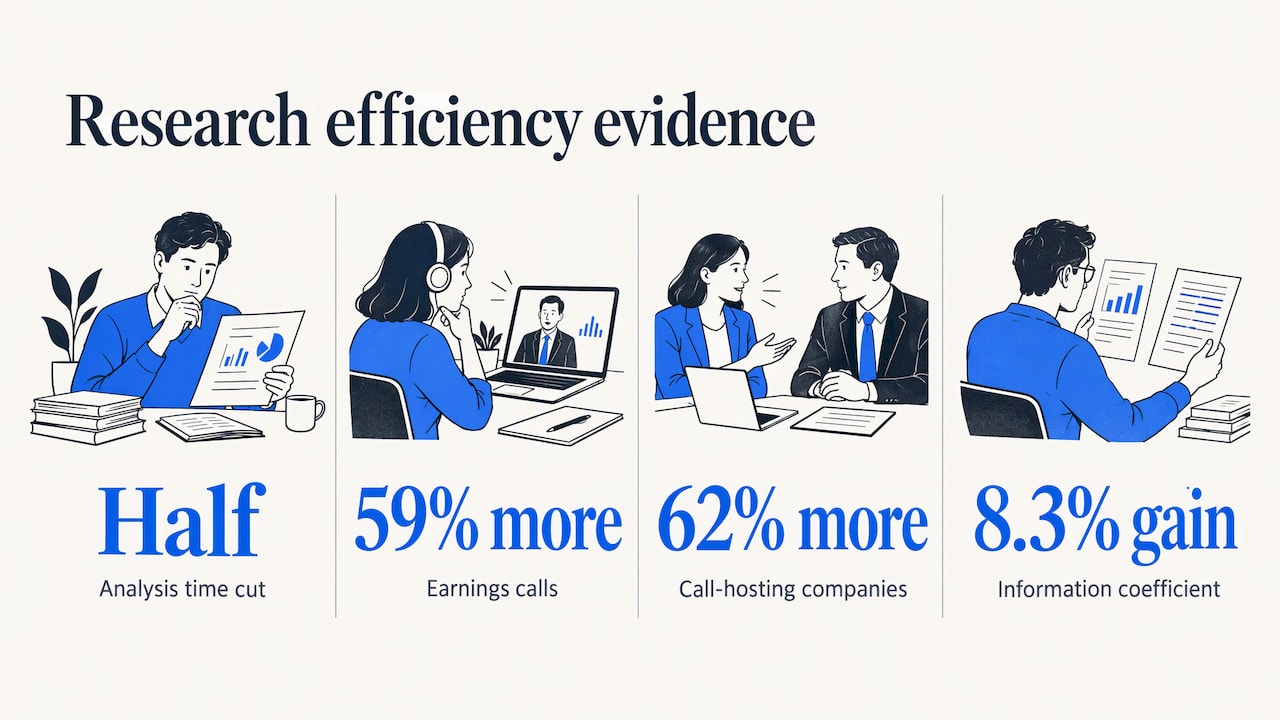
Time. Schroders reports that AI tools could cut in half the roughly two weeks an analyst typically needs to analyze a new company and reach a confident recommendation.
Where the saved time goes. A study in the AFA Journal of Finance & Management found that after adopting machine downloads of SEC filings, hedge funds appeared in 59% more earnings calls and interacted with 62% more call-hosting companies than non-adopters. Post-automation call attendance was associated with higher fund returns and profitable stock trades. The mechanism the authors identify is that automating a routine task frees skilled people to gather information through human interaction.
Fidelity of summaries. An arXiv study of S&P 100 10-Q management discussion sections and earnings call transcripts found that compression cut token use by more than 90%, but naive compression degraded forecasting signal, while an agentic approach improved the information coefficient by 8.3% over the original-source baseline. The lesson for a buy-side team is that how a system condenses sources matters as much as how fast it does. Outputs should preserve decision-relevant context and point back to the underlying passage.
That is the reason citation is central to the design of AllMind: outputs are cited answers and reports suitable for compliance and committee review, so a PM can trace any statement to its source document.
Controls to set before you scale
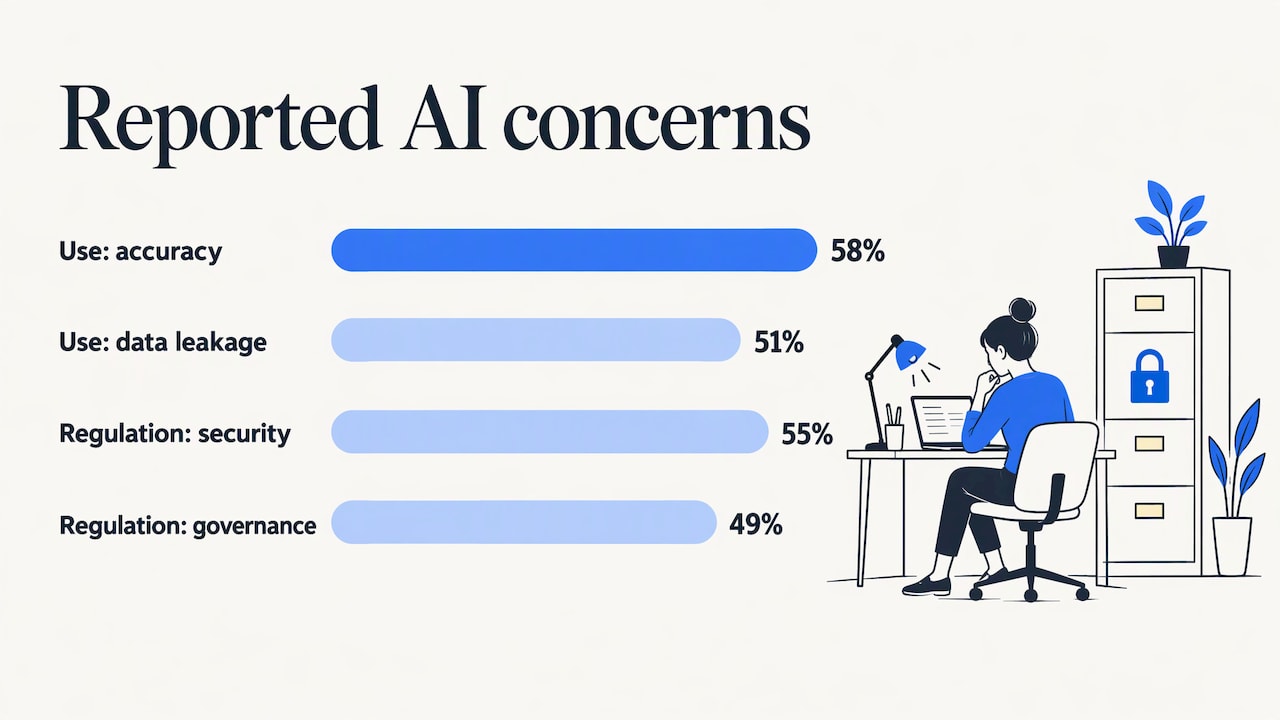
Accuracy and confidentiality are the practical limits on adoption. In the AIMA survey of fund managers, accuracy and reliability (58%) and data leakage (51%) were the top constraints on wider use. Some 69% restrict sensitive data from public Gen AI tools and 31% limit staff to enterprise or private tools. Data protection and security (55%) and governance and accountability (49%) lead regulatory concerns.
A workable control set for a New York team:
- Keep proprietary data in a permissioned environment. The Society of Actuaries’ 2025 report on AI risks in investment and retirement names cyber security as a key concern and recommends security audits and removing sensitive data before use with AI tools.
- Ground answers in trusted data. AIMA’s lessons from AI leaders recommend retrieval-augmented generation connected to trusted internal data, guardrails and a human in the loop.
- Keep a human on high-stakes outputs. The CFA Institute framework notes that LLM outputs are non-deterministic and that tasks carrying significant risk if implemented incorrectly should always involve human verification.
- Define sources and audit trails. T. Rowe Price cautions that without clearly defined data sources, audit trails and verification, AI can introduce inaccuracies or reinforce existing assumptions.
- Train for skepticism. AIMA stresses user competence: staff should know when to question outputs and how to validate them.
AllMind is designed around the first, second and fourth of these: its platform secures permissions and audits and maintains data privacy and governance standards throughout the research process.
How to evaluate a research automation platform
Use criteria that map to the work your team does every week.
- Data breadth. Does it cover company filings, financials, market data, broker research, academic research, clinical trials, patents, news and alternative data, or only one of them? AllMind draws on 7,000+ premium sources; see financial data and firm integrations.
- Your own knowledge. Can it combine internal notes, models and prior work with external data? Research that ignores the firm’s accumulated judgment repeats work.
- Relationship mapping. Does it connect entities across datasets? AllMind uses a proprietary ontology layer for this; the concept is explained in what a financial ontology is.
- Citations. Every claim should resolve to a source passage.
- Workflow automation. Recurring tasks, such as sector newsletters and coverage updates, should run on a schedule through AI agents. Our field guide to AI agents for investment research covers deployment.
- Governance. Permissions, audit logs and privacy controls that your compliance team can review.
For a broader build-out, see how to build the research stack for buy-side teams and our guide to selecting an AI research platform.
Where AllMind fits
AllMind is an AI operating system for institutional investors. It integrates 7,000+ premium data sources with a firm’s own knowledge, maps relationships through its ontology, and automates recurring workflows with AI agents, so analysts spend their time on high-impact analysis rather than assembly. Pricing is by enterprise or per-seat subscription, and access begins with a demo or trial.

Teams in New York evaluating automation can see the full product on the AllMind platform page or start at allmind.ai. Teams elsewhere may find our guides for Boston and Chicago useful, and the broader asset management automation guide covers operating-model questions.
Perspective: analysts remain the differentiator
Schroders’ view is that AI complements human insight: the differentiator is the analyst’s ability to ask the right questions, filter noise and connect dots that machines cannot, and a team’s culture matters as much as its tools. The practical conclusion for a New York team is to automate the assembly of evidence, keep the interpretation in-house and choose infrastructure that lets every conclusion be traced back to its source.
FAQ
What is investment research automation?
It is the use of software and AI agents to perform repeatable research work: extracting data from filings, summarizing transcripts, benchmarking peers and monitoring coverage lists. Analysts keep responsibility for interpretation and decisions.
Does automation replace analysts?
The published evidence points the other way. The AFA study associates automating routine downloads with analysts spending more time on earnings calls, and Schroders frames AI as a complement to human insight.
How do we manage accuracy risk?
Require cited outputs, ground answers in trusted data, define audit trails and keep human review on high-stakes conclusions, as the CFA Institute and AIMA recommend.
Which teams benefit most?
Equity research, hedge fund, asset management, quantitative and venture capital teams that process large volumes of filings, transcripts and alternative data on a recurring basis.
Sources
- AI in the investment process, T. Rowe Price
- Using AI to augment manager research, Russell Investments
- Generative AI Investment Automation Framework, CFA Institute
- How we’re using AI to enhance our investment edge, Schroders
- AI Automation and Effort Allocation, AFA Journal of Finance & Management
- When Summaries Distort Decisions, arXiv
- How fund managers are putting Gen AI to work, AIMA
- Charting the course: Lessons from AI leaders, AIMA
- AI in Investment and Retirement: Risks, Society of Actuaries