
Sell-Side Research Aggregation: How Institutional Teams Do It
How buy-side teams aggregate sell-side research: what to pull together, the US rules that shape access, and how to tie broker views to filings and your own work.

Sell-side research aggregation is the practice of bringing broker research from many firms into one searchable, permissioned workspace, then reading it next to filings, market data and your own notes, so the team sees where views converge, where they diverge and why. Done well, it replaces inbox sorting and portal hopping with a single evidence base. At AllMind, we build the AI research platform that connects broker research to 7,000+ premium data sources and to a firm’s own knowledge, and every answer it produces carries its citations.
This guide is written for buy-side research teams: analysts, portfolio managers and research heads at hedge funds, asset managers and venture firms. It covers what aggregation has to collect, how teams search and organize it, what US rules touch the research you receive, and how to judge a platform.
TL;DR
- Aggregation is not a bigger inbox. It means normalizing reports from many brokers by company, topic, rating and date, so a question can be answered across all of them with the source preserved.
- The value comes from joining broker views to primary evidence: filings, financials, market data and the firm’s own models and notes.
- US research rules, chiefly FINRA Rule 2241, shape what brokers must disclose in a report. Your team’s obligations center on permissions, usage terms and an audit trail.
- Judge a platform on integrations, citations, permissioning and adoption by the team, not on the number of reports it stores.
- AllMind pairs 7,000+ premium sources with your own knowledge through an ontology layer, with cited outputs suitable for compliance and committee review.
Table of Contents
- What sell-side research aggregation actually collects
- How teams search broker research and organize the results
- The US rules behind the research you receive
- What a sell-side research platform should do for each role
- Joining broker views to filings, data and your own work
- How to assess a platform: a checklist for your team
- Where AllMind fits
- FAQ
- Sources
What sell-side research aggregation actually collects
Sell-side research is the analysis that broker-dealers and banks produce and distribute to clients. A coverage analyst at one firm may publish several items a week on a single name, and a buy-side team with twenty brokers can receive thousands of documents a month.
The formats are more varied than most teams plan for. FINRA’s Series 86/87 content outline, the qualification exam for research analysts, lists the main report types: initiation reports, earnings analysis, preview and review reports, in-depth fundamental reports, topical or theme reports, reports announcing changes in rating, recommendation or projected earnings, coverage-elimination reports, short notes and news summaries, and industry reports.
Each type answers a different question for your desk:
| Report type | What it tells the team | How it should be filed |
|---|---|---|
| Initiation | The broker’s full thesis, model assumptions and valuation framework | By company, with the analyst and date as fixed fields |
| Earnings preview and review | Expectations going in, and the reading of the print | By company and quarter, linked to the filing and transcript |
| Rating or estimate change | A shift in conviction or numbers | As an event on a timeline, with the prior value kept |
| Thematic and industry report | Cross-company argument on a sector or trend | By theme and by every company it names |
| Coverage elimination | A broker leaving a name | As an event, because it affects consensus breadth |
| Short note and news summary | Fast reaction and commentary | By company, ranked below deeper work |
Aggregation fails when it treats all of these as the same object. A rating change, a model and a two-line note need different metadata, and a search that cannot distinguish them returns noise.
How teams search broker research and organize the results
Most desks start with three channels: email distribution, broker portals and an internal archive of PDFs. Each has a different gap. Email is chronological but not searchable by claim. Portals are searchable but one broker at a time. The archive is shared, but only as good as the last person who filed into it.
A workable aggregation setup organizes along four axes at once:
- Company. Every document resolves to the issuer or issuers it covers, including thematic reports that name many.
- Broker and analyst. Teams weigh views by the author’s track record and sector depth, so authorship must survive ingestion.
- Topic. Margin structure, pricing, regulatory exposure, supply chain: the questions the team repeatedly asks.
- Time. What the broker believed before the quarter against what it believed after.
Keyword search over this structure is a start. The better test is whether an analyst can ask a question in plain language, such as how brokers’ views on a company’s gross margin have changed since the last print, and receive an answer that names each broker, quotes the passage and links to the page. That is where AI agents earn their place: they read across documents, group the claims and return the source for each one.
If you want to see how this fits the wider stack, our guide to broker research and RMS explains what to buy and how to use it, and our overview of AI tools for sell-side equity research covers the desk-side view.
The US rules behind the research you receive
Aggregating research does not make a buy-side firm a research publisher, but the rules that govern the reports explain what you will find in them and why. Read this section as orientation for your research and compliance teams, not as legal advice. For your own firm’s obligations, consult your compliance officer or securities counsel.
FINRA Rule 2241 and what it puts in every report
FINRA Rule 2241 addresses conflicts of interest in the publication and distribution of equity research. According to FINRA Regulatory Notice 15-30, the rule requires firms to maintain conflict policies, to have a reasonable basis for recommendations with a valuation explanation and risk presentation, to define their ratings, and to disclose rating percentages and investment-banking services. The same notice states that the rule implements the Sarbanes-Oxley separation of research from investment banking, and requires policies designed to keep research and analysts from being used to manipulate or condition the market.
For an aggregation workflow, this has a practical consequence. Disclosures, rating definitions and conflict statements are part of the document, and they should travel with any extracted claim. A summary that strips the rating definition or the banking-relationship disclosure can mislead a committee reader. Preserve the source context, and link each extracted statement back to the page.
Who counts as an institutional investor
Some research rules distinguish retail from institutional recipients. According to the Federal Register notice on Regulation Best Interest, that regulation applies to broker-dealer recommendations to retail customers, meaning natural persons who use recommendations primarily for personal, family or household purposes. It does not generally apply to recommendations to institutional money managers, which fall under FINRA Rule 2111 suitability. The same material treats institutional accounts as including persons with total assets of at least $50 million, and its definition of institutional investors includes governmental entities, qualifying employee-benefit plans with at least 100 participants, and members or registered persons of FINRA members.
If your allocator or pension client base sits in that group, our page on AI research tools for pension funds and allocators addresses their workflow.
Debt research and foreign brokers
Two more distinctions matter when your broker list is international or includes credit. FINRA’s Rules Reference Guide provides an exemption for distributing debt research to institutional investors: qualified institutional buyers able to evaluate risk independently, or institutional-account persons who notify the member in writing that they want institutional debt research. Reports under that exemption carry a prominent first-page statement that they are intended for institutional investors and may not be independent of the firm’s proprietary interests.
On the foreign side, a practitioner summary of Rule 15a-6 explains that a foreign broker-dealer may provide research directly to Major Institutional Investors, including entities with at least $100 million in financial assets. It also notes that a US broker-dealer may distribute clearly labeled third-party research it did not help prepare, with disclosures under Regulation AC and FINRA Rules 2241(h)(4) and 2242(g)(3). In practice, a research library holds documents with different disclosure regimes, and the platform should keep the original disclosure page attached.
What is under discussion now
The disclosure format is being debated. In its comment letter on FINRA Regulatory Notice 25-06, SIFMA supported modernizing the research rules. It proposed replacing the prescriptive “Other Business Disclosures” in Rules 2241©(4) and 2242©(4) with a standard disclosure, replacing front-page requirements with a “clear and prominent” standard suited to electronic platforms, and relaxing the mandatory line-graph price history.
A Morgan Lewis comment letter dated June 25, 2025 goes further. It argues that institutional investors ingest research as one input into independent analysis aggregated from many sources, increasingly with AI, and that retail-style disclosures matter less to them. It proposes an institutional exemption under Rule 2241 modeled on the debt research exemption, plus relief for short-form institutional research and for foreign broker-dealer research distributed under Rule 15a-6.
These are proposals from commenters, not adopted rules. The direction is clear, though: research is increasingly consumed electronically, in pieces, and the format of disclosures is being rethought for that. Teams building on AI tooling for this kind of work, whether for inference capacity or workflow design, should expect the packaging of research to keep changing, which is one more reason to keep documents and their original disclosures intact at the source.
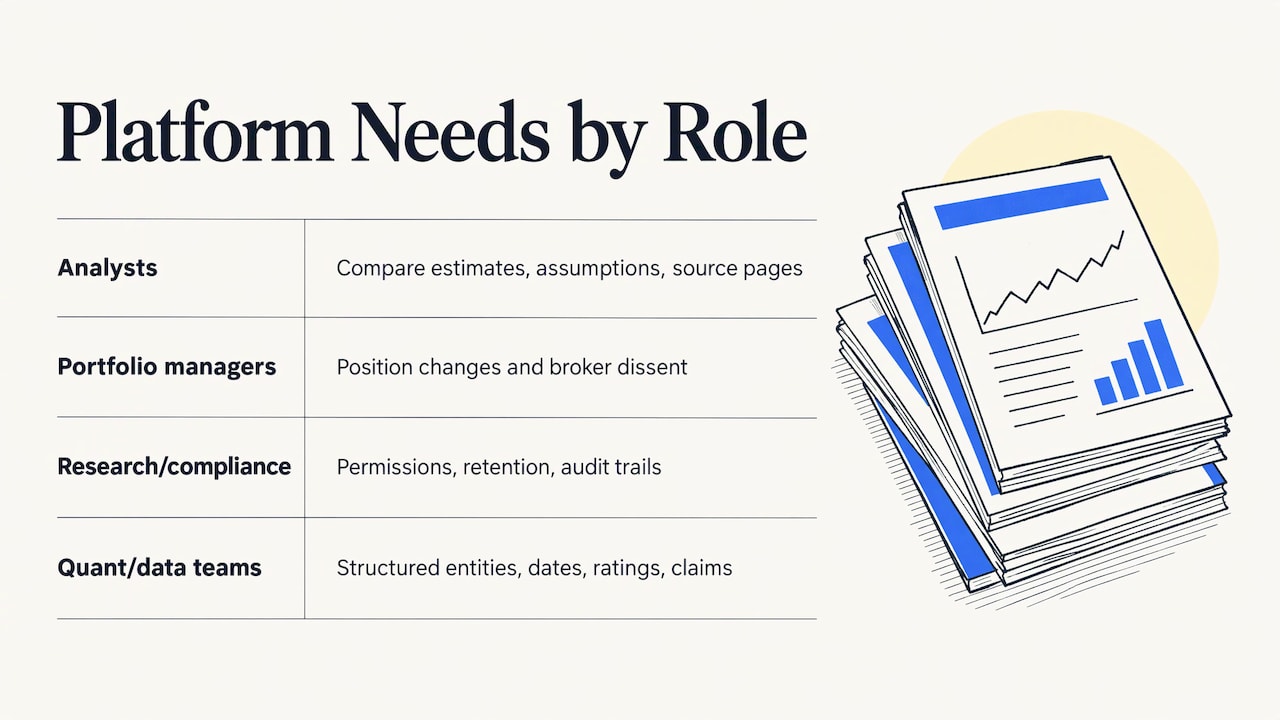
What a sell-side research platform should do for each role
The same library serves different people. A platform that fits one role and frustrates another does not get adopted.
Analysts need fast retrieval and comparison: every broker’s estimate for a line item, the stated assumptions behind it, and the page where it appears. They also need to put those views beside the filing text and the company’s reported figures without leaving the workspace.
Portfolio managers need a position-level view: what changed in the brokers’ view of my holdings this week, and what is the dissent. A digest keyed to the portfolio beats a firehose.
Research heads and compliance need permissions, retention and an audit trail. Which broker content may be used by which team, who queried what, and which source supports each line of a committee memo.
Quant and data teams need structured access: entities, dates, ratings and extracted claims that downstream models can use.
A 2023 Alpha FMC whitepaper describes asset managers struggling with disparate data sources, compliance and reporting requirements, record-keeping and cross-team collaboration. It sees the value of a research management system resting on three components: the user experience, a data science engine that stores, aggregates and analyzes research, and data foundations that integrate with the firm’s data warehouse and downstream order management systems. It also stresses that investment teams must be involved early, and that even a powerful system can hinder a manager if it is not built around the team’s actual workflow.
That last point deserves emphasis. The distance between research and execution is where time is lost, which is why teams also look at the tools around the desk, such as performance improvement tools for traders. The aggregation layer should hand off cleanly: recommendations and commentary should be able to flow to the systems where decisions are made.
Joining broker views to filings, data and your own work
Broker research is secondary evidence. It interprets company disclosures, adds estimates and states a view. The strongest use of an aggregated library is therefore to test those interpretations against primary material, and to do so while keeping each claim tied to its source.
A repeatable routine looks like this:
- Resolve entities. Map each report to the company, segments, products and competitors it names, so a thematic report appears under every relevant issuer.
- Extract claims with provenance. Pull estimates, ratings, targets and stated drivers, each with broker, analyst, date and page.
- Link to primary data. Attach the filing section, the reported financials and the market data behind each claim. Our page on company financials, estimates and operating KPIs shows the data this draws on.
- Overlay the firm’s knowledge. Internal models, meeting notes and prior memos belong in the same workspace, with their own permissions.
- Produce a cited output. A committee memo or a recurring sector note, where every statement has a link back to its evidence.
The connecting layer is what makes step 1 and step 3 possible. An ontology is a structured map of how entities and concepts relate: a company, its subsidiaries, its products, the trials or patents tied to them. Our explainer on what a financial ontology is goes through the idea. Without it, the same company appears under three tickers and four spellings, and a cross-broker question returns partial answers.
A short worked example. A hedge fund analyst covering a medical device maker wants to know whether brokers’ margin expectations assume the new product ramps on schedule. The aggregated library returns each broker’s gross margin estimate and the ramp assumption behind it, with the page cited. The workspace places the company’s latest filing language on the product beside them, and the analyst’s own model sits in the same view. The outcome is a documented list of where the street’s assumptions rest on the company’s guidance and where they extend past it, which is what an investment committee asks for.
How to assess a platform: a checklist for your team
Use these criteria when you evaluate any aggregation workflow.
| Criterion | What to confirm |
|---|---|
| Source coverage | Broker research alongside filings, financials, market data, academic research, patents, clinical trials, news and alternative data |
| Citations | Every answer points to the document and passage it came from |
| Permissions | Access follows your entitlements and team structure, with usage logged |
| Auditability | A record of queries, sources and outputs for compliance and committee review |
| Integration | Connects to the firm’s data warehouse and downstream systems, and ingests the firm’s own knowledge |
| Entity resolution | A shared ontology so cross-source questions return complete answers |
| Workflow automation | Recurring tasks such as sector newsletters and earnings read-throughs run on a schedule |
| Adoption | The team shapes setup, and outputs match the formats it already uses |
Our guides on selecting an AI research platform and on building the buy-side research stack go deeper on each criterion, and the AI agents deployment field guide covers recurring workflows.
Where AllMind fits
AllMind is an AI operating system for institutional investors. It integrates 7,000+ premium data sources with your firm’s own knowledge through a proprietary ontology layer, so broker research, company filings, financial statistics and clinical trial results can be queried together. AI agents handle complex inquiries and recurring research workflows, and answers and reports come with citations suited to compliance and committee review. Permissions and audits are built into the research process, and data privacy and governance standards apply throughout.
If your team is weighing how to consolidate broker research into a working evidence base, start with the AllMind platform or see how financial data and firm integrations are structured.

FAQ
What is the difference between sell-side research aggregation and a research management system?
An RMS typically stores, tags and distributes research a firm receives and creates. Aggregation emphasizes consolidating many brokers’ work and making it answerable by question. The strongest setups combine both, with ingestion, search, a shared entity map and an audit trail in one workspace.
Can we search broker research across brokers by claim rather than keyword?
Yes, when documents are resolved to companies, topics and dates and claims are extracted with their page references. An analyst can then ask how views on a metric differ across brokers and receive each position with its source. Keyword search alone cannot separate a rating change from a passing mention.
Do US research rules limit how our team uses aggregated reports?
FINRA Rule 2241 governs the brokers that publish equity research, including the disclosures each report carries. Your own obligations depend on your contracts with each broker and your firm’s compliance policy, so involve your compliance officer in setting permissions. Keeping the original disclosures attached to every document is a sound default.
How should we combine broker views with our own research?
Keep them in one permissioned workspace, with each broker claim linked to the filing or data behind it and your internal models and notes alongside. Cited outputs then show which conclusions came from the street, which from primary data and which from your team.
Sources
- FINRA Research Analyst Qualification Exam (Series 86/87) content outline
- FINRA Regulatory Notice 15-30
- Federal Register, Vol. 84, Issue 134 (July 12, 2019): Regulation Best Interest
- FINRA Rules Reference Guide
- Current Practices and Issues for Foreign Broker-Dealers: Rule 15a-6
- SIFMA comment letter on FINRA Regulatory Notice 25-06
- Morgan Lewis comment letter on FINRA Regulatory Notice 25-06
- Alpha FMC, Worth The Investment: Improving Asset Management Research (2023)