
How to Analyze Alternative Data: A Workflow for Research Teams
A practical workflow for analyzing alternative data: define the hypothesis, vet vendors, map to securities, test out of sample and document compliance for audit.

Analyzing alternative data well is a sequencing problem more than a data problem. The teams that get value from it define the hypothesis first, vet the provenance of each dataset, map records to securities, test the signal at a tradable moment, and keep a cited record of every step. AllMind is an AI operating system for institutional investors that combines more than 7,000 premium data sources with a firm’s own knowledge, so the connecting work in that sequence can be automated and cited rather than rebuilt for each question. The sections below set out the workflow, where it usually fails, and what a team should document.
TL;DR
- Start from a falsifiable hypothesis about a specific company, sector or factor, then choose the dataset. Starting from the dataset produces signals without a thesis.
- Value a dataset by uniqueness and additivity as well as raw predictive power. A signal that duplicates an existing model’s output adds little.
- Most of the effort is cleaning, entity mapping and point-in-time discipline. Raw data generally needs scrubbing, reformatting and mapping before analysis.
- Test whether the edge survives to a moment you can trade, and expect decay out of sample.
- Under SEC rules, written policies and re-performed diligence on data vendors are part of the analysis, not an afterthought.
Table of Contents
- What counts as alternative data
- Step 1: Write the hypothesis before choosing the data
- Step 2: Assess the dataset on uniqueness and additivity
- Step 3: Clean, standardize and map to securities
- Step 4: Test the signal at a tradable moment
- Step 5: Document diligence as part of the analysis
- Where the manual workflow breaks down
- How AllMind supports the workflow
- A worked example: one hypothesis, five checks
- FAQ
- Sources
What counts as alternative data
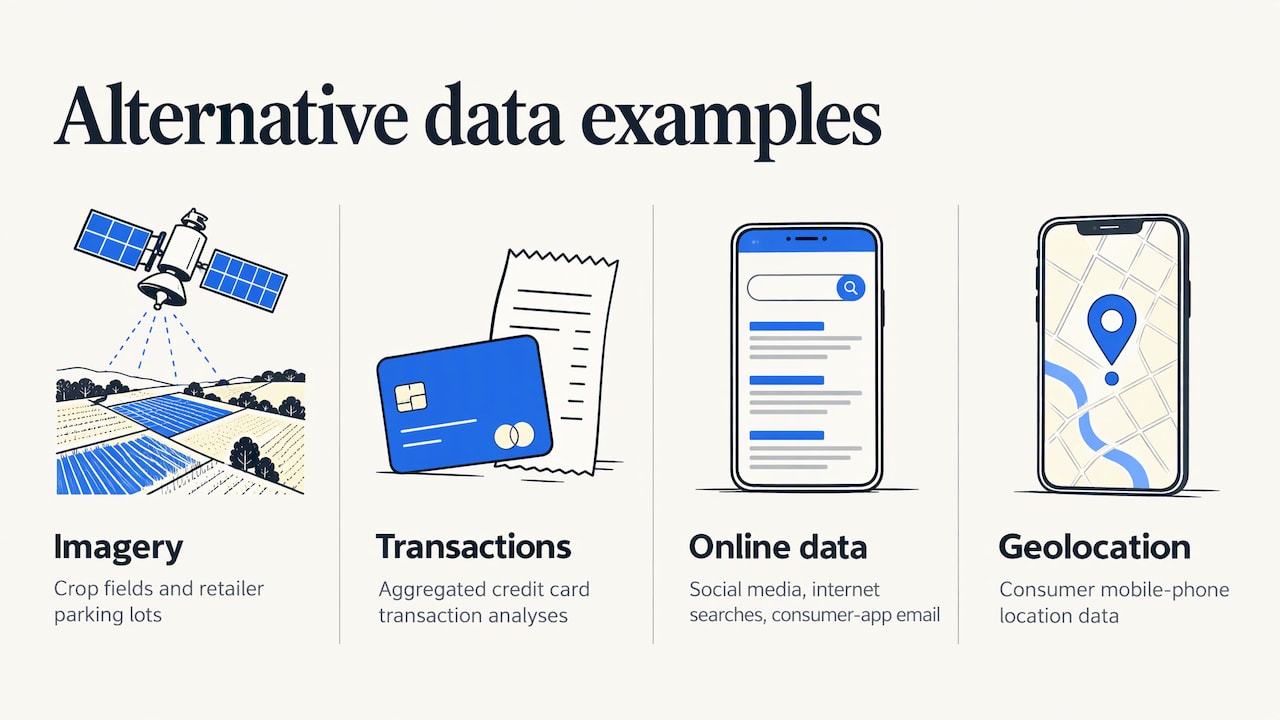
The SEC’s April 2022 risk alert on investment adviser MNPI compliance describes alternative data as information used in financial analysis beyond traditional financial statements, company filings and press releases. Its examples include satellite and drone imagery of crop fields and retailer parking lots, aggregated credit card transaction analyses, social media and internet search data, consumer mobile-phone geolocation data, and email data from consumer apps. MNPI means material non-public information, the category of data that can create insider trading exposure if it is obtained or used improperly.
The practical distinction from traditional data is timing and structure. Filings and statements arrive on a reporting calendar in a standard format. Alternative data arrives continuously, in inconsistent formats, and often without identifiers that tie it to a listed issuer. CFA Institute coverage of the field gives examples of why teams accept that burden: heat or energy indicators can gauge building occupancy, and highway traffic can show whether people are commuting into offices. These are leading indicators that may move before reported numbers do.
The same source adds a caution on sentiment data. NLP now lets investors extract sentiment from social media and spot trends in product discussion early, but what people say often does not correspond with what they do. That is a reason to treat text signals as one input to be corroborated, not as a conclusion.
Step 1: Write the hypothesis before choosing the data
A usable hypothesis names an entity, a measurable variable and an expected relationship to a reported or priced outcome. For example: “Weekly foot traffic at a retailer’s stores leads reported same-store sales by one quarter.” That statement tells you which data to look for, which lag to test and what result would disprove it.
The FISD Alternative Data Council guide notes that fundamental managers tend to use alternative data to confirm signals from traditional models, while quantitative managers feed it directly into trading algorithms. Decide which role the data plays on your team before you buy or ingest anything, because it determines the evidence standard. A confirming input for an analyst’s thesis needs traceability and context. A model input needs history, stability and clean timestamps.
Where this step typically goes wrong is scope. Analysts collect interesting data, then look for a question it can answer. The resulting backtests have many degrees of freedom and little discipline. Writing the hypothesis, the expected lag and the disconfirming result down first limits that.
Step 2: Assess the dataset on uniqueness and additivity
The FISD guide states that a signal’s alpha is central to a dataset’s value, but additivity matters as much. A signal with good alpha that resembles an existing model’s output has less value than a unique, uncorrelated signal that adds meaningful value in combination with other factors. The guide also observes that broader coverage is generally preferable for capital allocation and risk management.
In practice, assess five things before any modeling:
| Criterion | Question to answer | Evidence to keep |
|---|---|---|
| Uniqueness | Does it correlate with factors or datasets already in use? | Correlation table against existing signals |
| Coverage | How many issuers, geographies and periods does it span? | Coverage matrix by ticker and date |
| History | Is there enough history to span more than one cycle? | Start date, gaps, revisions |
| Timeliness | How long between the real-world event and delivery? | Delivery timestamps vs. event timestamps |
| Provenance | How was it collected, and under what terms? | Vendor questionnaire, collection terms |
The last row connects the quantitative assessment to the compliance one. A dataset that scores well on every other row can still be unusable if its provenance cannot be documented.
Step 3: Clean, standardize and map to securities
Most alternative data does not arrive keyed to a security. A card-transaction panel has merchant names, a geolocation feed has venue IDs, a job-postings feed has employer strings. The FISD guide reports that only 38% of hedge funds and asset managers want raw, unprocessed data, and that raw alternative data generally requires scrubbing, reformatting and mapping. It describes normalized delivery with embedded tags linking securities, industries and timestamps as the alternative.
The BIS guidance note on security databases is a useful reference for the mapping layer. It explains that CUSIP is used for clearing and settlement of North American securities, while ISIN and LEI are the international standards for identifying individual securities and issuers. It also says that producing a clean database means accounting for missing data, revisions after validation failures and revisions from new information, and it names name-matching algorithms such as Jaro-Winkler distance for cases where standardized identifiers are absent.
A workable mapping routine looks like this:
- Match on a standard identifier wherever the vendor supplies one.
- Where it does not, run fuzzy name matching and review every low-confidence match by hand.
- Resolve subsidiaries and brands to the listed parent, and record the effective dates of each relationship, since corporate structures change.
- Store the raw record, the mapped record and the mapping rule, so any figure in a note can be traced back.
The usual failure is silent mismatch: a brand mapped to the wrong parent, or a divested business still attributed to its former owner. These errors rarely look wrong in a chart. They surface when a signal fails to replicate.
Step 4: Test the signal at a tradable moment
Statistical significance is not the same as usefulness. Two recent academic papers show why the test design matters.
The PALM study, Point-in-Time Adaptation for Financial Language Models, shows that language models used in financial backtests suffer look-ahead bias when they were trained on text published after the study period, because they have already seen the outcomes. The authors validate point-in-time models on 252,000 article-day observations across 1,099 US tickers from 2014 to 2023, scoring articles against next-day open-to-close returns so that every score could have been acted on. The lesson for any dataset is the same: every observation must carry the date it was actually knowable, not the date it refers to.
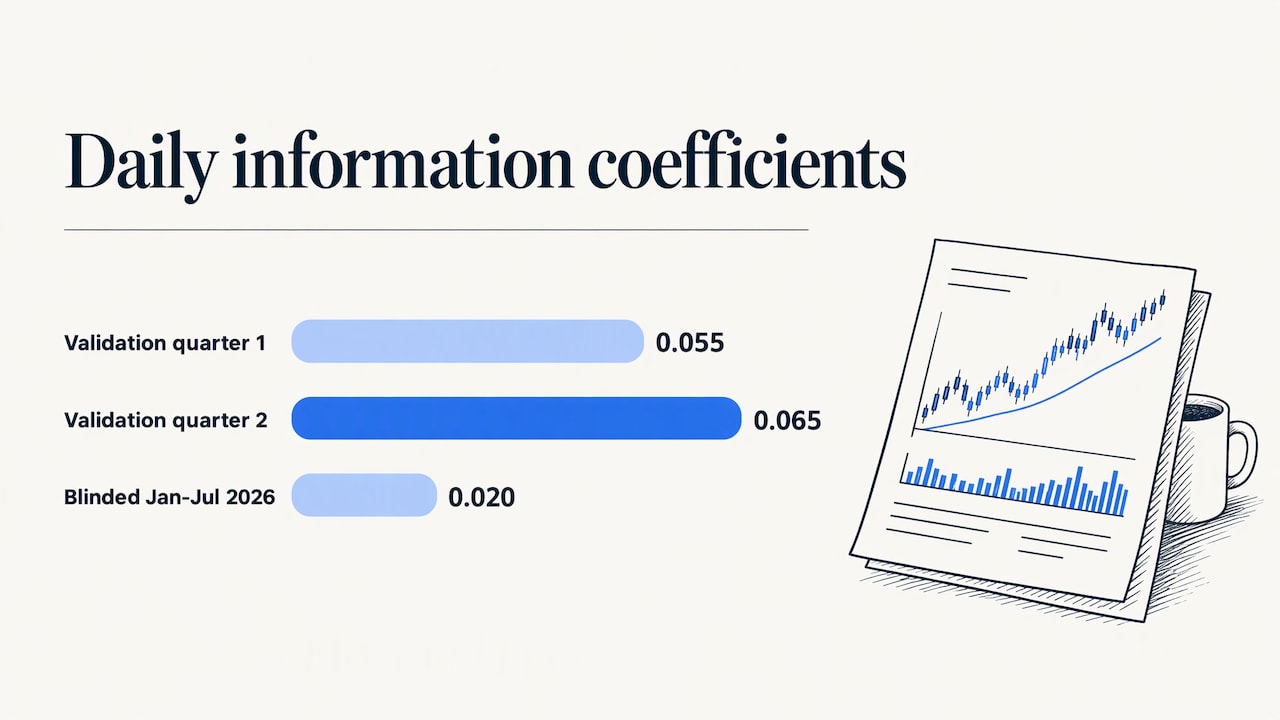
A second paper, Thinking Fast, Trading Late, tested LLM news signals on point-in-time S&P 500 data. A fine-tuned model’s signal replicated on two validation quarters, with daily information coefficients of 0.055 and 0.065, but fell to 0.020 (t=1.7) on a blinded January to July 2026 test. No pre-registered strategy survived costs and a deflated Sharpe ratio. The authors also found that commercial readings aligned with the overnight move to the open but not with the move after it, meaning pre-open news was already priced by the time a trader could act.
For a research team, that translates into a short testing standard:
- Use point-in-time data, with vendor restatements and revisions tracked, not just the latest version.
- Hold out a final period that is not touched during development.
- Measure the signal against returns you could have captured after the data was available, net of costs.
- Adjust for the number of variants tried, for instance with a deflated Sharpe ratio.
- Re-test on a schedule, since a signal that held in one regime can decay.
A signal that fails these tests is useful information. It tells the team to stop spending analyst hours on that dataset.
Step 5: Document diligence as part of the analysis
The SEC risk alert states that Section 204A of the Advisers Act requires all investment advisers, registered and unregistered, to maintain written policies reasonably designed to prevent misuse of MNPI. In its examinations the staff observed deficiencies specific to alternative data: ad hoc diligence processes, policies that did not address collection terms and red flags, inconsistent application, and no system for re-performing diligence over time.
An academic treatment in the Brooklyn Journal of Corporate, Financial & Commercial Law argues that managers should build compliance programs that provide assurance datasets were not acquired in breach of a duty for purposes of Rule 10b5-1, and that satisfy the written-policy obligations under the Advisers Act. It also recommends a culture in which employees report unusual receipt of MNPI, along with documentation, recording of reports and training on securities laws and red flags.
FISD’s Alternative Data Identification Factors gives risk-based factors for assessing data and vendor characteristics, market adoption and other red flags. It notes that firms must take reasonable steps to address potential compliance issues before trading, and that due diligence questionnaires, independent verification and documented diligence may be used. It also records increasing regulatory scrutiny, including the SEC’s first enforcement action against an alternative data provider for securities fraud in 2021, followed by the April 2022 risk alert.
For each dataset, we recommend that the team’s file contains:
- the vendor questionnaire and the collection terms it describes;
- the red-flag review and who signed off;
- the date of the last diligence review and the date the next is due;
- the datasets’ approved uses and the personnel permitted to access them.
Counsel should review the policy itself. A diligence checklist from a fractional legal team shows how legal readiness items such as data provenance and written policies are organized, which can help a compliance officer structure an internal template. Your chief compliance officer or securities counsel decides what your firm’s program must contain.
Where the manual workflow breaks down
Each step above is straightforward on one dataset. The strain appears at scale. A team running ten datasets has ten mapping tables, ten vendor files, ten sets of timestamps and a growing set of cross-dataset questions: whether web traffic, transaction data and a broker’s estimate revision all point the same way for the same company. Analysts spend their time reconciling formats and tracing where a number came from instead of judging what it means.
That is the problem a research platform should solve. It should hold alternative data next to filings, financial statistics, broker research and the firm’s own notes, so one question can draw on all of them with the sources visible. For more on structuring that work, see our workflow for alternative data investing and our guide to alternative data due diligence for institutional investors.
How AllMind supports the workflow
AllMind integrates more than 7,000 premium data sources with a firm’s own knowledge. Its proprietary ontology layer connects company filings, financial statistics, clinical trial results and alternative data, so relationships between entities are mapped once and reused across questions. This addresses the entity-mapping burden described in Step 3. Our financial ontology guide explains the concept.
AI agents handle complex inquiries and recurring workflows, and answers and reports come with citations suitable for compliance and committee review. Permissions and audit trails are built into the research process, which supports the documentation discipline in Step 5. The platform covers market data, broker research, academic research, patents, news and mining data alongside alternative data, so a signal can be read against the fundamentals that it is meant to anticipate.

To see how this fits your coverage, review AllMind’s alternative data capabilities or the AI research platform for institutional investors.
A worked example: one hypothesis, five checks
Take an analyst covering a consumer discretionary name who hypothesizes that web search interest leads quarterly revenue by four to six weeks.
- Hypothesis: written down with the lag range and the result that would disprove it (no relationship after controlling for seasonality).
- Dataset assessment: the search series is checked against the team’s existing demand model. If it correlates highly, its additive value is low, whatever its standalone fit.
- Mapping: brand and product terms are mapped to the listed parent with effective dates, including recently acquired lines.
- Testing: the series is aligned to the date each observation was available, tested on a held-out final period, and judged on whether the signal arrives before the information is priced.
- Documentation: the vendor file, terms of collection and sign-off are stored alongside the analysis, with the next review date.
If the signal survives, it enters the analyst’s thesis as a cited input. If it does not, the file records why, which prevents the same idea from being re-tested next quarter.
FAQ
What is an example of alternative data?
The SEC’s 2022 risk alert lists satellite and drone imagery of retailers’ parking lots, aggregated credit card transactions, social media and internet search data, consumer mobile-phone geolocation data and consumer-app email data. All of these sit outside traditional financial statements, filings and press releases.
How do you know if an alternative dataset is worth using?
Assess uniqueness and additivity as well as predictive power. A signal that overlaps heavily with your existing models adds less than an uncorrelated one, according to the FISD Alternative Data Council guide. Check coverage, history and timeliness, and confirm that provenance can be documented.
Why do alternative-data signals stop working?
Signals often weaken out of sample. In a 2026 study of LLM news signals, a signal that replicated in validation fell sharply on a blinded test period, and no pre-registered strategy survived costs. Point-in-time data, held-out periods and scheduled re-testing help teams detect decay early.
What compliance steps apply to alternative data in the US?
Section 204A of the Advisers Act requires advisers to maintain written policies reasonably designed to prevent misuse of MNPI. The SEC’s 2022 risk alert highlighted ad hoc diligence, policies that ignored collection terms and red flags, and no re-performance of diligence over time. Your compliance officer and counsel should set the firm’s program.
Sources
- SEC Risk Alert: Investment Adviser MNPI Compliance Issues (April 2022)
- CFA Institute: Using NLP to unlock a treasure trove of alternative data
- FISD Alternative Data Council: A Guide to Alternative Data
- BIS IFC Guidance Note 5: Development and maintenance of a security-by-security database
- PALM: Point-in-Time Adaptation for Financial Language Models (arXiv)
- Thinking Fast, Trading Late (arXiv)
- Alternative Data and Insider Trading, Brooklyn Journal of Corporate, Financial & Commercial Law
- FISD Alternative Data Identification Factors (March 2023)
- Sell-Side Diligence Checklist