
Investment Research Automation in San Francisco: A Guide
How Bay Area research teams can automate filings, transcripts and data synthesis while keeping citations, analyst review and privacy intact.

For a Bay Area buy-side team, investment research automation means moving the repeatable work of reading, extracting, reconciling and drafting out of the analyst’s day, while keeping every output cited and reviewable. We built AllMind for this purpose: an AI operating system that connects more than 7,000 premium data sources to your firm’s own knowledge through a proprietary ontology layer, so analysts spend their time on judgment rather than assembly.
TL;DR
- Automation pays off first in recurring work: filings, transcripts, sector monitoring and committee materials.
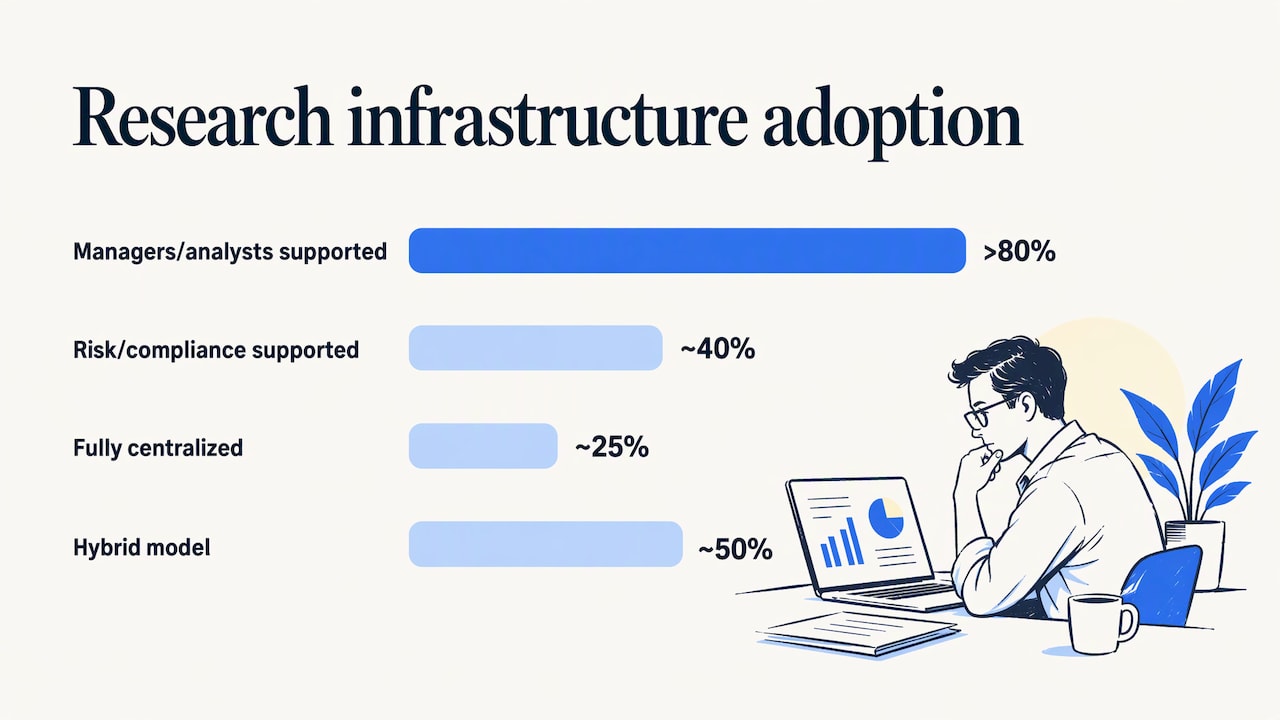
- Programmatic research infrastructure is already mainstream: more than 80% of buy-side portfolio managers and analysts are supported by it, according to a January 2026 study.
- The value comes from joining external sources with your firm’s proprietary knowledge, and from outputs that cite their evidence.
- Human review, permissions and audit trails should be designed in from the first deployment, not added later.
- Judge any rollout on analyst hours recovered and on the accuracy of cited outputs, measured against a workflow you already run.
Table of Contents
- What research automation covers for an institutional team
- Where the industry stands in 2026
- Which tasks to automate first
- Why connecting your own knowledge matters
- Agents and recurring workflows
- Safeguards: citations, review and privacy
- What to assess before integrating
- How to measure whether it works
- Automation for a Bay Area team
- How AllMind fits
- FAQ
- Sources
What research automation covers for an institutional team
Research automation is not a single tool. It is a set of steps in the research cycle that software can perform consistently:
- Collection: pulling company filings, earnings transcripts, broker research, news, patents and clinical trial results into one place.
- Extraction: turning unstructured documents into structured figures and statements that can be compared.
- Synthesis: linking facts across datasets, such as a supplier disclosure in a filing and a trial readout that affects the same issuer.
- Monitoring: watching a coverage universe and flagging changes against a thesis.
- Drafting: producing cited summaries and reports that a committee can review.
The CFA Institute’s research on unstructured data and AI notes that natural language processing is particularly suited to unstructured alternative datasets such as PDFs and news articles, and that fine-tuning on proprietary data can add more value than the underlying models used in isolation. That second point matters for how you choose a platform, and we return to it below.
Where the industry stands in 2026
The Crisil Coalition Greenwich study, based on interviews with 66 investment professionals at buy-side firms in the US, UK and Europe, found that more than 80% of portfolio managers and analysts are supported by their firm’s programmatic research infrastructure, as are about 40% of risk and compliance teams. About a quarter of participants described that infrastructure as fully centralized, and roughly half use a hybrid model.
The same research program observes that as datasets grow, tooling for consuming, coding and modeling is becoming imperative and upskilling needs are increasing. For a San Francisco team, that means automation is less a question of whether than of how much of the workflow is shared, governed and reusable across analysts.
The largest managers show the scale that is now possible. At QCon San Francisco in November 2026, BlackRock described its internal research platform, whose continuous thesis monitoring processes approximately 150,000 documents each week across 10,000 companies. Most Bay Area hedge funds, venture firms and mid-sized asset managers will not build such a system in house, which is the gap a purpose-built platform addresses.
Which tasks to automate first
Start where the work is frequent, rule-bound and easy to check. The Federal Reserve Board’s own AI use case inventory is a useful illustration: its research division operates a natural language system, in production since 2021, that reads SEC filings to identify security issuers in money market fund portfolios. Governor Lisa Cook observed in a May 2026 speech at Stanford that the financial sector is adopting AI first in highly manual areas.
For an investment team, the equivalent starting points are:
| Workflow | What is automated | What the analyst still does |
|---|---|---|
| Filing review | Extraction of figures, changes in language, risk-factor comparisons | Judges materiality and interprets management intent |
| Earnings season | Transcript summaries, guidance tracking against prior quarters | Decides what changes the thesis |
| Sector newsletter | Recurring collection and drafting of cited updates | Edits the view and sets priorities |
| Cross-dataset questions | Linking filings, financial statistics, trials and patents | Tests the conclusion and sizes the position |
| Committee materials | Cited drafts with sources attached | Signs off and presents |
Our guide on analyzing SEC filings with AI takes the first row in detail, with a verification-first approach to checking extracted figures.
Why connecting your own knowledge matters
Most teams already hold years of notes, models, meeting records and past memos. A generic assistant cannot see them, and a data terminal cannot reason across them. The strongest case for a platform like ours is that it joins both sides.
AllMind integrates 7,000+ premium sources, spanning company filings, financials, market data, broker research, academic research, clinical trials, patents, news, mining and alternative data, with a firm’s own knowledge. A proprietary ontology layer maps relationships between companies, products, people, trials and datasets, so a question that crosses sources can be answered from connected evidence. If the term is new to your team, what a financial ontology is explains the concept in plain terms.
This aligns with the CFA Institute’s finding that proprietary data fine-tuning can outperform underlying models alone. It also explains why equity researchers, quantitative managers and venture teams get different value from the same platform: each brings different internal knowledge to the ontology.
Agents and recurring workflows
AI agents handle multistep questions that would otherwise require an analyst to open a dozen tabs. They also run recurring workflows, such as a weekly sector brief or a coverage assignment refresh, on a schedule.
The CFA Institute’s guidance on agentic AI for finance states that, because finance is tightly regulated and high stakes, workflow-style automations offering control and predictability are more likely to be adopted than highly autonomous agents. That is the design principle we recommend: defined steps, defined sources, and a person approving anything with consequences. Our field guide to AI agents for investment research covers deployment in more depth.
Safeguards: citations, review and privacy
Speed without traceability is a liability in front of a compliance officer or an investment committee. The CFA Institute’s ethical framework, set out in its unstructured data research, asks teams to assess four things at each step of the workflow:
- Data integrity: the source, cleansing, respect for privacy law, client confidentiality and the absence of material non-public information.
- Accuracy: validity, veracity and relevance of outputs.
- Transparency and interpretability: how inputs are described and referenced in the investment process and client reporting.
- Accountability: governance, secure storage, clear roles, approval before models go live, and periodic reviews.
The CFA Institute’s generative AI automation framework adds that large language model outputs are stochastic, so tasks with significant risk should involve a human in the loop before production. A hybrid portfolio risk example in the same framework assigns VaR and Sharpe calculations to traditional automation, unstructured sources such as earnings call transcripts to language models, and interpretation of high-stakes results to people.
On our side, AllMind delivers cited answers and reports suitable for compliance and committee review, and secures permissions and audits across the research process, with data privacy and governance standards maintained throughout. Each analyst can follow a claim back to its source before it enters a memo.
One regulatory point is worth noting for any team that markets its use of AI. The IMF’s December 2025 technical note reports that the US SEC has brought enforcement actions over so-called AI washing, meaning false claims about AI use in a business model or investment strategy. Describe your process accurately, and keep the audit trail that lets you do so.
What to assess before integrating
Before a rollout, a research team should answer a short list of questions:
- The use case: At a February 2026 San Francisco Fed event, Google’s chief economist said the top blocker to AI adoption was not identifying the business use case, ahead of cost or skills. Name the two or three workflows you want to change.
- Data readiness: Which internal sources, models and notes should be connected, and who owns them? Our piece on what makes financial data ready for AI research and the guide to point-in-time financial data help with this step.
- Architecture: BlackRock’s design, as presented at QCon SF, separates data, context and application layers so each can evolve independently under shared security and controls, with a standard path from experiment to production covering access controls, evaluation, monitoring and ownership. The same logic applies to a smaller team choosing a platform.
- Permissions: Who may see which sources and outputs, and how is access logged?
- Workflow redesign: The same speaker noted the biggest gains come when AI is deployed as a system that reinvents the workflow, not as a point solution.
How to measure whether it works
Set the baseline before the pilot. Pick one recurring workflow, such as the quarterly earnings review for a coverage list, and record three numbers.
- Analyst hours per cycle: time spent collecting, extracting and drafting before and after.
- Output accuracy: the share of cited figures and statements that a reviewer confirms against the source, on a fixed sample.
- Coverage and timeliness: how many names were covered, and how soon after a release the update reached the team.
Add a qualitative check from the committee: were the materials easier to challenge because the evidence was attached? Governor Cook cautioned in her Stanford remarks that systematic coverage without accuracy would be worse than a selective approach, so treat accuracy as the gate and breadth as the reward.
Automation for a Bay Area team
San Francisco and the wider Bay Area combine technology-heavy coverage universes, a large venture community and hedge funds that follow semiconductors, software and biotech. Those sectors generate exactly the dense, mixed-format material that automation handles well: technical filings, clinical trial records, patents and alternative data. Teams here also tend to be comfortable with experimentation, a mindset Governor Cook described as one that thrives in Silicon Valley, which shortens the path from pilot to routine use.
If you compare our approach with the New York market, see our investment research automation guide for New York and the broader piece on asset management automation.
How AllMind fits
AllMind is an AI research platform for institutional investors: hedge funds, asset managers, quantitative managers, equity research teams and venture investors. It combines 7,000+ premium sources with your own knowledge, automates synthesis and recurring workflows, and returns cited answers and reports under permissioned, audited access. You can see the full capability set on our AI research platform page.

For teams building a shortlist, our guide to choosing an AI platform for asset management sets out the criteria we recommend, and you can start a conversation with us at allmind.ai.
FAQ
What is investment research automation?
It is the use of software and AI to perform repeatable research steps: gathering documents, extracting data, linking facts across sources, monitoring coverage and drafting cited outputs. Analysts keep the judgment, review and decisions.
Which research tasks should a team automate first?
Begin with recurring, high-volume work that is easy to verify, such as filing review, earnings-season transcript summaries and sector newsletters. These give a clear before-and-after comparison and low risk.
Does automation replace analyst review?
No. The CFA Institute recommends a human in the loop for tasks with significant risk, and our platform is built around cited outputs so analysts can verify each claim before it informs a decision.
How do we know the automation is working?
Measure analyst hours per cycle, the share of cited statements a reviewer confirms, and the coverage and timeliness of updates, against a baseline taken before the pilot.
Sources
- Crisil Coalition Greenwich: Buy-side professionals embedding programmatic research
- Coalition Greenwich: Buy-side programmatic research infrastructure and tooling
- CFA Institute: Unstructured Data and AI
- CFA Institute: Generative AI Investment Automation Framework
- CFA Institute: Agentic AI for Finance
- Federal Reserve Board: AI Use Case Inventory 2025
- Governor Cook speech on AI, May 27, 2026
- QCon San Francisco 2026: Inside Asimov
- Federal Reserve Bank of San Francisco: Driving AI Adoption
- IMF Technical Note TNM 2025/16