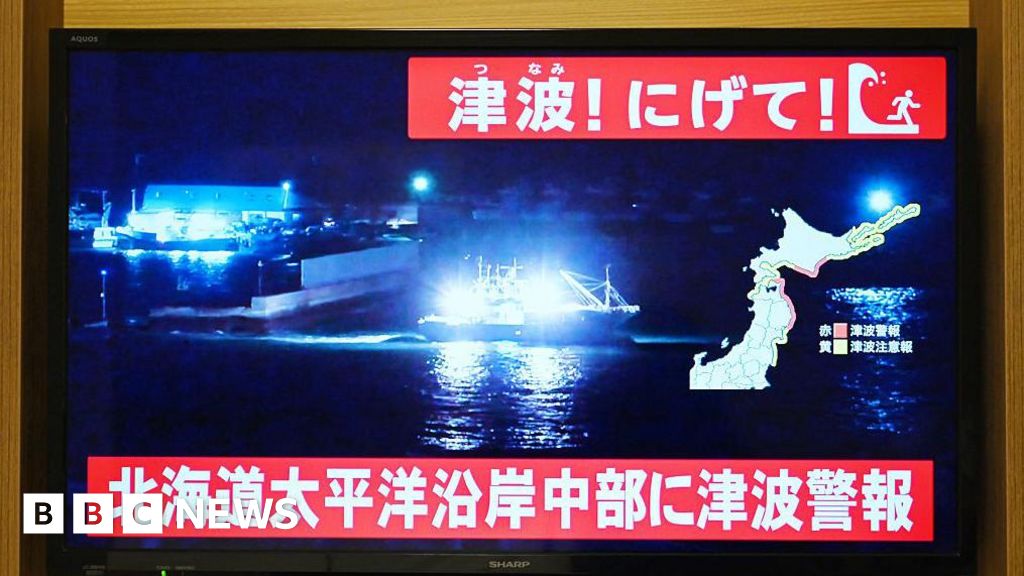
A magnitude 7.6 earthquake struck off Japan's north-eastern coast at 23:15 (14:15 GMT), 50km deep and about 80km off Aomori, triggering tsunami warnings later downgraded to advisories and local waves up to 40cm. Authorities ordered roughly 90,000 residents to evacuate, suspended trains and reported some injuries while the government mobilised an emergency response; Tohoku Electric and Japanese authorities reported no irregularities at Higashidori, Onagawa or the disabled Fukushima site. Immediate implications include regional transport disruption, potential localized economic and insurance losses, and near-term monitoring of power generation and supply-chain risks for affected prefectures.
Market structure: Near-term winners are regional construction/engineering and building-materials suppliers that win urgent reconstruction contracts (order book growth could rise +10–30% in affected prefectures over 3–12 months); losers are regional transportation, tourism, and P/C insurers facing claims and short-term revenue hits. Competitive dynamics favor large listed contractors (scale, bonding capacity) who can price up and capture rapid municipal spending; smaller subcontractors may be squeezed by input-cost inflation for steel/concrete. Cross-asset: expect a brief JPY safe‑haven bid (USD/JPY down 0.5–1.5% intraday), JGB yields compressing, equity weakness in Japanese regional banks/railways, and modest upward pressure on spot LNG/oil (order-of-magnitude +0.5–2% risk premium if infrastructure disruptions extend beyond one week).
Risk assessment: Tail risks include a damaging aftershock/tsunami or a nuclear containment issue (low-probability but high-impact) that could create multi-week port closures and >$1–5bn insured losses; probability of significant aftershocks is high in the first 7–14 days. Immediate horizon (days): operational disruption and volatility in FX/equities; short-term (weeks–months): elevated claim accruals and reconstruction capex; long-term (quarters–years): sustained higher public capex and possible regulatory tightening on nuclear/critical infrastructure. Hidden dependencies: rail/port chokepoints feeding auto/semiconductor supply chains could transmit shocks to global suppliers within 1–3 weeks. Catalysts: aftershocks, government stimulus package size (watch 72‑hour and 30‑day announcements), and insurance loss estimates.
Trade implications: Direct plays — tactical overweight in large-cap Japanese contractors (e.g., KAJIMA 1812.T, OBAYASHI 1802.T, TAISEI 1801.T) sized 2–3% NAV with 3–12 month targets +15–30% and stop-loss at −12%. Short 1–2% NAV in major P/C insurers (TOKIO MARINE 8766.T, SOMPO 8630.T) anticipating 1–3 quarter margin pressure; cover on reduced claim estimates. FX/options — implement a 1% NAV short USD/JPY (or buy 1‑month USD/JPY puts ~1% OTM) to capture immediate safe‑haven; cut if USD/JPY moves unfavorably by 1.5%. Rotate 0.5–1% into global reinsurers (e.g., SWISS RE SREN.S) only if loss estimates exceed consensus by >20%.
Contrarian angles: The market may over-penalize utilities and nuclear-adjacent names despite official checks showing no irregularities — selective long in Tohoku Electric (9506.T) on a 6–12 month horizon could pay off if nuclear risk is proven limited and reconstruction boosts local demand. Insurer overreaction could create entry points: if reported insured losses settle <¥100bn, expect a 10–20% snapback in domestic insurers within 1–2 months. Historical parallels (2011 Tohoku quake) show deep initial risk-off followed by multi-quarter construction/industrial outperformance; size positions to play the reconstruction leg, not short-term headline volatility.
AI-powered research, real-time alerts, and portfolio analytics for institutional investors.
Request DemoOverall Sentiment
moderately negative
Sentiment Score
-0.50
