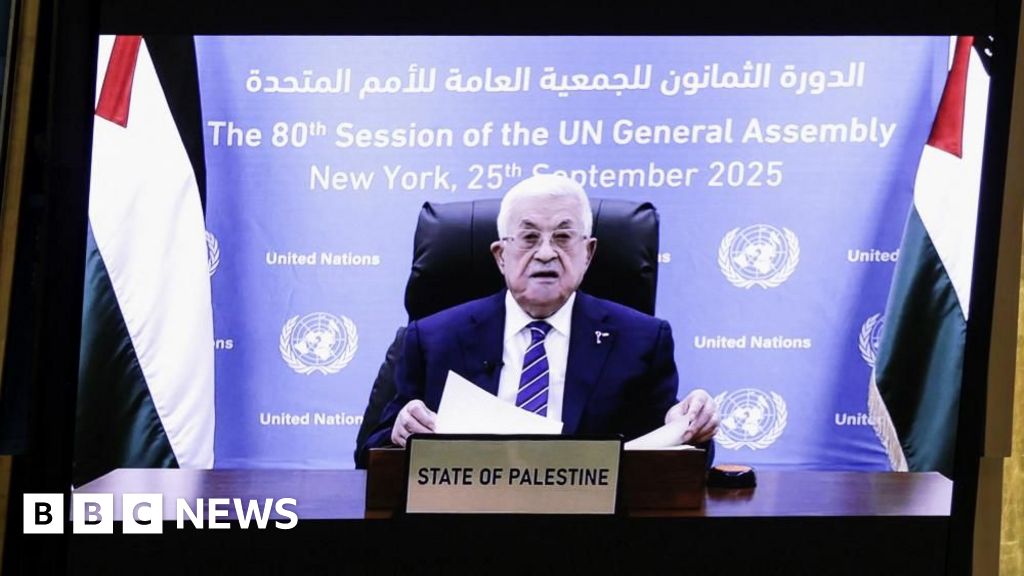
Palestinian President Mahmoud Abbas endorsed a French-Saudi peace plan at the UN General Assembly, proposing a post-war Gaza governed by a reformed Palestinian Authority, excluding Hamas, leading to a sovereign Palestinian state. Abbas expressed readiness to collaborate with international leaders, including former President Trump, on this initiative, which calls for simultaneous hostage release and an end to Israeli operations. However, the plan faces significant opposition as neither the U.S. nor Israel currently supports it, highlighting persistent geopolitical fragmentation regarding the region's future.
Palestinian President Mahmoud Abbas has publicly endorsed a French-Saudi peace plan, presenting a formal framework for a post-war settlement, yet its viability is immediately compromised by a lack of support from key stakeholders. The proposal calls for a simultaneous release of the 48 remaining hostages and a full cessation of Israeli military operations, followed by a transitional administration in Gaza led by the Palestinian Authority (PA), explicitly excluding Hamas, and ultimately leading to a demilitarized Palestinian state. This diplomatic initiative is supported by a growing number of countries, including recent recognitions from Canada, Australia, the UK, and several EU members, indicating a shift in the international consensus. However, the plan faces categorical opposition from both Israel, which rejects any future role for the PA in Gaza, and the United States, which views unilateral statehood recognition as a 'reward for Hamas'. Abbas's pledge to hold presidential and parliamentary elections within a year of the war's conclusion is an attempt to address long-standing questions about the PA's legitimacy, given the last elections in 2006 were won by Hamas. The situation underscores a significant geopolitical fragmentation, with a potential diplomatic path forward being blocked by the primary regional actors, justifying the 'uncertain' tone and 'moderately negative' sentiment associated with this development.
AI-powered research, real-time alerts, and portfolio analytics for institutional investors.
Request DemoOverall Sentiment
moderately negative
Sentiment Score
-0.45
