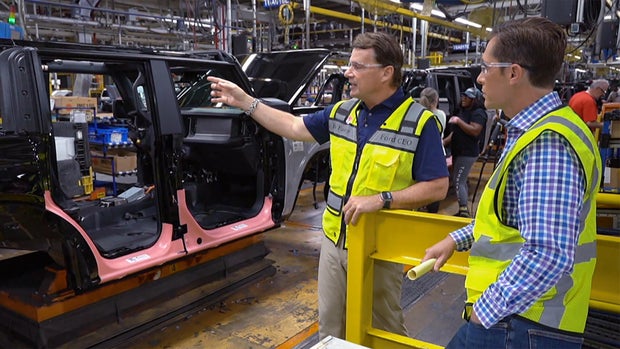
Ford CEO Jim Farley detailed significant challenges impacting the automaker, including Trump-era tariffs costing $2 billion annually—20% of global profit—and the "existential threat" from highly competitive, inexpensive Chinese electric vehicles. Despite a 100% Biden-era tariff blocking Chinese EVs from the U.S. market, their global proliferation is compelling Ford to strategically pivot. Farley, who drives a Chinese EV to understand the competition, is leading Ford's shift towards developing smaller, more affordable electric vehicles, exemplified by a new $30,000 midsize electric pickup, and has initiated key collaborations like integrating Tesla's Supercharging network, signaling a critical transformation for the company's future competitiveness and the American auto industry.
Ford Motor Company (F) faces significant financial headwinds from existing trade policies, incurring a $2 billion annual tariff bill, which accounts for approximately 20% of its global profit. CEO Jim Farley highlights the impracticality of fully domestic parts sourcing, noting that some components are not manufactured in the U.S. and that tariffs on imported parts, sometimes up to 70%, directly impact the company's profitability and ultimately its workforce. This cost burden underscores the vulnerability of Ford's supply chain to geopolitical trade tensions.
The company is also confronting an "existential threat" from highly competitive, inexpensive Chinese electric vehicles (EVs), which possess sufficient production capacity to serve the entire North American market. While a 100% Biden-era tariff currently shields the U.S. market, these Chinese EVs are rapidly gaining market share in Europe and other global regions, intensifying future competitive pressures for Ford. Farley's personal assessment of a Chinese EV underscores the perceived quality and technological advancement of this competition.
In response, Ford is undertaking a radical strategic pivot towards developing smaller, more affordable EVs, exemplified by a new $30,000 midsize electric pickup. This transformation, described as the most significant since the Model T, is being driven by Farley's leadership, including key collaborations such as integrating Tesla's Supercharging network. The company's ability to execute this shift while managing tariff costs and maintaining its commitment to American manufacturing will be critical for its long-term competitiveness.
AI-powered research, real-time alerts, and portfolio analytics for institutional investors.
Request DemoOverall Sentiment
strongly negative
Sentiment Score
-0.70
Ticker Sentiment
