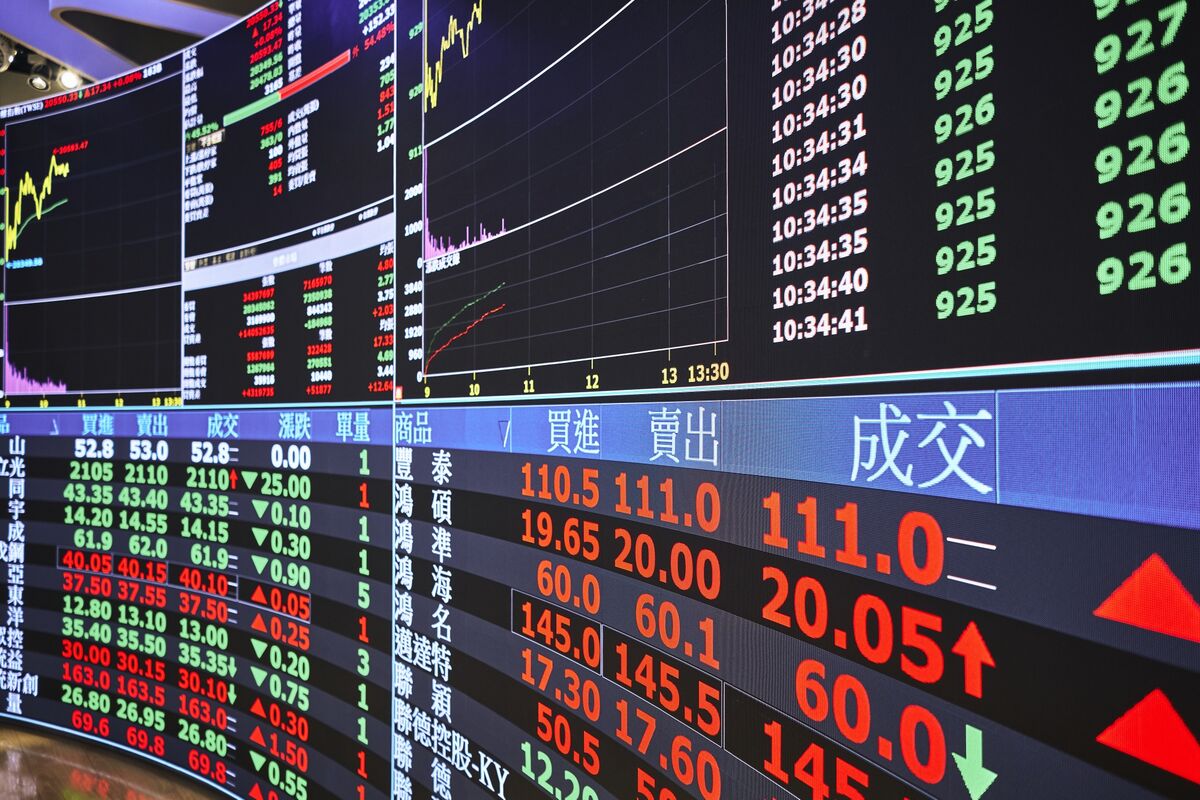
Taiwan’s stock market capitalization rose to $4.14 trillion, overtaking the UK’s roughly $4.09 trillion to become the world’s seventh largest. The move reflects renewed enthusiasm for Taiwan’s tech sector, supported by the AI boom and hopes of further de-escalation in the Iran war. The article is broadly positive for Taiwanese equities and the technology-heavy market backdrop, though it is primarily a market-cap milestone rather than a direct earnings catalyst.
The important signal is not the headline ranking change itself, but the rotation it implies: global capital is re-rating Taiwan as the clearest liquid proxy for AI capex and advanced-node supply, while the UK remains a low-growth value/defensive market with far less earnings torque. In a risk-on tape, that creates a self-reinforcing flow loop because Taiwan’s weights are dominated by a small number of mega-cap semis, so incremental passive and thematic buying has a larger marginal impact than in a more diversified index.
Second-order beneficiaries are not just the obvious foundry and equipment ecosystem, but also the entire upstream of high-bandwidth memory, packaging, and power infrastructure tied to AI server buildouts. If AI demand remains intact, the real trade is that Taiwan’s market cap can keep compounding faster than GDP for longer than consensus expects, because index-level ownership and strategic supply-chain concentration turn earnings growth into multiple expansion. The main loser is capital allocation to the UK market: global EM/tech allocators may continue to fund Taiwan by reducing exposure to slower-growth developed markets with weaker innovation optionality.
The risk window is asymmetric: over days to weeks, geopolitics can reverse part of the move if the Middle East de-escalation narrative fades or Taiwan risk premium widens again. Over months, the key variable is whether AI demand is being pulled forward rather than simply expanded; if order growth normalizes, the valuation premium can compress even if earnings stay solid. The contrarian point is that market-cap leadership can become crowded fast: when a country becomes the ‘cleanest’ AI beta, positioning often outruns fundamentals, leaving it vulnerable to any earnings miss or USD/TWD volatility.
For the UK, the implication is less about direct damage and more about relative underperformance risk: absent a catalyst, it may remain a funding source for global reallocators chasing higher-velocity tech exposure. The opportunity set is therefore primarily relative-value, not outright macro, with Taiwan as a momentum beneficiary and the UK as a structural laggard until earnings breadth improves.
AI-powered research, real-time alerts, and portfolio analytics for institutional investors.
Request DemoOverall Sentiment
moderately positive
Sentiment Score
0.45
Ticker Sentiment
