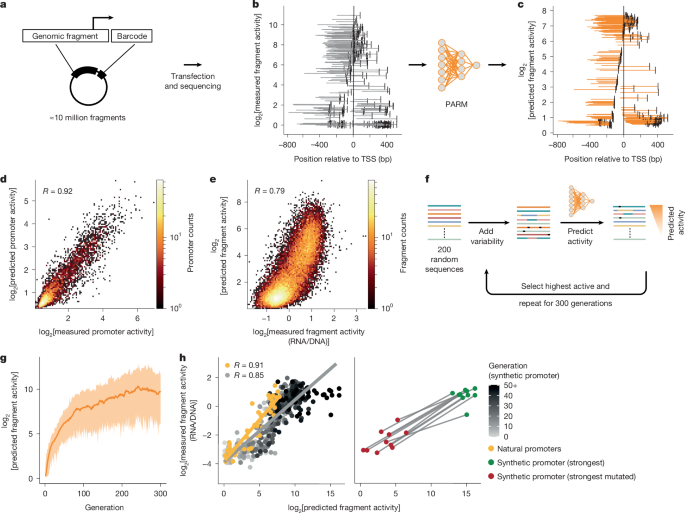
PARM is a lightweight, cell-type-specific deep‑learning CNN trained on promoter‑focused MPRA data that predicts autonomous human promoter activity from sequence alone; models were trained across >30,000 curated TSSs and ten cell types and achieved high out-of-sample performance (Pearson R = 0.92 in K562 and R = 0.89 in HepG2). The platform uses a capture-based focused library (~4M fragments, ~151× TSS coverage) allowing experiments with ~5–50M cells and model training in ~1 day on a single GPU (RTX6000), and it successfully designed synthetic promoters comparable to the strongest natural promoters, mapped functional TF binding (regulatory sites), and detected stimulus-specific rewiring. The authors have filed a patent on PARM and highlight potential translational applications (patient-derived organoids, drug-response profiling), though near-term market impact is limited to tool adoption in biotech R&D rather than broad market-moving financial events.
Market structure: PARM democratizes high-quality promoter modeling by coupling small, focused MPRAs with lightweight CNNs. Winners are sequencing and consumables vendors (higher recurrent MPRA sequencing demand), mid-tier bioinformatics/assay-service firms, and small-cap lab-automation providers; losers are premium long-range AI incumbents that monetize massive GPU runs. NVDA impact is marginal short-term (reduced demand for multi-week GPU training) but not existential given broader AI growth.
Risk assessment: Key tail risks are (1) IP/regulatory: the authors filed patents — litigation or restrictive regulation of synthetic promoter use could curtail commercialization (probability ~10–15% over 12–24 months, high impact), and (2) technical: in vitro-to-in vivo translation failure could slow pharma adoption (30–50% chance blunting revenue). Immediate (days) — minimal market moves; short-term (1–3 months) — vendor orders; long-term (6–24 months) — sustained instrument/consumable revenue if pharma adoption occurs.
Trade implications: Primary actionable sector tilt is toward sequencing/consumables exposure (ILMN) and life-science tools; expect incremental 3–8% top-line uplift for instrument vendors if MPRA adoption scales to mid-size pharmas in 12–18 months. NVDA exposure: avoid buying short-dated bullish options premised on incremental demand from this specific paper; consider modest vega-selling against large positions. Watch for partnership/collaboration announcements (illness-to-commercial deals) in next 90 days as catalysts.
Contrarian angles: Consensus underestimates recurring consumables revenue from routine focused MPRAs — these produce steady sequencing runs vs one-off model training. Conversely, market may be overrating the immediate GPU demand reduction; hybrid models and larger prospective datasets will still drive NVDA/GPU demand. Historical parallel: emergence of cheaper NGS assays expanded sequencer consumables more than instrument margins — expect similar dynamics here.
AI-powered research, real-time alerts, and portfolio analytics for institutional investors.
Request DemoOverall Sentiment
mildly positive
Sentiment Score
0.25
Ticker Sentiment
