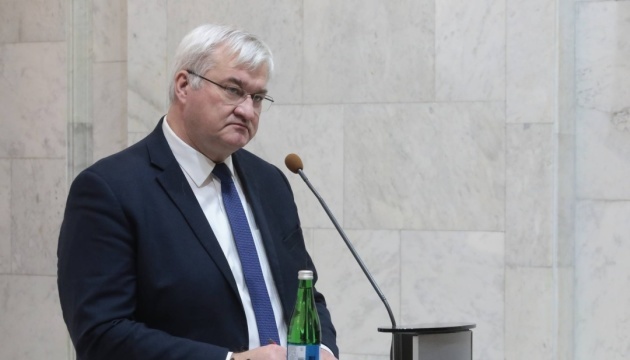
Ukrainian Foreign Minister Andrii Sybiha publicly accused Hungarian Prime Minister Viktor Orban of deliberately blocking Ukraine's EU accession and of acting against Hungarian national interests and in line with Kremlin objectives. Orban has said no Hungarian parliament would approve Ukrainian EU membership for the next 100 years; parliamentary elections on April 12 and recent polls showing the opposition Tisza ahead of Fidesz could alter Budapest's stance. The dispute heightens political risk in Central Europe and threatens EU cohesion, a factor investors should monitor for potential second-order effects on regional sentiment and capital flows.
Market-structure: Orban’s public blocking of Ukraine’s EU path raises localized political risk for Hungary (electoral uncertainty Apr 12) and increases probability of capital flight from Hungary into safer CEE markets. Expect HUF weakness, wider Hungary 5y sovereign spreads, underperformance of domestic cyclicals (banks OTP BSE:OTP, energy MOL BSE:MOL) vs regional peers by 5–15% over 1–3 months if rhetoric persists.
Risk assessment: Tail risk includes Hungary facing EU sanctions or reduced EU funds (low-probability, high-impact) which could lift 5y CDS >200bps and push EUR/HUF above 380 in months; immediate risk is volatility around the Apr 12 election (days–weeks). Hidden dependency: continued Kremlin alignment could invite regulatory scrutiny of Hungarian firms operating in EU supply chains, producing second-order earnings shocks 2–6 quarters out.
Trade implications: Short-duration directional plays best: FX/sovereign protection and relative-value short Hungarian banks vs Polish peers; defense names (Rheinmetall ETR:RHM, BAE LSE:BA) are convex hedges if conflict prolongs—expect 6–12 month alpha. Options: prefer structured defined-risk put spreads on BSE:OTP or EUR/HUF to monetize skew; rotate away from Hungary-weighted EM exposures into western EU defensives and gold (GLD).
Contrarian angles: Consensus presumes full contagion across CEE; that’s likely overdone—Poland and Czech fundamentals remain stronger, so pair trades (short HUF vs long PLN) offer asymmetry. Historical parallel: 2014–16 Russia shocks caused >20% HUF drawdowns but limited systemic EU spillover; if opposition wins Apr 12, HUF can mean-revert within 1–3 months, so time entry size accordingly.
AI-powered research, real-time alerts, and portfolio analytics for institutional investors.
Request DemoOverall Sentiment
moderately negative
Sentiment Score
-0.30
