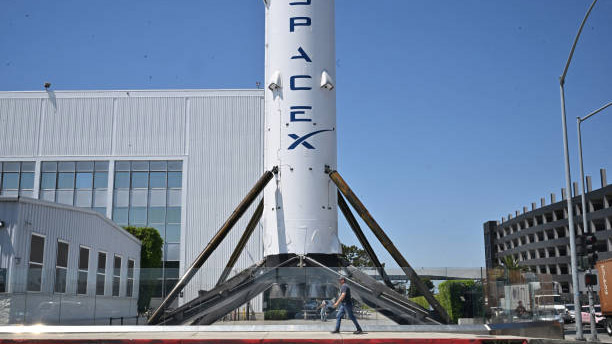
SpaceX is running a secondary tender offering that employees and early investors are using for liquidity; sources say the tender price is nearer $300/share implying a company valuation around $600 billion (contrasting with a reported $800 billion figure). The company has communicated plans to pursue an IPO in H2 2026—potentially of the whole company rather than a Starlink spin-off—and Tesla’s board has indicated it is comfortable with Elon Musk remaining CEO of multiple public companies. Management continuity (Gwynne Shotwell and CFO Brett Johnson) and Starlink’s higher-margin profile versus launch services are highlighted as material to investor deliberations.
Market structure: A SpaceX tender at ~$300/share (~$600B) and a potential full-company IPO in H2 2026 disproportionately benefits SpaceX/Starlink stakeholders, upstream suppliers (NVDA, Lumentum) and Musk-linked equities (TSLA) via sentiment and tech transfer; incumbents in fixed and legacy satellite broadband (VSAT, LORL) face immediate pricing pressure as LEO capacity scales. Competitive dynamics will compress ARPU for rural ISPs and raise margins for vertically integrated launch+satcom players; expect 10–30% downward pressure on legacy satcom EBITDA multiples over 12–24 months if Starlink execution stays on track.
Risk assessment: Tail risks include US/foreign regulatory intervention (export controls, DoD procurement limits) and an IPO pricing shock (valuation < $400B) that could trigger >30% implied private-to-public markdowns and knock-on volatility in TSLA; operational failure (constellation loss or spectrum litigation) could materially impair revenue. Immediate (days) reaction is sentiment-driven; short-term (weeks–months) sees volatility spikes and option IV lifts around IPO milestones; long-term (years) outcome depends on Starlink achieving sustained positive free cash flow (>10% margin target cited historically).
Trade implications: Establish a 1–2% long TSLA position (12-month horizon) to capture positive reflexivity if SpaceX IPO confirmation arrives; hedge with a 10–12% OTM 6–9 month put to limit downside. Initiate a 0.5–1% short position in VSAT (or similar legacy satcom) targeting 25–35% downside within 12 months; pair trade: long NVDA (0.5%) vs short VSAT (0.5%) to play compute/edge demand from space-based datacenters. Use options: buy a 9–12 month TSLA call spread (delta ~0.4) instead of naked calls to cap premium; buy 6–12 month VSAT puts with stops at 15% adverse move.
Contrarian angles: Consensus underestimates the upside to data-center and edge-compute suppliers (NVDA, AMD, INTC) from space-based workloads — factor a 5–10% revenue tail over 3 years into models if Starlink signs government/cloud contracts. Conversely, the market may be underpricing governance and execution risk from Musk running two public companies — anticipate 20–40% volatility windows for TSLA around any SpaceX IPO confirmations. Historical parallels: Facebook/Instagram tie-ups show value transfer between platforms; unintended consequence: IPO-driven insider liquidity could flush supply into public markets, temporarily pressuring risk assets rather than generating sustained buy-side demand.
AI-powered research, real-time alerts, and portfolio analytics for institutional investors.
Request DemoOverall Sentiment
mildly positive
Sentiment Score
0.25
Ticker Sentiment
