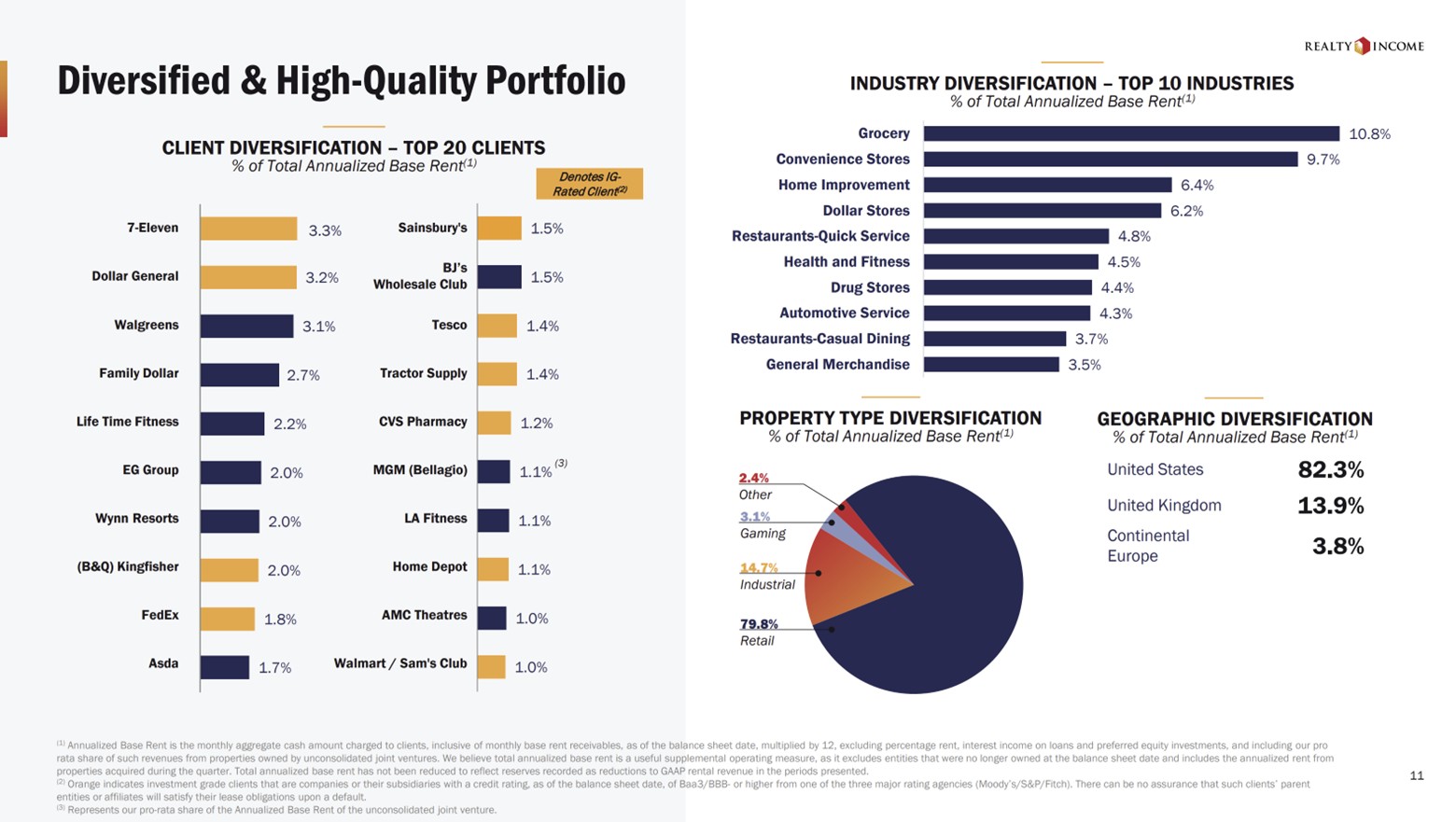
Realty Income has materially diversified beyond U.S. freestanding retail to 15,500+ properties leased to over 1,600 clients across nine countries, adding new property types (gaming, data centers) and credit investments while expanding deeper into Europe. Management closed $1.0 billion of European investments in Q3 versus $380 million in the U.S., citing higher initial weighted average cash yields (8% international vs. 7% U.S.), and describes addressable markets of ~$8.5 trillion (Europe), $900 billion (data centers/gaming) and a $14 trillion combined opportunity; it is also launching an inaugural U.S. private fund to tap an $18.8 trillion private real estate market. The strategic diversification is positioned to lower risk, increase investment flexibility and support future dividend and shareholder-value growth.
Market structure: Realty Income's pivot into pan‑European assets, data centers and credit products shifts winners toward large, capital‑rich net‑lease platforms (O, WPC) and private funds managers that can underwrite cross‑border rollouts. Smaller, single‑market, single‑asset REITs and regional mall owners are the likely losers as O can outbid on scale and offer fee income; expect upward pressure on bid prices for trophy European retail and select experiential assets, compressing new deal yields if capital flows accelerate.
Risk assessment: Key tail risks are a sudden euro‑USD move (>5% in 90 days), a funding shock (LIBOR/Treasury +200–300bps widening) or a concentrated tenant default (large sale‑leaseback partner). Near term (days–weeks) volatility will be driven by rate moves and Q earnings; medium term (3–12 months) by execution of private funds and capital markets access; long term (2–5 years) by successful scale of fee business and integration of data/gaming assets. Hidden dependency: growth assumes persistent access to low‑cost debt and steady sale‑leaseback pipelines from global retailers.
Trade implications: Direct play is selective long O exposure funded through modest shorts of U.S. single‑market retail REITs (e.g., STORE Capital) to express quality/diversification premium over 6–18 months. Use option structures: buy 9–15 month call spreads to cap premium and sell near‑term calls to harvest yield if assigned. Manage entry when O yield spreads over 10‑yr Treasury exceed ~225bps or when 3Q/4Q international acquisitions >$1bn.
Contrarian angles: Consensus prizes diversification but underestimates margin impact of higher financing costs on cross‑border cap rates; multi‑jurisdiction risk could depress NAV if currencies or local cap‑rates move adverse 100–150bps. Fee income from private funds could be underpriced—if O builds an $8–15bn AUM pipeline by 2027, ROE lift would be material. Unintended consequence: faster roll‑out risks governance/credit dilution; watch leverage and covenant creep closely.
AI-powered research, real-time alerts, and portfolio analytics for institutional investors.
Request DemoOverall Sentiment
moderately positive
Sentiment Score
0.60
Ticker Sentiment
