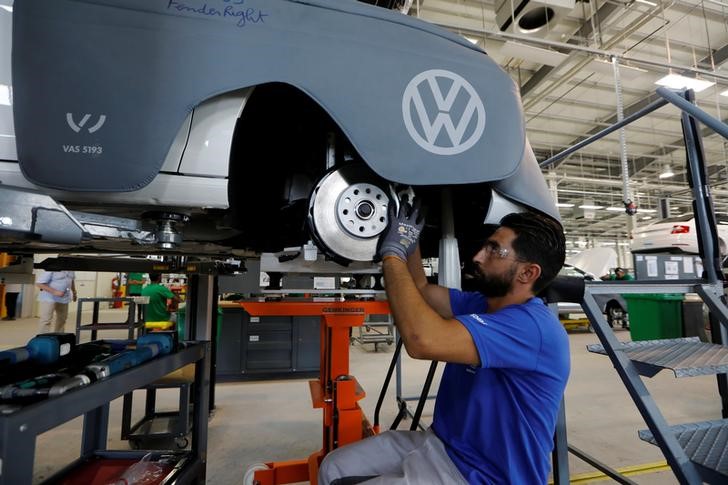
Volkswagen will reduce ~50,000 jobs in Germany by 2030 and forecasts an operating return as low as 4% for the year. Management is imposing plant-specific manufacturing cost targets and shifting to a decentralized footprint to offset high German labor, regulation and energy costs and to defend margins against heavy EV investment and lower-cost Chinese competition. The overhaul aims to cut overcapacity and lower breakeven, but execution risk, restructuring costs and margin pressure could weigh on near-term profitability and stock performance.
Volkswagen’s shift to strict plant-level cost targets and a decentralized production footprint will not only compress its own breakeven but re-price the entire European supplier ecosystem over 12–36 months. Expect dual outcomes: margin recovery for flexible, low-cost suppliers and outsourcers that can capture relocated volumes, and a prolonged squeeze for Germany-centric tier‑1s and service providers that cannot retool quickly; this creates a multi-year consolidation opportunity in parts and logistics.
A rapid part‑reallocation to non‑German sites will change logistics flows and working-capital profiles — increased inbound/outbound freight into Eastern Europe and Turkey, higher capex in low-cost jurisdictions, and elevated short-term inventory as lines are retooled; those cash-flow timing effects will be visible in quarterly working-capital swings within 2–4 quarters. Politically and operationally, the main near-term tail risks are labor actions and regulatory interventions that could force stop‑start execution; a visible, sustained unit-cost improvement (reported as plant-level breakevens) is the primary catalyst that would validate the play.
The consensus frames this as a German cost problem; the overlooked lever is strategic outsourcing of high-capex modules (battery packs, E/E architecture, compute hubs). If VW offloads these to partners, it could convert fixed-cost exposure into recurring supplier margins — a scenario that benefits specialized software/compute vendors and large modular suppliers while keeping headline volumes stable. That pathway is the fastest route to a positive re-rating, but it requires 12–24 months of clean execution and signed supplier contracts to materialize.
AI-powered research, real-time alerts, and portfolio analytics for institutional investors.
Overall Sentiment
strongly negative
Sentiment Score
-0.55
Ticker Sentiment
