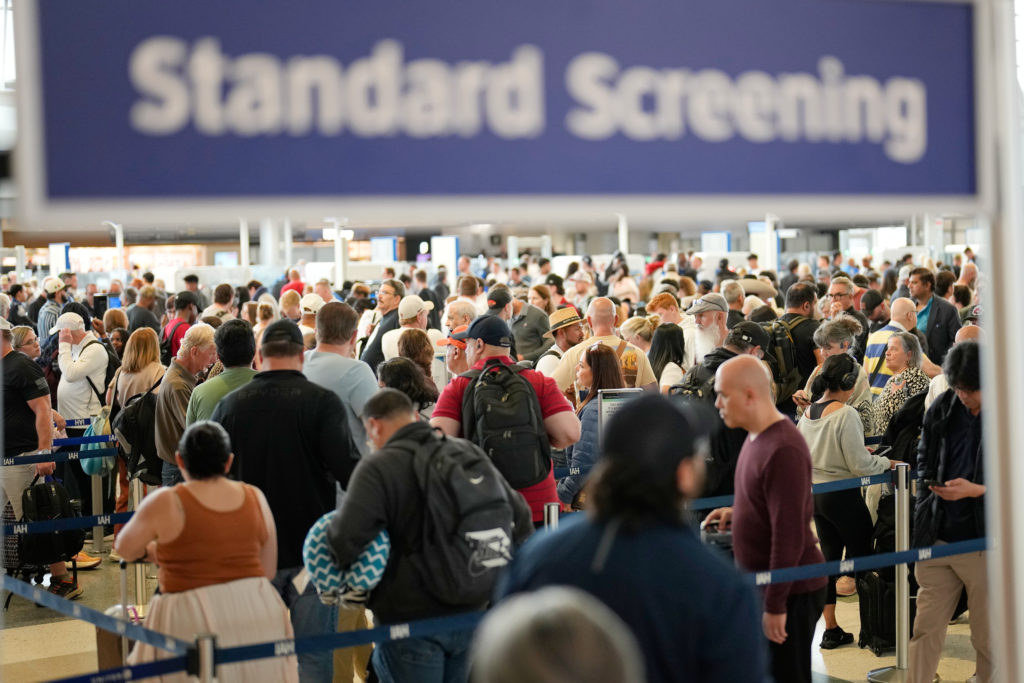
Shutdown hits day 40 with TSA reporting >40% callout rates at multiple airports, more than 480 officers have quit and TSA assaults up over 500%, producing record-high passenger wait times and frequent 4+ hour security lines. Congressional proposal would fund most of DHS but exclude ICE enforcement, and political resistance from both parties leaves the deal teetering and risks operational disruption or partial airport closures. FEMA's Disaster Relief Fund is rapidly depleting with ~10,000 disaster workers paid from it, raising contingency risks for disaster response funding. Expect material implications for airlines, airport operators, travel-related service providers and insurers exposed to operational disruption.
Operational friction at airports will cascade into four cash-flow channels: higher unit opex for carriers (extra crew costs, rebookings), lost ancillary spend (parking, concessions, lounges), demand substitution toward road transport, and compressed liquidity for smaller airport authorities that rely on near-term passenger volumes. If disruptions persist beyond two weeks, expect consensus EPS for US carriers to be marked down by mid-single digits for the quarter as re-accommodation and irregular operations costs are realized; this is a playing-out of margin pressure rather than a ticket-volume structural decline.
Second-order winners will be ground-transport platforms and short-term rental ecosystems that capture local mobility demand and origin/last-mile spend; vendors selling checkpoint automation and biometric screening stand to win in any post-crisis funding rider even if that takes 3–9 months to legislate. Conversely, airport concessionaires, car-park operators, and smaller, leveraged regional carriers are the most vulnerable to rolling liquidity stress and covenant pressure — expect credit spreads on smaller airport revenue bonds to widen before public equities fully price in credit risk.
Catalysts and timing: a stopgap funding fix within 0–14 days is the only high-probability path to rapid mean reversion in travel names; absent that, expect sequential downgrades and downticks in bookings over 2–8 weeks, and potential consolidation activity among carriers over 3–12 months. The consensus underestimates the political tail-risk — if the funding fight becomes an electoral flashpoint, regulatory and labor responses (accelerated automation, contracting out security) will materially re-shape capex winners and losers over the next 12–36 months.
Contrarian angle: market reaction has likely over-indexed to headline travel risk while underweighting the tactical takeover value of large carriers with healthy balance sheets; a prolonged disruption raises the odds of strategic asset sales or opportunistic M&A among weaker regional and leisure carriers, creating asymmetric upside for selected long exposures after near-term capitulation.
AI-powered research, real-time alerts, and portfolio analytics for institutional investors.
Request DemoOverall Sentiment
strongly negative
Sentiment Score
-0.65
