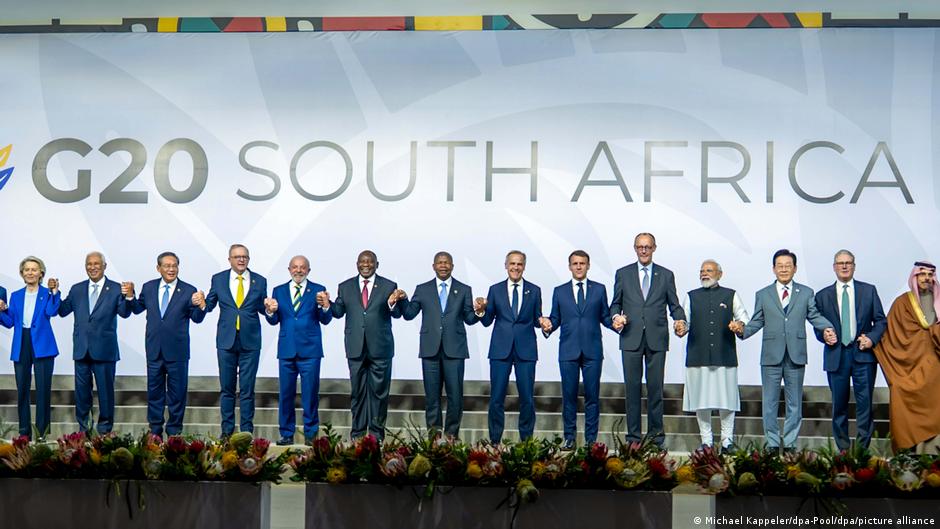
G20 leaders in South Africa adopted a 122‑point declaration despite a U.S. boycott, with host Cyril Ramaphosa defending the relevance of multilateralism as the summit was overshadowed by President Trump’s decision not to send a delegation. The declaration calls for scaling climate finance “from billions to trillions,” endorses reform of international financial systems to help low‑income countries manage debt and urges a just peace in multiple conflict zones, although its language on taxing the ultra‑rich is weaker than last year’s. Western leaders warned the G20 may be at an inflection point amid deep geopolitical rifts, and the U.S. absence disrupted the customary handover of the rotating presidency after South Africa refused to transfer it to a junior U.S. diplomat, underscoring strains that could complicate coordinated economic and geopolitical responses.
G20 leaders in South Africa adopted a 122-point declaration despite a U.S. boycott after President Trump declined to send a delegation, a break with protocol that included South Africa refusing to transfer the rotating presidency to a junior U.S. diplomat. Host Cyril Ramaphosa defended the relevance of multilateralism while Emmanuel Macron and Keir Starmer warned the G20 "may be coming to the end of a cycle," underscoring a visible leadership rift at the summit.
The declaration endorsed scaling "investment and climate finance" from "billions to trillions" and called for reforms to international financial systems to help low-income countries manage debt, but contained weaker language on taxing the ultra-rich than last year’s Rio text; it also urged a "just, comprehensive, and lasting peace" in Ukraine, Sudan, DRC and the Occupied Palestinian Territory, with Ukraine only mentioned once in the 30-page text. Chinese Premier Li Qiang warned that "unilateralism and protectionism are rampant," highlighting divergent member priorities.
The article’s signals register a moderately negative, uncertain tone with a modest market-impact score (0.35); the combination of diplomatic breakdown, uneven policy commitments on taxation, and a push for large-scale climate finance raises the likelihood of episodic geopolitical-driven volatility, uneven EM credit outcomes, and selective opportunities in green finance and sovereign/debt-restructuring related instruments.
AI-powered research, real-time alerts, and portfolio analytics for institutional investors.
Request DemoOverall Sentiment
moderately negative
Sentiment Score
-0.35
