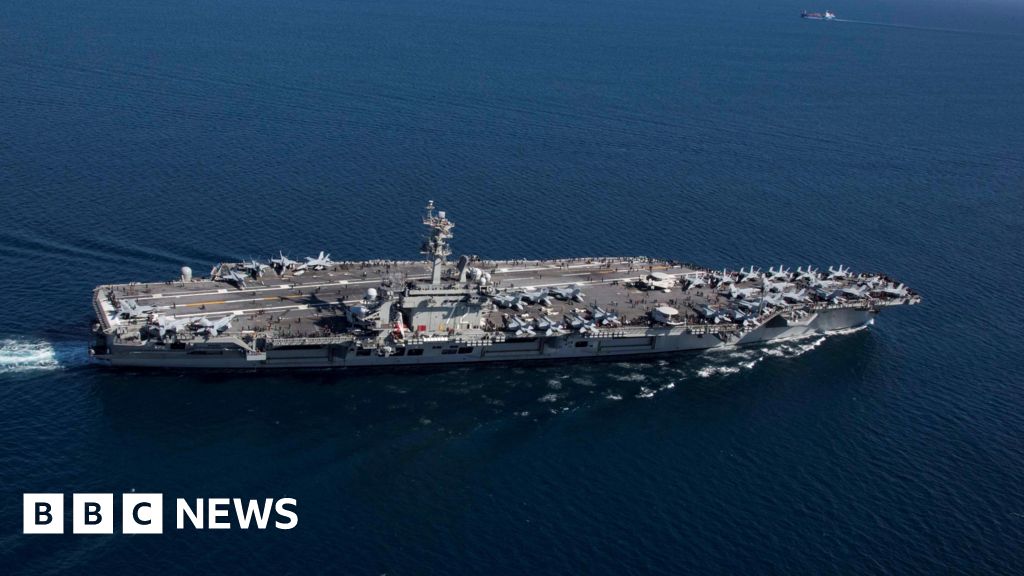
President Trump warned Iran that "time is running out" as the US has deployed a large naval force led by the USS Abraham Lincoln to the Gulf, escalating tensions over Iran's nuclear programme and past US strikes on Fordo, Natanz and Isfahan. Iran signalled willingness to talk but warned it would defend itself if pushed; the piece also highlights heavy casualty reports from domestic unrest, and prior Iranian missile retaliation against a US base in Qatar. The developments raise downside risk for regional stability and likely increase risk premia for oil and regional assets—hedge funds should monitor subsequent military movements, diplomatic signals, and oil market and risk‑premium flows closely.
Market structure: Immediate winners are US defense primes (LMT, NOC, RTX) and oil services/producers (XOM, CVX) via higher defense budgets and risk premium in oil; losers include commercial airlines/cruise (BA, JETS), regional banks with MENA exposure, and EM FX (TRY, IRR proxy pressure) as risk-off flows to USD and Treasuries. A sustained threat that removes ~0.3–1.0 mbpd of supply would likely push Brent +$10–25 in 2–8 weeks, shifting cash flows to energy producers and increasing war-risk premiums for shipping/insurance costs.
Risk assessment: Tail risks include a kinetic strike on oil infrastructure or a blockade that spikes oil >$100 (+>30% from $75) with >5% instantaneous global growth drag; probability near-term 5–15% but systemic if Israel/Iran escalation occurs. Immediate (days) sees volatility and safe-haven flows; short-term (weeks–months) sees commodity and defense repricing; long-term (quarters) could restructure supply chains, insurance costs, and defense budgets. Hidden dependencies: insurance/warrants, secondary sanctions, and proxy attacks on shipping lanes amplify impact nonlinearly.
Trade implications: Prioritize convex, time-limited exposures: 3–6 month long positions in defense equities and oil call spreads, paired with short-duration equity hedges (S&P put spreads or VIX calls). Use relative-value trades (long LMT/RTX vs short JETS/BA) to monetize defense/airline dispersion. Size positions modestly (1–3% portfolio each) and scale on volatility; exit/trim at +15–25% moves or if Brent crosses $95 sustainably.
Contrarian angles: Consensus overweights defense and energy but underestimates rapid de-risking if conflict stays localized — defense stocks can gap up then mean-revert; airlines may be oversold relative to stimulus-driven travel recovery. Historical parallels (2019 tanker incidents) show spikes fade in 6–12 weeks absent wider war; therefore prefer time-limited option structures and strict profit-taking rules to avoid being long transitory repricings.
AI-powered research, real-time alerts, and portfolio analytics for institutional investors.
Request DemoOverall Sentiment
moderately negative
Sentiment Score
-0.50
