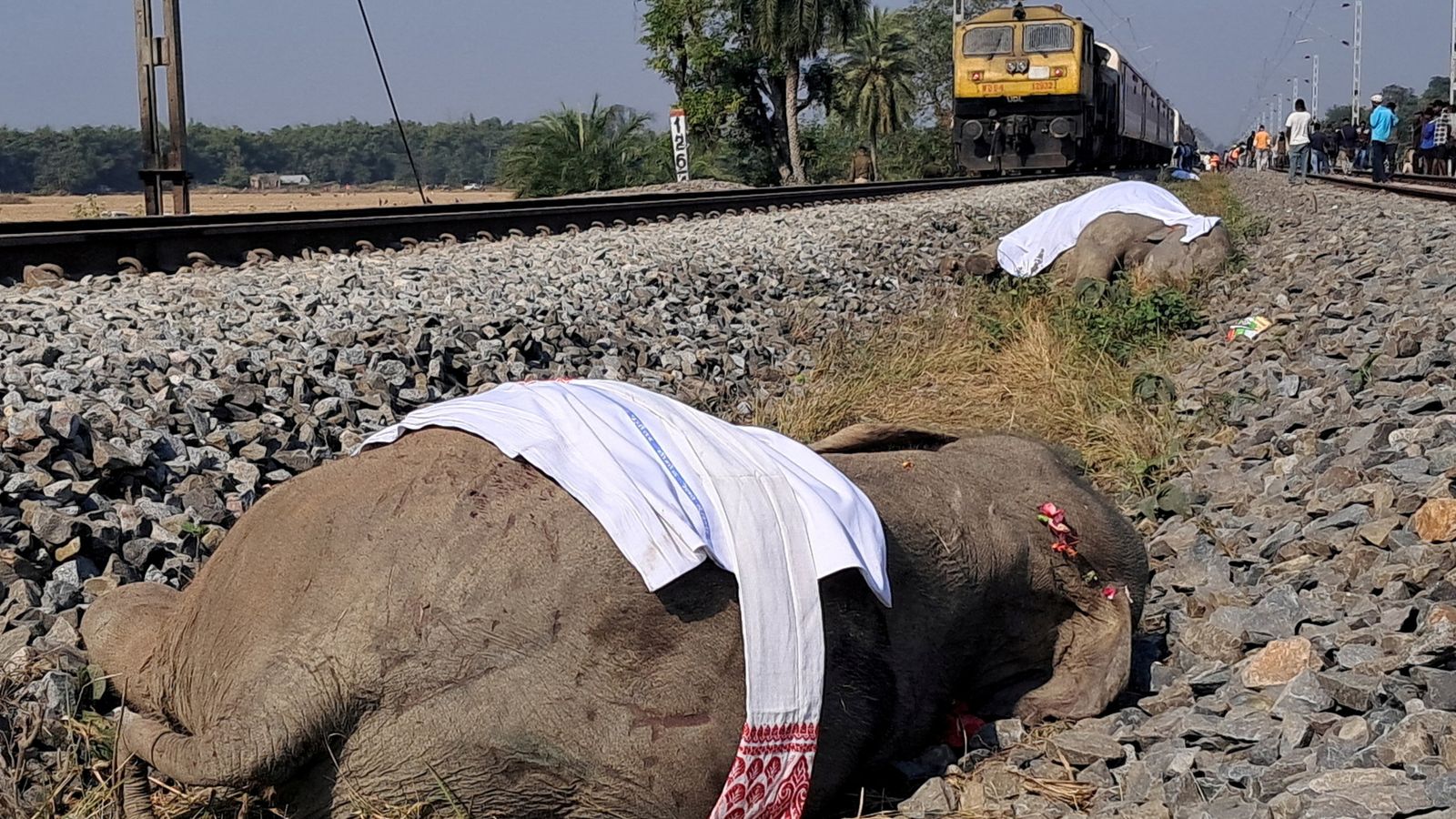
A Rajdhani Express high-speed train carrying about 650 passengers struck a herd in Assam early Saturday, killing seven wild Asiatic elephants and injuring a calf; five coaches and the engine derailed but there were no human fatalities and roughly 200 passengers from the derailed coaches were transferred to Guwahati. The accident occurred in a forested area not designated as an elephant corridor—Assam hosts an estimated 7,000 elephants and has seen at least a dozen train-related deaths since 2020—raising potential operational, ESG and regulatory scrutiny of Indian Railways (speed limits, corridor designation), though immediate market implications appear limited.
Market structure: Direct beneficiaries are firms that can supply rail-mitigation capex (track fencing, underpasses, sensor/AI detection). Priorities: domestic EPC contractors (Larsen & Toubro LT.NS) and global rail-systems suppliers (Siemens SIEGY, Alstom ALSMY) could capture new tenders worth low‑hundreds of millions INR in Assam alone over 12–36 months; insurers (ICICIGI.NS) and state rail operating units face near‑term liability and reputational costs. Pricing power will favor specialized systems integrators; commodity demand (steel, concrete) may see a localized uptick of ~1–2% incremental demand in near term.
Risk assessment: Tail risks include aggressive regulatory action (national speed caps on trunk routes) that shave rail revenue by 1–3% and force expedited capex, or large litigation forcing centralized compensation pools. Immediate (days) risk = reputational headlines; short term (30–180 days) = tender announcements/budget reallocations; long term (6–36 months) = execution risk and margin pressure on contractors. Hidden dependency: execution depends on state budgets and central funding — political cycles can accelerate or stall projects.
Trade implications: Tactical ideas — establish a 1–2% long in LT.NS to capture likely Assam/NE India civil works within 3–12 months; initiate a 0.5–1% position in SIEGY (or buy 6–12 month 10–15% OTM call spreads) to play sensor/AI detection deployments. Reduce or hedge a 1% position in ICICIGI.NS (or buy 3–6 month puts) to protect against reserve/tort outcomes; pair trade = long LT.NS, short IRCTC.NS (0.5%) on potential ticketing/throughput impacts if speed limits follow.
Contrarian angles: Consensus will underprice multi‑year mitigation capex if government opts for visible action — that favors large EPC names but risks being overbid for lower margins; alternatively, the market may overprice wins for multinationals when local SMEs win contracts. Historical parallels: US wildlife crossing programs scaled over 5–10 years with sustained contractor revenues, implying a patient 12–36 month timeframe to realize gains. Key unintended risk: contracting could be re‑directed to local suppliers, diluting upside for global suppliers — size positions accordingly.
AI-powered research, real-time alerts, and portfolio analytics for institutional investors.
Request DemoOverall Sentiment
neutral
Sentiment Score
0.00
