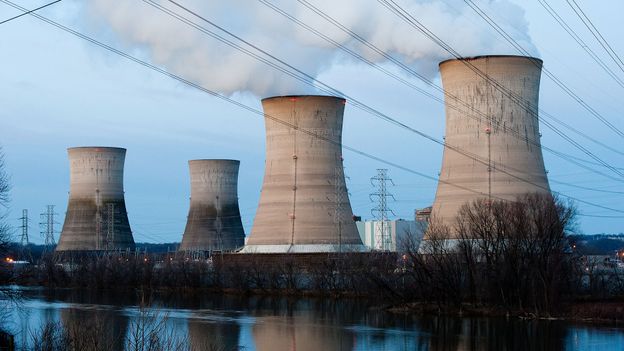
Major tech companies, including Microsoft, Google, and Amazon, are increasingly investing in nuclear power, particularly Small Modular Reactors (SMRs), to meet the escalating energy demands of AI data centers, which are projected to double global electricity consumption within five years. While nuclear offers a carbon-free, always-on energy solution, SMRs face substantial challenges, including long development timelines, questionable commercial viability due to efficiency and scale issues, and persistent public perception hurdles. Experts caution that SMRs are years away from practical deployment to address immediate AI energy needs, and local opposition to nuclear projects remains a factor, despite a slight majority of Americans favoring increased nuclear energy.
Big tech firms, including Microsoft (MSFT), Google (GOOGL, GOOG), and Amazon (AMZN), are increasingly investing in nuclear power, particularly Small Modular Reactors (SMRs), to meet the surging energy demands of AI data centers. Data center power consumption is projected to double within five years from its current 1.5% of global electricity, making carbon-free, "always-on" nuclear energy an attractive, albeit long-term, solution. Microsoft has even joined the World Nuclear Association, signaling a serious commitment.
However, the viability of SMRs faces significant challenges. Experts, such as former NRC chair Allison Macfarlane, state that most SMRs are still in testing, years away from commercial viability due to efficiency issues and a lack of economies of scale. Haider Raza notes SMRs will not address immediate AI energy demands within the next 1-2 years, highlighting a mismatch between current needs and future supply.
Public perception and waste management also present substantial hurdles. Local opposition, exemplified by North Tonawanda's ban on nuclear generation, persists despite a slight majority of Americans favoring nuclear energy. Furthermore, SMRs are found to produce more radioactive waste than larger conventional reactors, complicating disposal. The overall sentiment towards this initiative is strongly negative, reflecting these inherent difficulties and the long lead times involved.
Microsoft's own policy brief acknowledges that "no one technology or solution" will meet future energy needs, underscoring the complexity and multi-faceted approach required. While tech companies are pouring resources into research and pilots, the immediate impact on AI's energy crunch remains limited, with some businesses already holding off on AI adoption due to economic concerns.
AI-powered research, real-time alerts, and portfolio analytics for institutional investors.
Request DemoOverall Sentiment
strongly negative
Sentiment Score
-0.65
Ticker Sentiment
