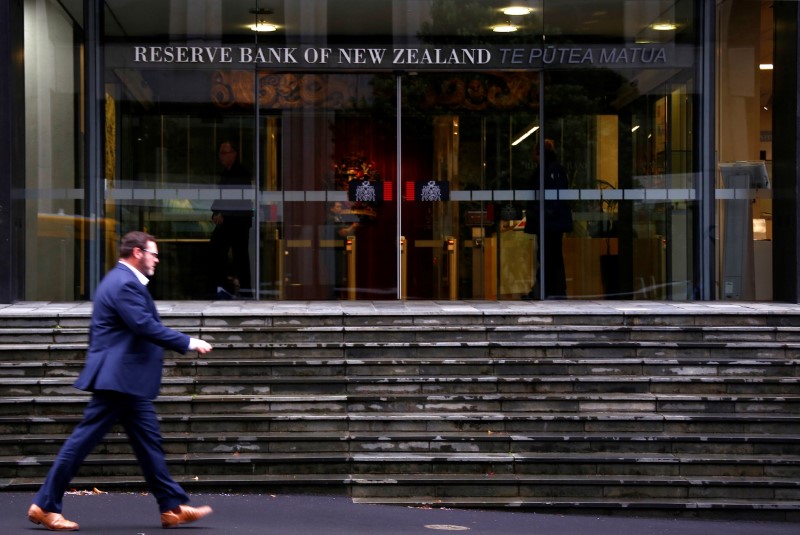
The Reserve Bank of New Zealand held the OCR at 2.25% (in line with expectations) and now sees headline inflation rising to ~4.2% in the June quarter (from 3.1% in December) driven by higher fuel and transport costs. NZD/USD jumped ~1.4% on a temporary U.S.-Iran ceasefire-driven relief rally as stocks rose and oil dipped below $100. The RBNZ warned higher energy prices and global uncertainty could damp domestic demand and said 'decisive and timely' rate hikes would be required if inflation expectations become unanchored.
The policy stance described implies a classic small-open-economy tradeoff: transitory external price shocks can lift headline inflation while simultaneously weakening domestic demand, leaving the central bank with optionality rather than a binary hawkish pivot. Practically, that means market moves driven by geopolitics (oil and risk-on/off) will dominate the near-term path for FX and short-end yields (days–weeks), while pass-through into wages and core inflation will determine rate moves over quarters. A useful rule of thumb: a sustained $10/bbl move in Brent tends to shift headline CPI in a small commodity-importing economy by a few tenths of a percent over 3–12 months, so the decisive risk to NZ policy is persistence, not a one-off headline print.
Winners/losers are non-linear. Exporters with USD pricing can see a two-way squeeze — a stronger NZD (from pre-emptive hikes) compresses NZD revenues, while a weaker NZD (from rate inaction or global risk-off) mechanically boosts them; the biggest second-order winners are exporters with low local cost bases (dairy processors, education/tourism services when FX weakens) and commodity processors that can flex volumes. Deflationary pressure on transport-intensive domestic sectors (airlines, freight) is immediate when oil falls; conversely, upstream suppliers to logistics see margin relief but possible order book weakness if demand softens.
Key catalysts and tail risks to watch: (1) reversal of geopolitical risk (ceasefire breakdown or new supply disruptions) can reflate oil and immediate FX/rates moves in 24–72 hours; (2) OPEC+ coordination or unexpected SPR releases shift the medium-term oil trajectory over 1–3 months; (3) NZ domestically, a single inflation print showing de-anchoring of expectations would force a rapid OCR repricing within 1–4 months. Monitoring real-time inflation breakevens, short-end OIS spreads, and NZD implied vols will give advance warning of regime change.
Positioning should reflect convexity: tactical directional exposure to the oil move is sensible, but core NZ fixed-income and FX books should be hedged against a volatility re-tightening. Use options to express views where possible (to cap downside) and size rate exposure to absorb a 50–75bp move in yields without large mark-to-market ruin.
AI-powered research, real-time alerts, and portfolio analytics for institutional investors.
Request DemoOverall Sentiment
mildly positive
Sentiment Score
0.20
