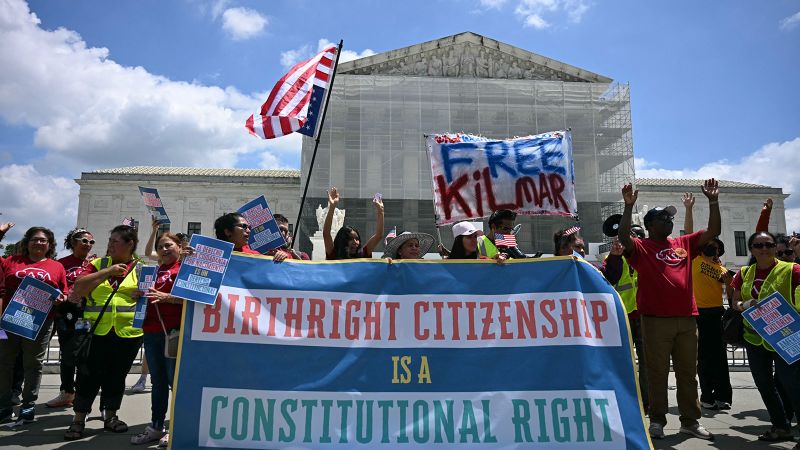
Supreme Court will hear arguments on President Trump's executive order to end automatic birthright citizenship; if upheld, children of as many as 6.5 million legally resident people could be denied U.S. citizenship. The dispute hinges on reinterpreting the 14th Amendment's 'subject to the jurisdiction' and the concept of 'domicile,' directly affecting DACA recipients, asylum seekers and humanitarian-program beneficiaries (e.g., Uniting for Ukraine). Immediate market impact is limited, but a ruling for the administration would amplify legal and political risk with material socioeconomic consequences and potential policy spillovers.
A ruling that narrows birthright citizenship is not just a constitutional event — it is a labor-market shock with uneven sectoral winners and losers. On the margin it increases enforcement demand (detention, surveillance, border tech) and raises the cost and legal friction of hiring and housing immigrant-heavy workforces, which will accelerate substitution toward automation/capital in agriculture, food processing and certain construction tasks. Municipalities and employers in immigrant-dense metros face multi-year administrative burdens (verification, litigation, benefits re-calculation) that will depress local consumption growth relative to national averages and reallocate public spending toward enforcement and legal defense.
Timing and cascade risks are asymmetric: the Supreme Court argument is an immediate liquidity event, a final ruling could arrive within months, but real-world implementation would be staggered over 6–24 months through litigation, injunctions and regulatory rulemaking. Tail risks include a partial ruling that invites a patchwork of state responses (sanctuary policies, state-level protections) or Congress stepping in to codify citizenship norms — any of which would blunt sector-specific upside and create regulatory unpredictability. Conversely, a decisive ruling for the administration would produce rapid reallocation of contracts (federal, state) and hiring/policies that materially benefit a narrow set of contractors and hardware suppliers.
The consensus view treats this as a purely political/legal event; that misses near-term demand reallocation into border enforcement and medium-term capital substitution in labor-intensive industries. Positioning should be tactical and size-aware: beneficiaries (detention contractors, border-tech suppliers, farm-capex names) can move quickly but face high regulatory and reputational risk, so prefer option structures or small percent equity tilts and pairs to hedge policy reversal scenarios.
AI-powered research, real-time alerts, and portfolio analytics for institutional investors.
Request DemoOverall Sentiment
strongly negative
Sentiment Score
-0.65
