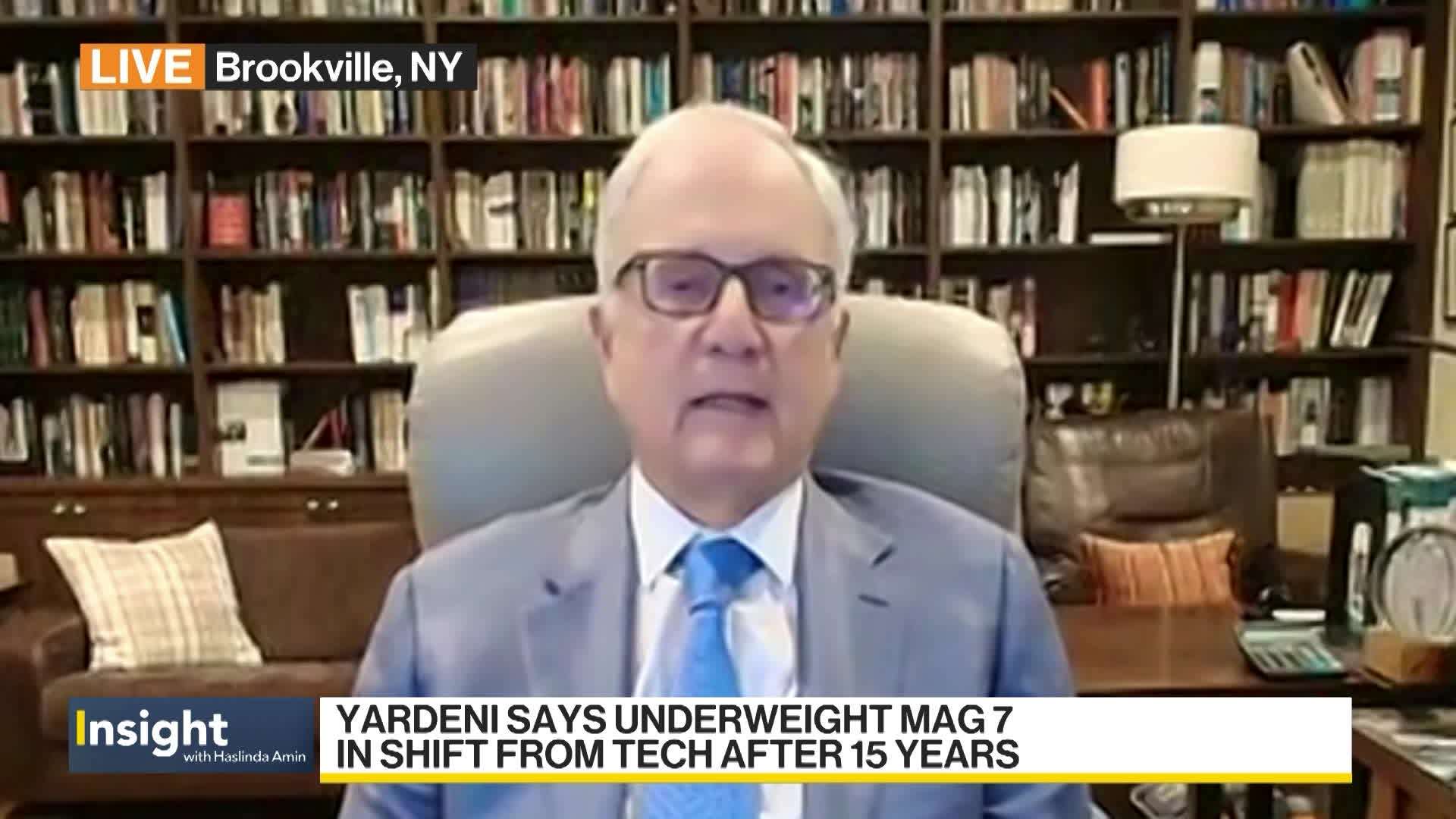
Yardeni Research recommends effectively underweighting the mega-cap 'Magnificent Seven' and the U.S. in global portfolios, arguing IT and communication services now represent about 45% of the S&P 500 market cap while the U.S. makes up roughly 65% of world market cap. Heightened competition in AI — highlighted by Google’s Gemini 3 and rival models from DeepSeek — and the risk that outsized profit margins invite challengers underpin the call to broaden exposure to the remaining 493 S&P components; Yardeni also notes some global peers have outperformed on cheaper valuations and a weaker dollar, supporting a reallocation away from concentrated U.S. mega-cap positions.
Market structure: The immediate implication is deconcentration risk — the Magnificent Seven (AAPL, MSFT, NVDA, AMZN, GOOG, META, TSLA) currently drive ~45% of S&P market cap and are most exposed to margin compression as competition (Gemini 3, DeepSeek) erodes pricing power. This shifts expected excess returns toward the “impressive 493” — sectors like Industrials (XLI), Financials (XLF) and select mid-cap tech — where AI is an input rather than the product, suggesting broadening demand for software/automation but lower supply-side pricing power for cutting-edge LLM services.
Risk assessment: Tail risks include rapid regulatory action (DoJ/FTC antitrust suits) or a single-model consolidation that reestablishes dominance (high-impact, <20% probability over 12 months). Short-term (days–months) this means higher volatility for mega-caps and concentrated ETF flows; medium/long-term (3–24 months) the risk is earnings revisions if margin pressure persists. Hidden dependencies: index concentration drives passive flows and gamma risk — a small price move can trigger outsized rebalancing; catalyst watchlist: product launches (Gemini updates), quarterly cloud margins, and FOMC rate guidance.
Trade implications: Implement relative-value trades that reduce passive concentration: overweight equal-weight S&P (RSP) vs QQQ short to capture mean reversion; add 2–3% overweight to IEFA/VEU for valuation and dollar exposure within 1–3 months. Use tactical options to time volatility: buy 3-month QQQ put spreads sized 0.5–1% notional (5–8% OTM) and sell 6–9 month XLF or XLI covered calls to fund carry.
Contrarian angles: The consensus underestimates network effects and platform lock-in — a transient model parity does not immediately translate to revenue share loss; historical parallel: 2010–2014 incumbents regained share after technology cycles. The reaction may be moderately overdone in short term, so size position risk (max 3% active overweight/short per trade) and expect episodic rebounds that create buying opportunities rather than complete structural obsolescence.
AI-powered research, real-time alerts, and portfolio analytics for institutional investors.
Request DemoOverall Sentiment
mildly negative
Sentiment Score
-0.25
Ticker Sentiment
