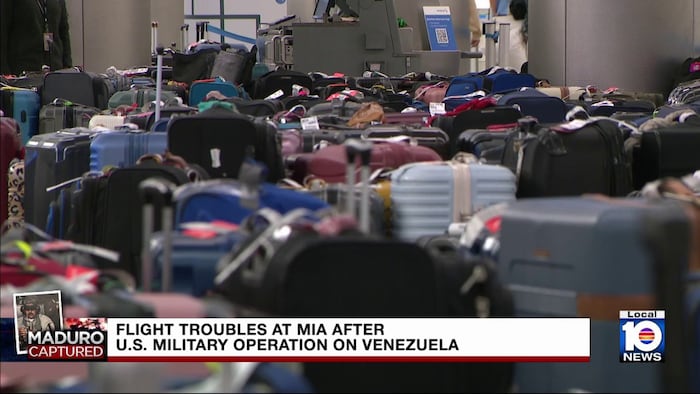
Airspace restrictions following news of Venezuelan leader Nicolás Maduro’s capture led to significant travel disruption, with Miami International Airport reporting 107 cancellations on Saturday and nine cancellations on Sunday, leaving many international passengers stranded and luggage unclaimed. The operational strain has forced airlines and MIA to prioritize rebooking and baggage retrieval, creating localized logistical and customer-service costs for carriers and the airport but limited broader market implications. Investors should monitor carrier operational metrics and near-term revenue/expense impacts on affected airlines and airport services, though systemic market effects appear minimal.
Market structure: Immediate winners are domestic-focused low-cost carriers with limited Latin/Caribbean exposure (e.g., LUV) and airport-adjacent ground-handling or short-term accommodation providers that pick up stranded passengers; losers are carriers with heavy Miami/Caribbean/LATAM networks (AAL, JBLU, possibly DAL/UAL) and OTAs (EXPE/BKNG) facing rebooking/refund flow. Routing and hub concentration at MIA magnifies market-share swings for weeks — expect unit revenue pressure on affected international routes but possible short-term yield uplift on rebooked itineraries. Cross-asset: EM sovereign/PDV credit spreads and Venezuela-linked FX will spike if conflict escalates; crude demand impact is negligible unless disruption widens to regional ports, while airline bond spreads and airline equity vol will rise.
Risk assessment: Tail risks include escalation into broader regional airspace closures or sanctions that last >30 days, producing a 5–15% quarterly revenue hit for exposed carriers and forcing fuel/hub reroutes; operational liquidity stress could surface for smaller regionals within weeks. Immediate (0–7 days) risk is logistical and reputational; short-term (1–3 months) is higher opex and compensation; long-term (3–12 months) depends on duration of Venezuelan instability and regulatory responses. Hidden dependencies: interline agreements, luggage handling subcontractors, and fuel hedges — a carrier with unhedged fuel and high Latin exposure is doubly vulnerable. Catalysts: official airspace restrictions, US/region sanctions, or reciprocal military action.
Trade implications: Implement a relative-value pair: long 2–3% portfolio in LUV while short equal notional AAL for 3 months to capture differential Latin exposure; size to net delta ~0. Options: buy 3-month AAL put spreads (10–15% OTM) sized 1–2% as downside insurance if cancellations persist >7 days or IV >35%. Consider a tactical short of EXPE (1% notional) if cancellations exceed 500 regional flights in 72 hours, pressuring near-term cancellations/refunds. Reduce exposure to smaller LATAM-focused regionals by 50% in model portfolios until airspace reopens or rerouting costs are quantified.
Contrarian angles: The market may overestimate lasting demand destruction — historical parallel: 2010 European ash disruption caused large but transient hits; if Venezuela disruption is <30 days, carriers will recover yields and lost demand will rebook within 2–3 months. The consensus risk is underpricing operational idiosyncrasies (baggage liabilities, compensation) which could create arbitrage in short-dated airline credit and put option premiums; if equities drop >10% in 48 hours on headlines, set limit-buy cushions to add selective LATAM exposure at 15–25% discounted valuations. Unintended consequence: aggressive shorting could backfire if capacity redeployments raise domestic yields and offset international losses.
AI-powered research, real-time alerts, and portfolio analytics for institutional investors.
Request DemoOverall Sentiment
moderately negative
Sentiment Score
-0.30
