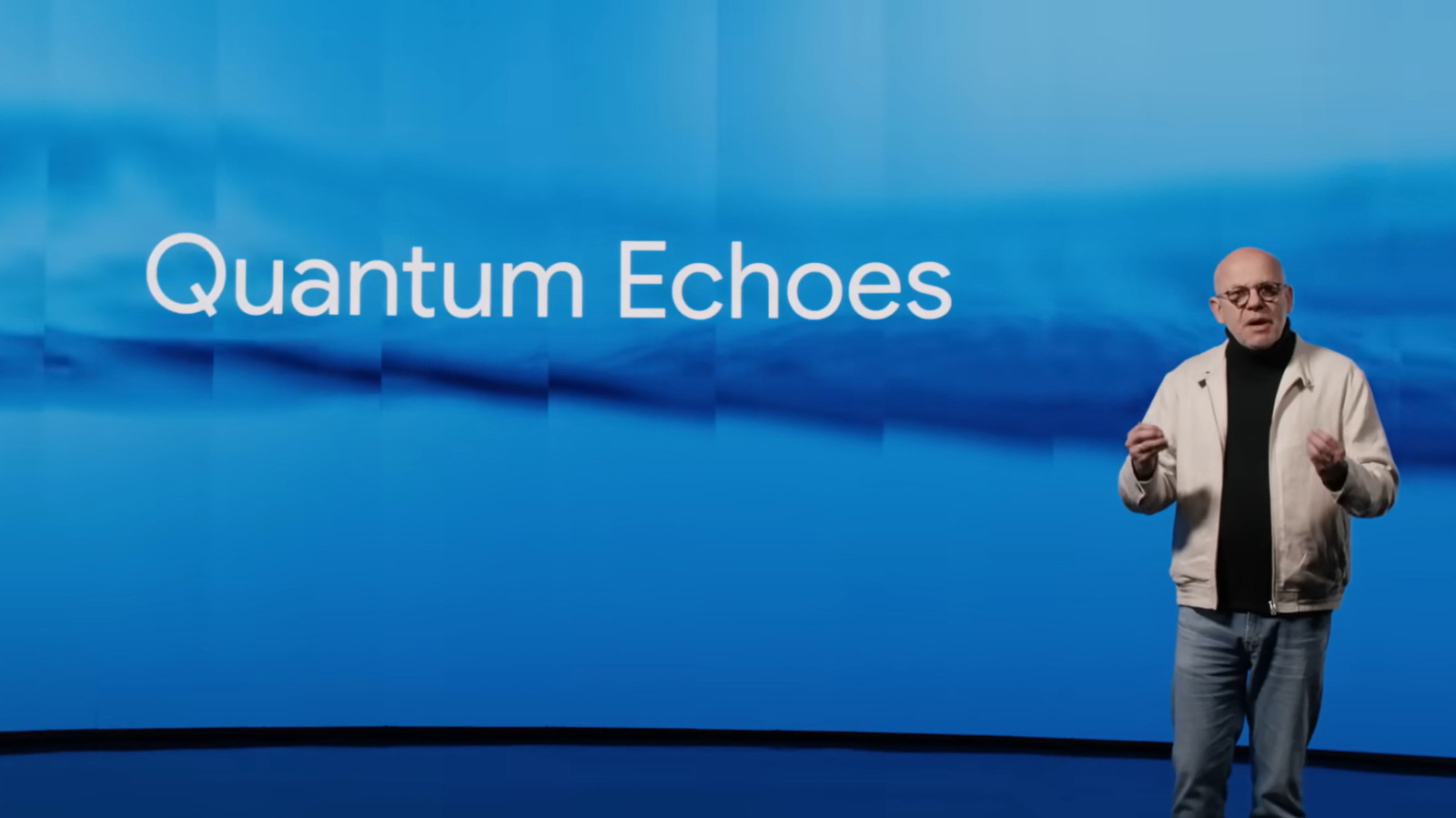
Google says it has developed Quantum Echoes, a verifiable out-of-time-order correlator (OTOC) quantum algorithm that ran on its Willow chip and is claimed to be about 13,000 times faster than the most powerful classical supercomputers; two October 2025 papers (one in Nature, one on arXiv) demonstrate applications to NMR-style spectroscopy and a “molecular ruler” that matched traditional NMR results in joint experiments with UC Berkeley while reducing error rates below threshold as qubits scale. These results mark a step toward repeatable, scalable quantum algorithms that could enable molecular-structure measurements relevant to drug discovery and materials science, and build on Willow’s December 2024 benchmark claim (completing a task in under five minutes that a top supercomputer would take vastly longer). However, the work remains experimental, commercialization and broader utility are uncertain, and Google faces fierce competition from IBM, Microsoft and Chinese firms in the race to practical quantum computing.
Google reports a breakthrough with Quantum Echoes, an out-of-time-order correlator (OTOC) algorithm that it says ran on the Willow quantum chip and is roughly 13,000x faster than the most powerful classical supercomputers; two October 2025 papers (one in Nature, one on arXiv) demonstrated applications to NMR-style spectroscopy and a “molecular ruler” that matched traditional NMR results in joint experiments with UC Berkeley. The company claims the algorithm is verifiable across hardware and achieved error rates “below threshold” while scaling qubits, building on Willow’s December 2024 benchmark where Google said it completed a task in under five minutes that a top supercomputer would take an astronomically longer time. Technically, Quantum Echoes functions by sending a signal that reverses evolution on Willow to produce an echo, increasing sensitivity via constructive interference and enabling measurements of magnetization and other quantum expectation values; this establishes a repeatability advantage that investors should note versus prior, non-verifiable quantum demonstrations. Commercial implications include potential applications in drug discovery and materials science within the next half-decade per the article, but the work remains experimental and Google faces significant competition from IBM, Microsoft and Chinese rivals, which makes timing and real-world revenue uncertain.
AI-powered research, real-time alerts, and portfolio analytics for institutional investors.
Request DemoOverall Sentiment
moderately positive
Sentiment Score
0.50
Ticker Sentiment
