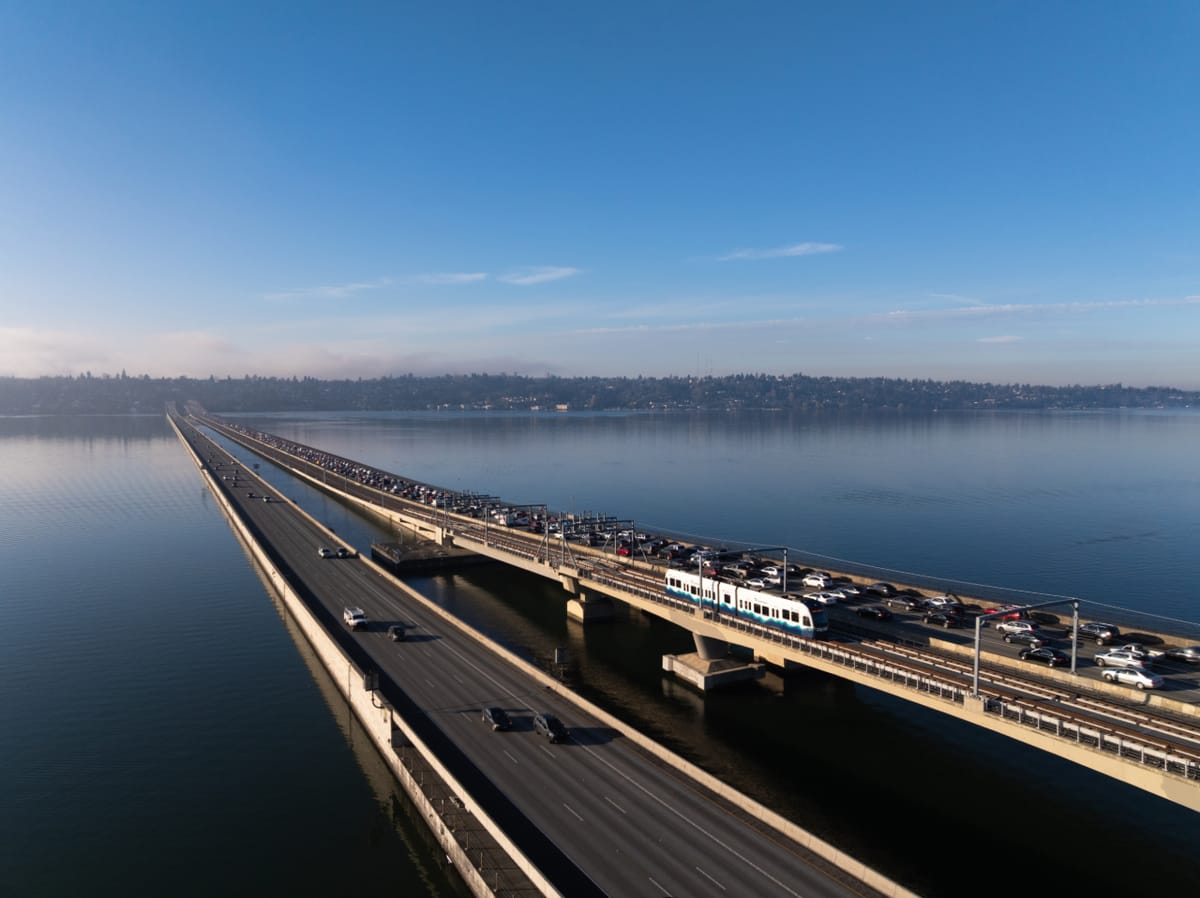
The 2 Line opened revenue service today, linking Seattle and the Eastside with 10-minute headways for most of the day and two new stations (Mercer Island, Judkins Park). The cross-lake connection creates one-seat rides from Downtown Redmond to Shoreline/Roosevelt/Capitol Hill, extends service toward midnight, and should boost regional mobility and local retail/real-estate activity. The project cleared years of political and legal risk, including >$100k in opposition spending and a roughly $10m settlement with Mercer Island, removing execution risk for the completed segment.
This connection is less a one-off transit improvement than a structural shrinkage of effective distance between two large employment and housing clusters — think an immediate 6 trains/hour backbone plus network transfer arbitrage that turns many marginal commutes into viable rail trips. That lowers effective labor-market frictions: firms on the Eastside gain access to downtown talent pools and vice versa, raising local office capture rates and lowering required parking demand; expect measurable hiring and retention benefits for campus employers within 12–24 months.
Commercial real estate effects will be highly non-uniform. Nodes with zoning capacity for densification and a short walk to stations will see the upside (higher rent growth, faster lease-up) within 12–36 months; locations constrained by local land-use opposition will capture only the transient foot-traffic uplift. Parking operators and peak-focused mobility services face a structural headwind to marginal trip volumes in commuter windows, though leisure and off-peak demand may be less affected.
Operational uniqueness — the floating bridge segment — concentrates tail risk in maintenance and service reliability. A single seasonal or mechanical issue that forces reroutes across the lake could produce outsized ridership reversions and political headaches that slow follow-on TOD approvals; the market should price this as a non-trivial probability over a 0–24 month horizon. Conversely, if early reliability is high and on-time performance sustains, political capital for rezoning and higher-density permitting is likely to accelerate, unlocking multi-year real estate revalorization.
The near-term narrative will be celebratory; the real alpha comes from positioning for the second-order zoning and tenant-mix shifts that play out over years. Monitor ridership cadence vs. projections (0–3, 3–12 month buckets), first-year farebox recovery, and any municipal litigation or zoning moratoria as binary catalysts that will amplify or reverse the price action in local assets.
AI-powered research, real-time alerts, and portfolio analytics for institutional investors.
Request DemoOverall Sentiment
strongly positive
Sentiment Score
0.80
