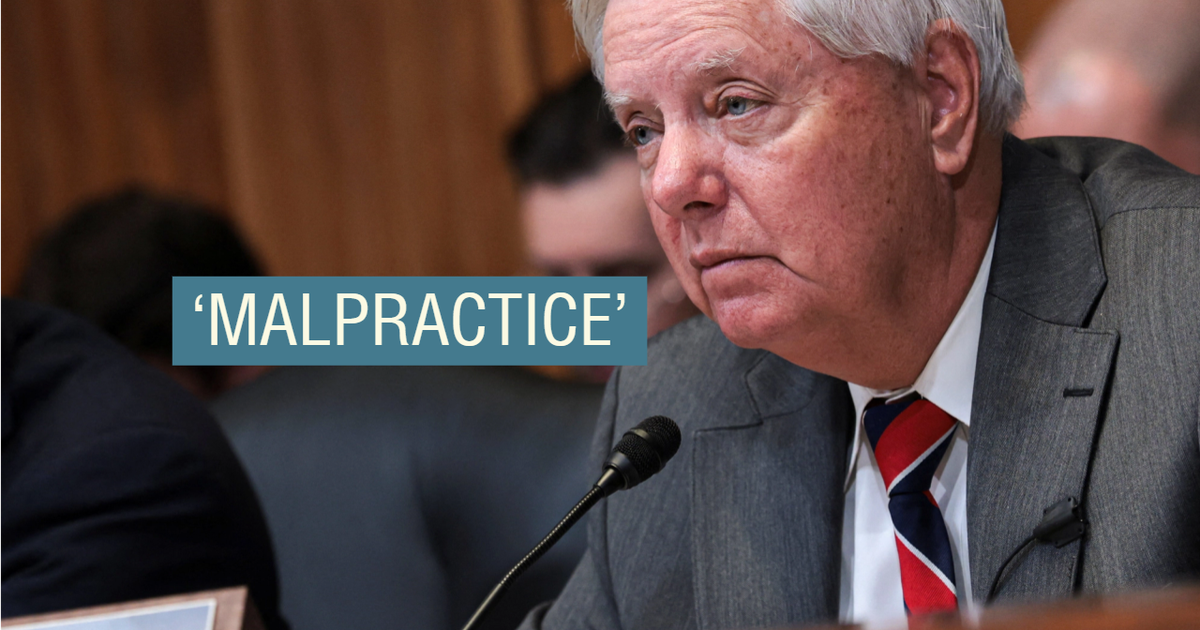
Senate Budget Chairman Lindsey Graham plans to begin a budget-resolution-driven reconciliation process early next year, aiming for a party-line package that could include military funding, health-care measures, and grants to states that assist ICE. President Trump and other GOP leaders have not committed to the approach, and with the filibuster remaining intact, reconciliation is being positioned as a potential last route to pass major legislation this Congress, leaving policy outcomes and market implications uncertain.
Market structure: A party-line reconciliation that includes military spending and ICE grants directly benefits prime defense contractors (LMT, RTX, NOC) and private prison/immigration-enforcement contractors (CXW, GEO) via near-term backlog and federal grant revenue; healthcare winners/losers depend on the bill’s details (insurers like UNH may gain if subsidies expand; large-cap pharma like PFE/MRK could face price negotiation downside). Pricing power shifts to firms with program-ready capacity and cleared facilities; a modest $1–5bn package materially boosts revenue for niche contractors (+5–15% revenue upside range within 6–12 months if enacted).
Risk assessment: Tail risks include a reconciliation failure that sparks headline volatility or an unexpected CBO deficit score that lifts 10yr yields +20–50bp. Immediate (0–7 days) is headline-driven option volatility; short-term (1–3 months) sees re-rating of contractors and small-cap policy-sensitive names; long-term (3–18 months) is fiscal/interest-rate trajectory. Hidden dependencies: White House buy-in, exact grant formula, state legal challenges that could nullify expected flows.
Trade implications: Actionable trades: overweight LMT and RTX (1–2% position each) via 3–6 month call spreads targeting +10–25% moves upon budget passage; small opportunistic long positions in CXW/GEO (0.5–1% each) given binary upside if ICE grants scale, with tight 20% stop-loss. Hedge rate risk by shorting TLT (2% portfolio risk) or buying 10yr futures to capture a 10–30bp yield rise; pair trade long LMT vs short IWM to express defense outperformance for 3–6 months.
Contrarian angles: Consensus assumes easy passage and full disbursement; that underestimates legal/state pushback that can delay payments 6–12 months. Defense names are partially priced for higher budgets, so use options to avoid overpaying; private-prison upside may be overdone if public/ESG pressure blocks state participation — size positions small and set precise legislative triggers (budget resolution vote in Q1 2026) as entry/exit points.
AI-powered research, real-time alerts, and portfolio analytics for institutional investors.
Request DemoOverall Sentiment
neutral
Sentiment Score
0.00
