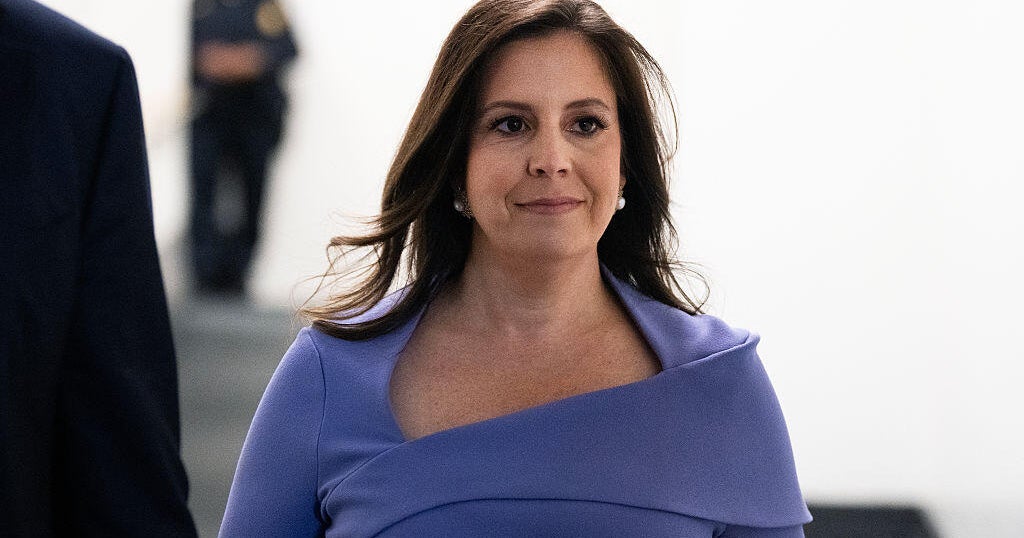
Rep. Elise Stefanik suspended her New York gubernatorial campaign, citing the risk that a protracted Republican primary would drain resources in an uphill statewide race after President Trump declined to endorse either candidate. Stefanik — who said she does not plan to seek reelection to Congress and had raised over $10 million — was widely expected to clear the convention threshold but nonetheless bowed out amid concerns a contest with Nassau County Executive Bruce Blakeman could become damaging; the eventual GOP nominee will face incumbent Democrat Gov. Kathy Hochul, who leads by double digits in a recent Siena poll. The move reduces near-term intraparty friction in New York but is unlikely to meaningfully move financial markets.
Market structure: Stefanik's exit removes a high-profile nationalized GOP candidacy and likely reduces incremental out-of-state fundraising/ad spending (she had >$10M raised). Winners are incumbents and local incumbency-sensitive assets (NY muni credit, large-state incumbents); losers are national political media/ad platforms that price inventory for high-profile races. Expect marginally lower short-term demand for politically driven local ad inventory (TV/digital) and a small drag on NY-focused political fundraising services.
Risk assessment: Tail risks include a sudden Trump endorsement or Stefanik reversal (low probability in next 60 days but high impact) that would re-nationalize the race and drive a fresh ad wave; another tail is Stefanik not seeking House reelection, creating a competitive House race that could alter House control math. Immediate (days) market impact should be negligible; short-term (weeks–months) could move local media/reit spreads by low single-digit percentages; long-term (quarters) effects are minimal absent wider national political shifts. Hidden dependency: February GOP convention mechanics (25% threshold) could still trigger a bruising primary if Blakeman contests.
Trade implications: Base case is minimal macro effect but local re-pricing opportunities: favor small-duration muni exposure in NY-sensitive paper and avoid levering media names priced for a high-ad cycle. Options strategies should be short-dated and low notional: sell ad-spend dispersion rather than directional macro. Key catalyst windows: end of Feb convention and any Trump public endorsement; trades should be sized small and horizon 1–3 months.
AI-powered research, real-time alerts, and portfolio analytics for institutional investors.
Request DemoOverall Sentiment
neutral
Sentiment Score
0.00
Ticker Sentiment
Contrarian angles: Consensus treats this as market-neutral — we see a narrow arbitrage: if GOP consolidates early, the general could tighten from +6 to ~+2–4 pts, re-accelerating ad flows and benefitting broadcasters and fundraising platforms. Conversely, if Stefanik’s exit suppresses donor enthusiasm, ad revenue could underperform consensus by 5–10% vs typical gubernatorial cycles. Historical parallels: midterm-state races with late withdrawals show muted market moves but clear local ad revenue compression over the subsequent 60–120 days.
