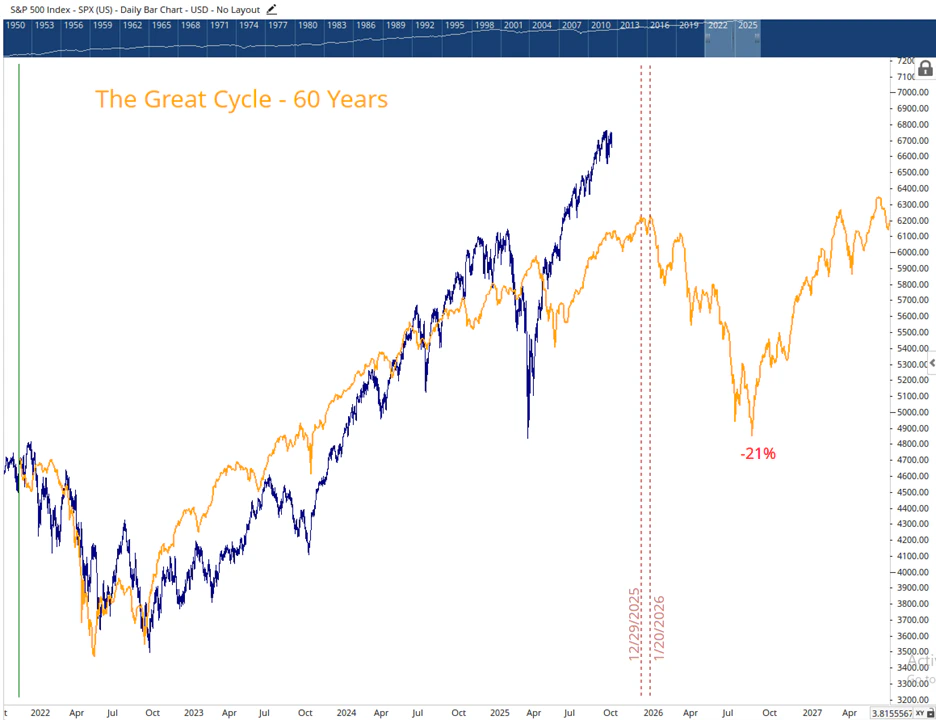
The article posits that market movements are primarily driven by historical cycles rather than daily headlines, using the 2025 market's Q1 decline and subsequent rally as a case study. It aligns 2025's trajectory with two W.D. Gann-derived cycles: a 45-year cycle (paralleling 1980's policy shock and recovery) and a 26-year cycle (mirroring 1998's global liquidity crisis and tech-fueled rebound). Both models forecast continued market strength through December 2025, followed by a period of increased volatility in Q1 2026, with nuances in the timing and nature of the potential correction.
The article posits that market movements are predominantly driven by historical cycles rather than daily news narratives, citing studies by Cutler, Poterba, and Summers, and Ray Fair, which found limited correlation between news events and major price swings. The COVID-19 market bottom and subsequent V-shaped recovery, despite severe economic deterioration (e.g., 31.4% annualized GDP drop), exemplify this disconnect, suggesting underlying forces like liquidity and sentiment are more influential.
Two dominant W.D. Gann-derived cycles are identified as aligning with 2025 market action, both following a Q1 2025 20% decline and subsequent seven-month rally. The 45-year cycle parallels 1980, where a policy shock (Volcker's rate hikes then tariffs in 2025) led to a liquidity squeeze and rapid recovery. The 26-year cycle mirrors 1998, characterized by a global liquidity crisis (Asian Financial Crisis, LTCM) and a Fed-induced rebound, fueled by optimism for emerging technology.
Both cycles project continued market strength through December 2025, followed by a period of increased volatility in Q1 2026. The 45-year cycle suggests a secondary high in mid-January 2026 and elevated volatility into Q2, while the 26-year cycle indicates an aggressive uptrend into mid-Q1 2026 before a potentially brief consolidation within a broader advance extending into late 2026. This divergence highlights differing potential paths for the upcoming correction's duration and depth.
AI-powered research, real-time alerts, and portfolio analytics for institutional investors.
Overall Sentiment
mildly positive
Sentiment Score
0.25
Ticker Sentiment
