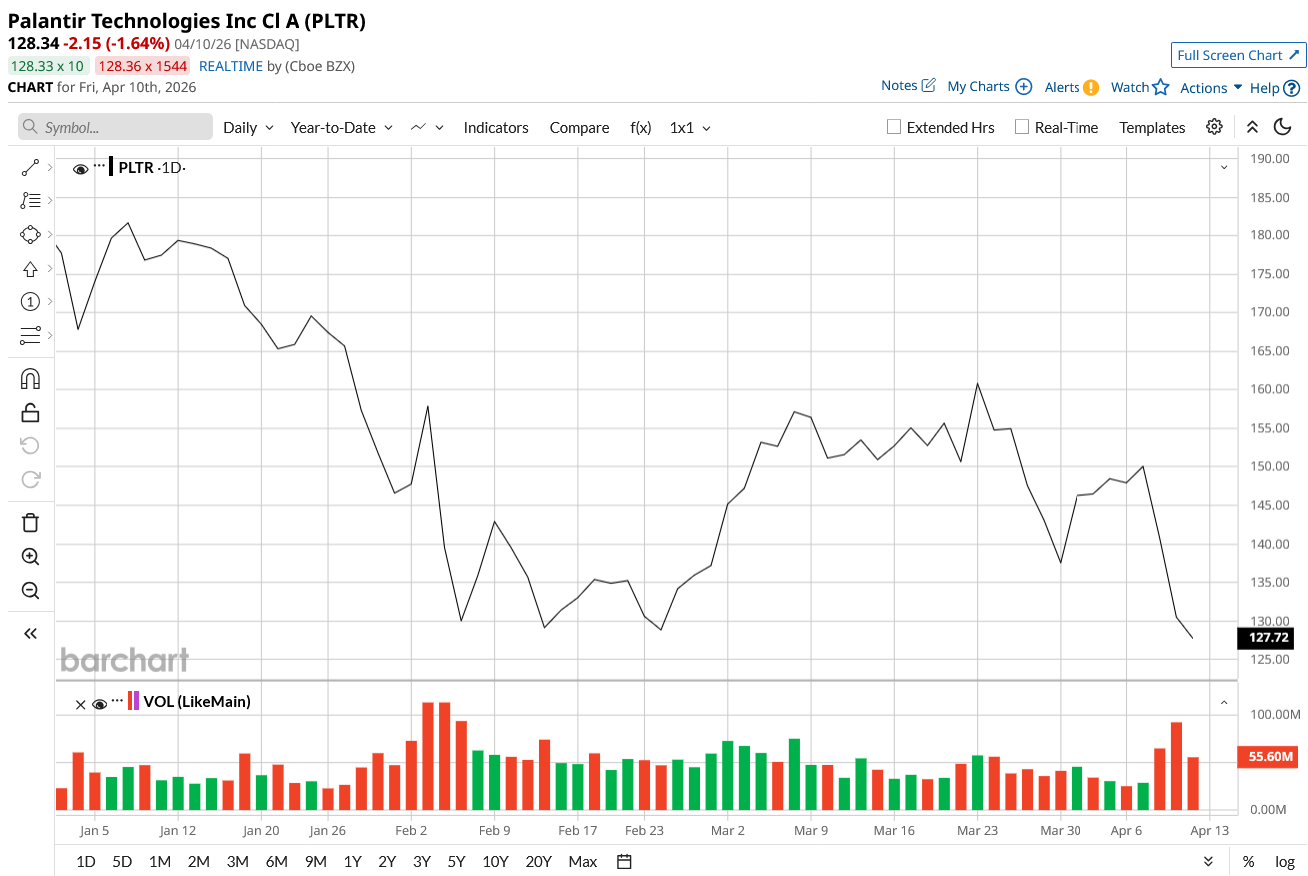
Palantir reported a strong quarter with revenue up 70% year over year to $1.41 billion, EPS up 78% to $0.25, and operating margin expanding to 57%. U.S. commercial revenue surged 137% to $507 million, U.S. government revenue rose 66% to $570 million, and total contract value jumped 138% to $4.26 billion, while management guided Q1 revenue to $1.532 billion-$1.536 billion and FY2026 revenue to $7.182 billion-$7.198 billion. Despite the strong fundamentals, valuation remains stretched at 106.53x forward P/E and 46.35x sales, though analysts still rate the stock a Moderate Buy with a $198.30 mean target.
The market is treating PLTR like a geopolitical beta trade when the real driver is operating leverage in a software-platform compounding story. The key second-order effect is that every new model partner increases Palantir’s value as a control plane: customers can swap compute engines without rebuilding permissions, workflows, or audit layers. That makes the moat less about model quality and more about being the enterprise’s “system of record for decisions,” which is stickier and harder to displace than a pure model vendor.
The biggest bear case is not competition on raw model performance; it is valuation compression if growth decelerates even modestly. At these multiples, a slowdown from hypergrowth to merely very strong growth can create a 20-30% drawdown quickly, even if fundamentals remain excellent. The setup is asymmetric because the stock now needs continued beats plus sustained guide raises to justify the multiple, so the next two quarters matter more than the next two years.
Contrarianly, the article may underweight procurement friction and budget scrutiny outside defense. Enterprises love the ROI story, but large-scale rollouts often run into data-cleaning, governance, and internal politics after the pilot phase, which can elongate monetization beyond the bootcamp cycle. Also, the geopolitical premium is fragile: if Middle East risk fades, the stock loses a narrative support pillar while still trading on extreme expectations.
NVDA is a quieter beneficiary only indirectly: Palantir’s broader model orchestration and deployment stack can increase enterprise appetite for premium inference and accelerator usage, but that effect is diffuse and unlikely to move NVDA near term. The cleaner trade is not to chase AI infrastructure here, but to respect that Palantir’s ecosystem can absorb competitors rather than be displaced by them. That is bullish structurally, but it also means the best entries are often on post-earnings volatility rather than strength.
AI-powered research, real-time alerts, and portfolio analytics for institutional investors.
Request DemoOverall Sentiment
moderately positive
Sentiment Score
0.55
Ticker Sentiment
