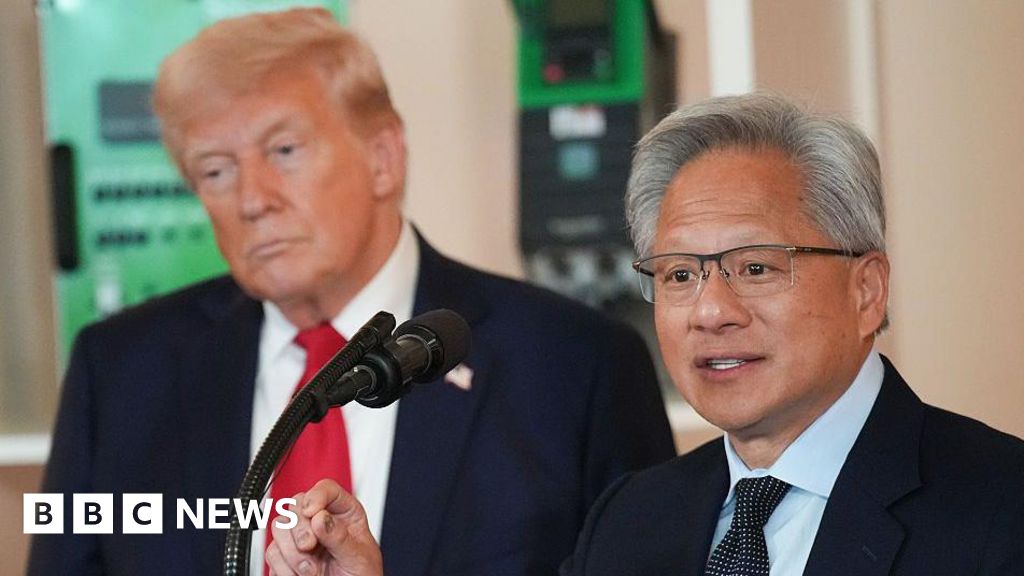
President Trump announced he will allow Nvidia to sell its H200 AI chips to 'approved customers' in China, a policy that reportedly also covers other U.S. chipmakers such as AMD and requires end-user vetting by the Commerce Department; the H200 is one generation behind Nvidia's top Blackwell chip. The decision follows intensive lobbying by CEO Jensen Huang and reverses earlier restrictions (previous reporting noted a July reversal tied to a proposed levy on Chinese revenues, with conflicting public comments about whether the take is 15% or 25%), and Nvidia shares ticked up on the news. For investors, the move opens near-term commercial upside and a narrative of protecting U.S. jobs and manufacturing, but it raises material national-security and supply-chain risks—analysts warn easier Chinese access could accelerate military AI development even as the policy may buy time for U.S.-China negotiations on rare earths while prompting China to double down on domestic chip self-sufficiency, and the arrangement could face Congressional pushback.
President Trump announced a policy change allowing Nvidia to sell its H200 AI chips to "approved customers" in China, extending similar treatment to other U.S. chipmakers such as AMD and requiring end‑user vetting by the Commerce Department; Nvidia has publicly welcomed the decision and its shares rose slightly on the news. The H200 is explicitly described as one generation behind Nvidia's Blackwell architecture, and the policy follows intensive lobbying by CEO Jensen Huang and earlier contradictory statements about a revenue levy (reported as 15% previously, with Trump later posting "25% [sic]").
The move creates near‑term commercial upside by reopening a large Chinese market, but Beijing had already directed domestic firms to reject Nvidia's older H20 chips and encourage local suppliers, so Chinese buyers may not immediately resume purchases. Analysts quoted in the article frame the decision as buying negotiating time over rare earths—where China has processing dominance—while also warning it may accelerate Chinese efforts at semiconductor self‑sufficiency.
Security and political risks are material: Georgetown CSET researchers flagged potential PLA use of U.S. chips for military AI, and the arrangement is likely to face Congressional pushback, creating regulatory and execution uncertainty. Key near‑term catalysts will be Commerce Department approvals, Congressional responses, Chinese procurement directives, and any clarified terms of the revenue‑sharing arrangement; these will drive the balance between commercial gains and geopolitical downside.
AI-powered research, real-time alerts, and portfolio analytics for institutional investors.
Request DemoOverall Sentiment
mildly positive
Sentiment Score
0.25
Ticker Sentiment
