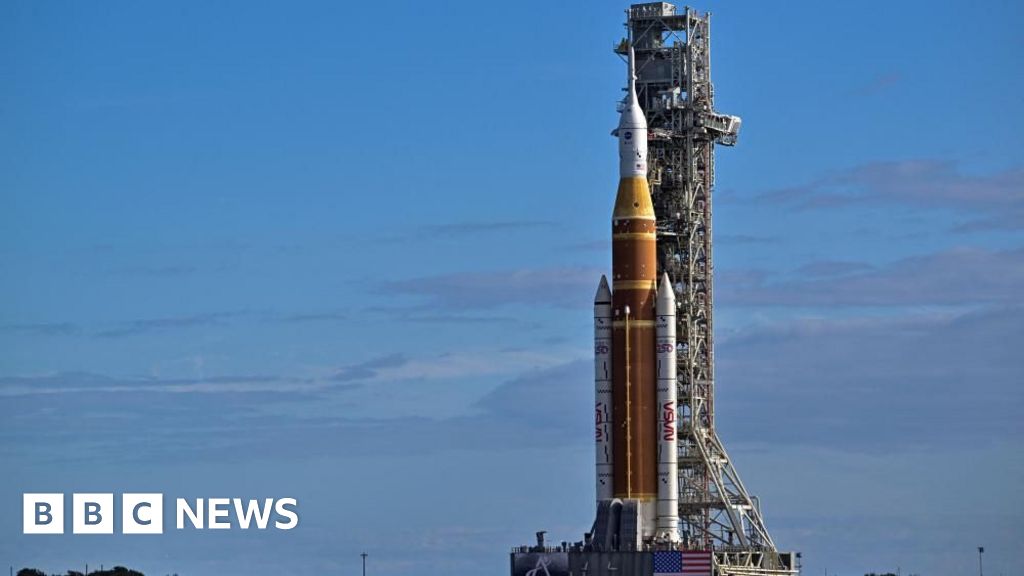
NASA's 98m Space Launch System for Artemis II was moved vertically about 4 miles from the Vehicle Assembly Building to Launch Pad 39B in a roughly 12-hour crawler-transporter operation as teams prepare for a wet dress rehearsal and final checks ahead of an earliest possible liftoff on 6 February. The 10-day crewed lunar flyby will carry four astronauts in an Orion spacecraft powered by an Airbus-built European Service Module; the mission is a non-landing precursor to Artemis III (no earlier than 2027, analysts point to 2028), marking schedule progress for NASA and signalling near-term activity for aerospace suppliers but with limited immediate market-moving impact.
Market structure: A successful Artemis II launch is a positive demand signal for prime contractors and specialized propulsion/electronics suppliers (Aerojet Rocketdyne, Lockheed Martin, Northrop Grumman, Airbus/EADSY), reinforcing government spending flows into aerospace and defense and increasing pricing power for niche space-capable suppliers. Commercial aviation/consumer cyclicals see negligible direct benefit; instead expect a re-rating of defense/A&D suppliers by +5–15% over 6–12 months on contract visibility if technical milestones hold. Cross-asset: small upward pressure on long-dated Treasuries yields (10–25bp) is possible if Congress funds accelerated programs; USD impact is muted but risk-on rallies could lift equities and gold mildly underperforming.
Risk assessment: Tail risk centers on an operational failure or in-mission anomaly causing multi-week program suspensions and supplier revenue hits—small-cap suppliers could gap down 20–50% on order risk. Timeline: immediate (days) — volatility around wet dress rehearsal and first launch window; short-term (weeks) — reaction to launch outcome and imagery; long-term (years) — Artemis III execution and budget cycles (2027–2028). Hidden dependencies: European Service Module (Airbus/EADSY) creates single-source geopolitical/supply-chain exposure; SpaceX subcontracting/competitive wins could shift future share away from legacy primes.
Trade implications: Favor overweight aerospace & defense (LMT, NOC) and specialized propulsion (AJRD) while underweight commercial aerospace (BA) and cyclical suppliers with weak NASA exposure. Use option structures to limit downside: calendar or 3–9 month call spreads around AJRD/LMT to play program execution. Pair trade: long AJRD (or ITA ETF) vs short BA to capture government vs commercial divergence; target 6–12 month horizon.
Contrarian angles: Consensus underprices European/SME suppliers enabling critical mission hardware (EADSY, small EMS contractors); a disciplined buy-on-failure approach is attractive — set tactical buy triggers at 12–20% post-failure dips. Historical parallel: post-Apollo consolidation shows upside for primes surviving cuts but high volatility for specialist suppliers; unintended consequence is faster private-sector entry (SpaceX) accelerating competitive pressures on long-cycle government contractors.
AI-powered research, real-time alerts, and portfolio analytics for institutional investors.
Request DemoOverall Sentiment
mildly positive
Sentiment Score
0.25
