


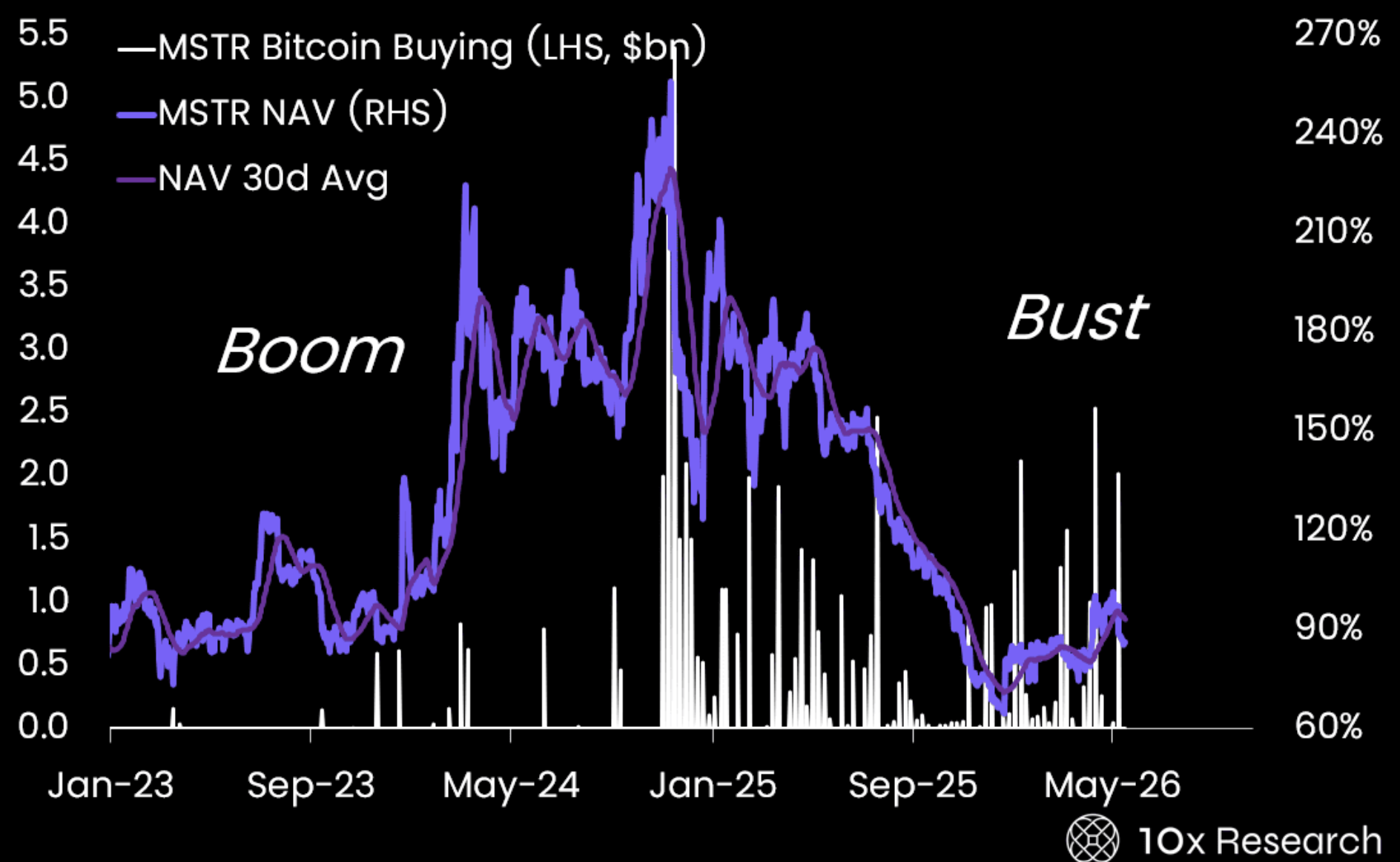
Bitcoin fell below $73,000, a six-week low and beneath the key $74,000 pivot, as spot bitcoin ETFs logged $733.4 million of outflows on Wednesday and $1.07 billion so far this week. Analysts warned that continued ETF outflows and elevated Treasury yields could pressure bitcoin toward the February lows just above $60,000, with $75,000 now seen as an important support/observation zone. Separately, Strategy's effective cash runway to fund its $1.7 billion annual dividend burden was cut to 6.1 months, raising the risk it may need to sell bitcoin soon and weakening a major source of market support.
The near-term setup is less about absolute bitcoin fundamentals and more about marginal forced flow. Once spot slips through a widely watched technical level, the market loses a simple reference point and liquid hedgers can dominate price discovery; that tends to amplify moves for 1-3 weeks before longer-horizon buyers re-engage. The bigger second-order risk is not the ETF outflow itself, but the signaling effect: if passive wrappers are no longer absorbing sell pressure, every incremental unwind from levered proxies, crypto treasury vehicles, and collateralized holders becomes more price-sensitive.
Strategy is the key convexity point because it has functioned as a quasi-sovereign bid for the entire digital-asset complex. If that buyer transitions from accumulation to potential liquidation, the market should not model the impact as linear supply; it is a regime change in sentiment and in the behavior of other DATs, which likely have weaker balance sheets and less tolerance for mark-to-market drawdowns. That creates a negative reflexivity loop: weaker price pressure raises funding stress, which reduces future balance-sheet demand, which further weakens the tape over the next 1-3 months.
The contrarian angle is that some of this is already moving from fundamentals into positioning. The market likely overestimates the mechanical magnitude of any single seller and underestimates the duration of a higher-rate, lower-liquidity environment that keeps risk budgets tight. If yields back off or a large new catalyst emerges, the rebound can be sharp because crypto is currently trading like a crowded macro-beta expression rather than a standalone asset class.
For BLK, the issue is reputational and flow-based more than earnings-based: continued ETF redemptions can dent near-term sentiment around its digital-asset franchise, but the bigger risk is that a perception of “hot money” makes allocators more selective across the complex. CME is a relative winner because elevated volatility and two-way hedging should support crypto options and futures activity even if spot weakens, especially if the market leans into downside protection around the $60k area.
AI-powered research, real-time alerts, and portfolio analytics for institutional investors.
Request TrialOverall Sentiment
strongly negative
Sentiment Score
-0.65
Ticker Sentiment
