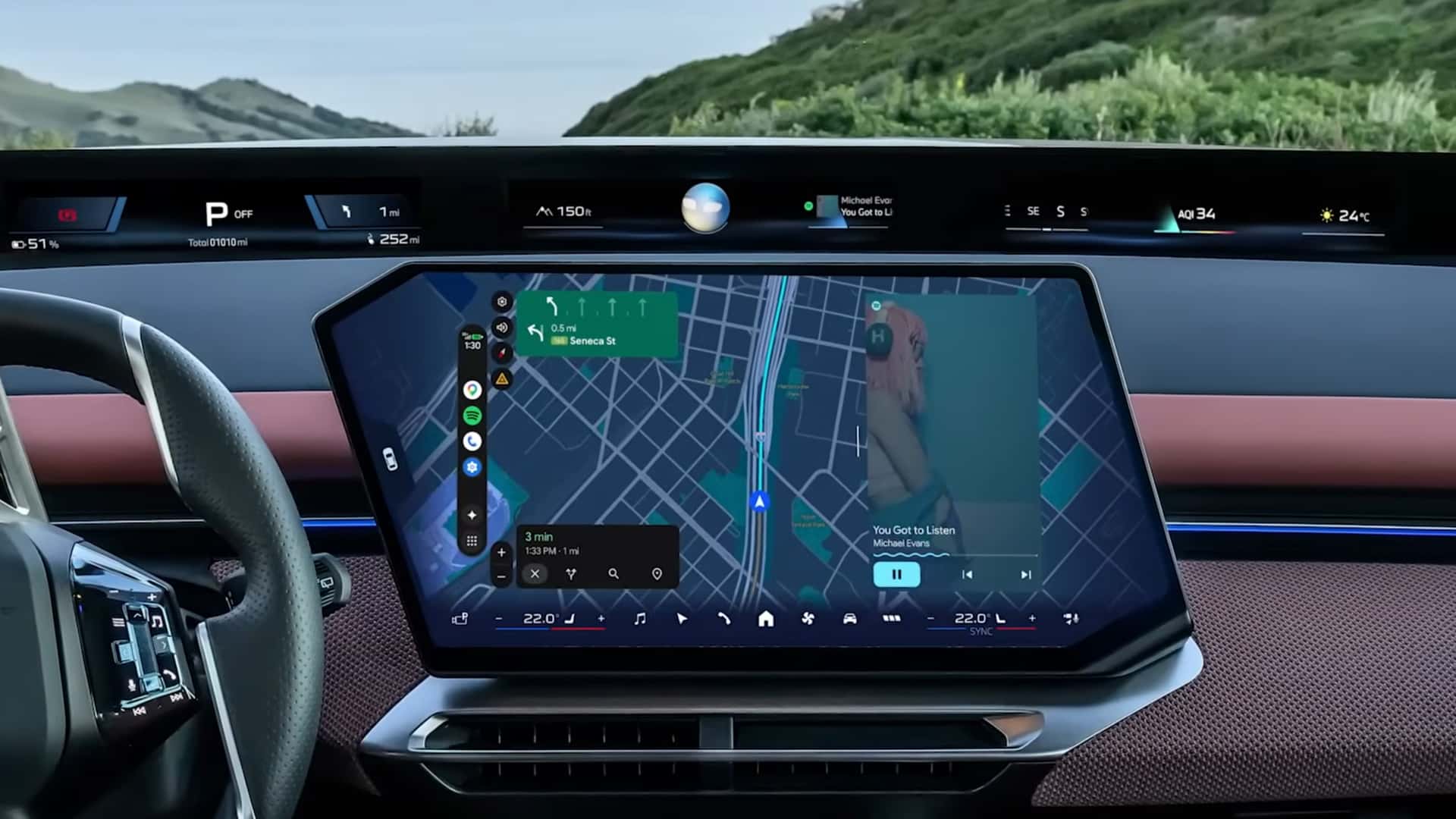
Google is rolling out a major Android Auto refresh that will let the system fill entire car screens, including irregular displays, while adding edge-to-edge Maps, pinned widgets, HD video playback, Dolby Atmos, and tighter Gemini AI integration. Supported 60fps full-HD video playback begins later this year across models from BMW, Ford, Genesis, Hyundai, Kia, Mahindra, Mercedes-Benz, Renault, Skoda, Tata, and Volvo. The update is positive for Google’s in-car ecosystem and carmakers using Android Auto, but the news is primarily product-driven rather than financially material in the near term.
GOOGL is the clear near-term winner because this is less about a cosmetic UI refresh and more about making Android Auto feel native enough to raise daily active usage. The second-order effect is stickiness: once navigation, media, and assistant functions are all layered into a full-screen workflow, the switching cost versus CarPlay rises, which should improve Google’s leverage with OEMs in future dashboard negotiations. That matters because in-car usage is one of the few consumer surfaces where a few extra minutes of engagement can translate into search, maps, assistant, and cloud monetization over a multi-year horizon.
The real competitive pressure lands on auto software stacks and OEM infotainment initiatives, not just Apple. If Google successfully owns more of the driver workflow, automakers lose some control over the customer relationship and data exhaust, which weakens their ability to monetize subscriptions and paid services directly. The likely incremental winner outside Google is Dash: smoother in-car voice-to-order and hands-free context recognition can reduce friction for food delivery and other on-the-go commerce, but the effect is adoption-driven rather than revenue-step-function immediate.
Ford and GM are more mixed. In the short term, broader compatibility is a tailwind because it reduces consumer frustration and may support vehicle feature perception, but over months it can make OEM-branded software look less differentiated. The contrarian view is that this may be over-credited as an auto thesis: the monetization inflection for Google is slow, and the update mostly strengthens a platform already winning share, so the bigger upside may be in Android ecosystem lock-in rather than direct automotive revenue. Tail risk is execution friction—if OEM integration is patchy or audio/video features are inconsistent across models, the market will quickly reclassify this as a product polish story rather than a meaningful platform shift.
AI-powered research, real-time alerts, and portfolio analytics for institutional investors.
Request DemoOverall Sentiment
mildly positive
Sentiment Score
0.45
Ticker Sentiment
