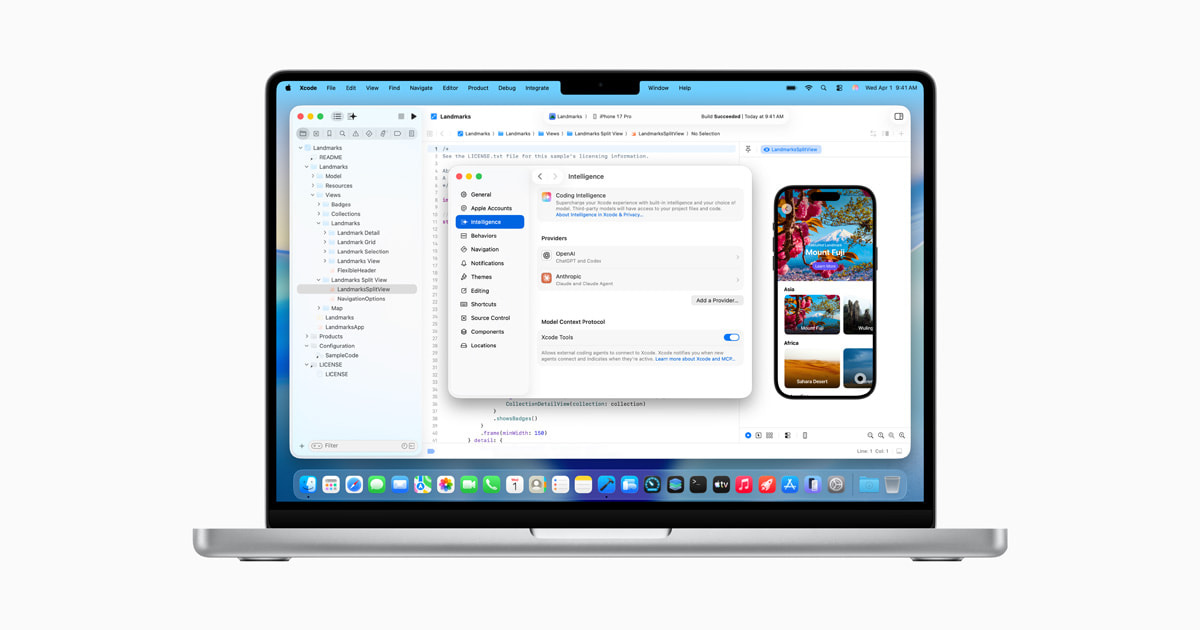
Apple has released Xcode 26.3 as a release candidate to Apple Developer Program members, introducing 'agentic coding' that integrates coding agents including Anthropic’s Claude Agent and OpenAI’s Codex directly into the IDE. The agents can autonomously break down tasks, modify project settings, explore file structures, run visual Xcode Previews and iterate through builds, while Xcode exposes these capabilities via an open Model Context Protocol to support third-party agents. The update is likely to increase developer productivity and strengthen Apple’s tooling ecosystem, a positive strategic development for platform lock-in and developer engagement, though it is unlikely to have immediate material near-term effects on Apple’s financials.
Market-structure: Apple (AAPL) is a clear direct winner — embedding agentic coding into Xcode lowers friction to build Apple-native apps, raising developer retention and likely increasing device and App Store monetization over 12–24 months. Beneficiaries also include cloud/AI infra providers (MSFT, AMZN) and GPU suppliers (NVDA) because model inference and CI cycles expand; independent IDE/tool vendors (public or private) that rely on plugin/IDE differentiation are at risk of losing share.
Competitive dynamics: Xcode + Model Context Protocol increases Apple’s platform lock‑in while allowing developers to pick agents, which paradoxically slows third‑party platform disruption but accelerates app velocity — I estimate a 1–3% incremental App Store revenue lift over 12–24 months if adoption is >20% of active iOS devs. Pricing power for Apple services increases modestly; conversely SaaS tooling vendors (Atlassian/TEAM, GitLab/GTLB exposure) could face 5–10% ARR pressure in developer workflow segments over the same horizon.
Risks & catalysts: Tail risks include regulatory scrutiny (antitrust/AI safety) within 12–36 months, supply shocks from model-provider pricing increases (Anthropic/OpenAI), and operational risks from agent hallucinations causing app failures and liability. Key catalysts to monitor in next 30–90 days: WWDC announcements, App Store policy updates, and developer adoption metrics (Xcode RC downloads and active project integrations >10% monthly growth).
Trade implications/contrarian: Market may underprice regulatory and third‑party pushback — early gains for AAPL could be front‑loaded but durability depends on adoption and legal risk. Expect muted near‑term equity volatility; longer term, infrastructure winners (NVDA, MSFT) get asymmetric upside if agent workloads migrate to cloud GPUs while some SaaS tooling valuations re-rate downward if integration reduces their stickiness.
AI-powered research, real-time alerts, and portfolio analytics for institutional investors.
Request DemoOverall Sentiment
mildly positive
Sentiment Score
0.30
Ticker Sentiment
