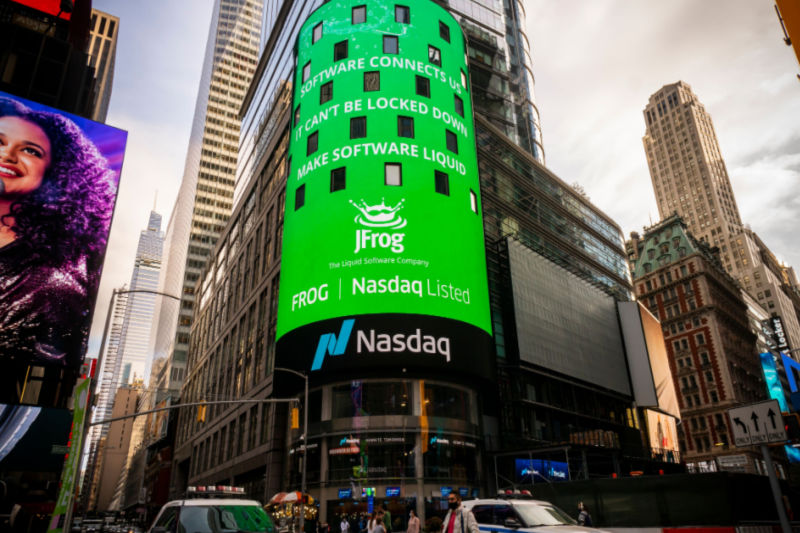
JFrog shares rose 2.5% after the company launched a new plugin for Anthropic’s Claude Code, immediately available to all users. The integration adds governed, supply-chain-aware AI coding capabilities, including artifact scanning, package security, license compliance, and provenance validation. JFrog also said it now manages over 18 billion artifacts, up 136% year over year, underscoring rising demand tied to AI coding agents.
This is less a one-day product headline than evidence that AI coding is turning into a distribution layer for enterprise security controls. The important second-order effect is that governance is becoming a budget line attached to agent usage, which raises the attach rate of security tooling as AI-generated code volume scales. That favors platform vendors that sit in the path of build artifacts and dependency resolution, because they monetize the “messy middle” created by autonomous code generation rather than the model layer itself. The competitive implication is that JFrog is trying to preempt two threats at once: native platform expansion from IDE/copilot ecosystems and point-solution security vendors that could wrap agent workflows with lighter-weight controls. If agents materially increase binary churn, then artifact management, provenance, and policy enforcement become more strategic, and the winner is the vendor already embedded in CI/CD and package governance. The risk is that this becomes an easy feature race if hyperscalers or developer-platform incumbents bundle similar controls at near-zero marginal price, which would compress the premium multiple before revenue can inflect. Near term, the stock can stay bid on incremental channel proof, but the real catalyst is whether the new integration drives measurable seat expansion or higher artifact throughput over the next 2-3 quarters. The bearish setup is a classic “good product, slow monetization” trap: investors may overpay for AI adjacency before the company shows that AI-native workflows improve retention, expansion, or deal size. If management cannot quantify contribution to net retention by the next two reporting cycles, the multiple likely reverts even if usage growth remains strong. Contrarian take: the market may be underestimating how sticky supply-chain governance becomes once developers standardize on agent-driven workflows. But it may also be overestimating how much this can accelerate revenue in the next 6-12 months, because security workflows are adopted by procurement, not enthusiasm. The best risk/reward is to own the secular winner, but only on weakness or through defined-risk options, because the narrative is strong while the monetization timeline is still uncertain.
AI-powered research, real-time alerts, and portfolio analytics for institutional investors.
Request DemoOverall Sentiment
moderately positive
Sentiment Score
0.42
Ticker Sentiment
