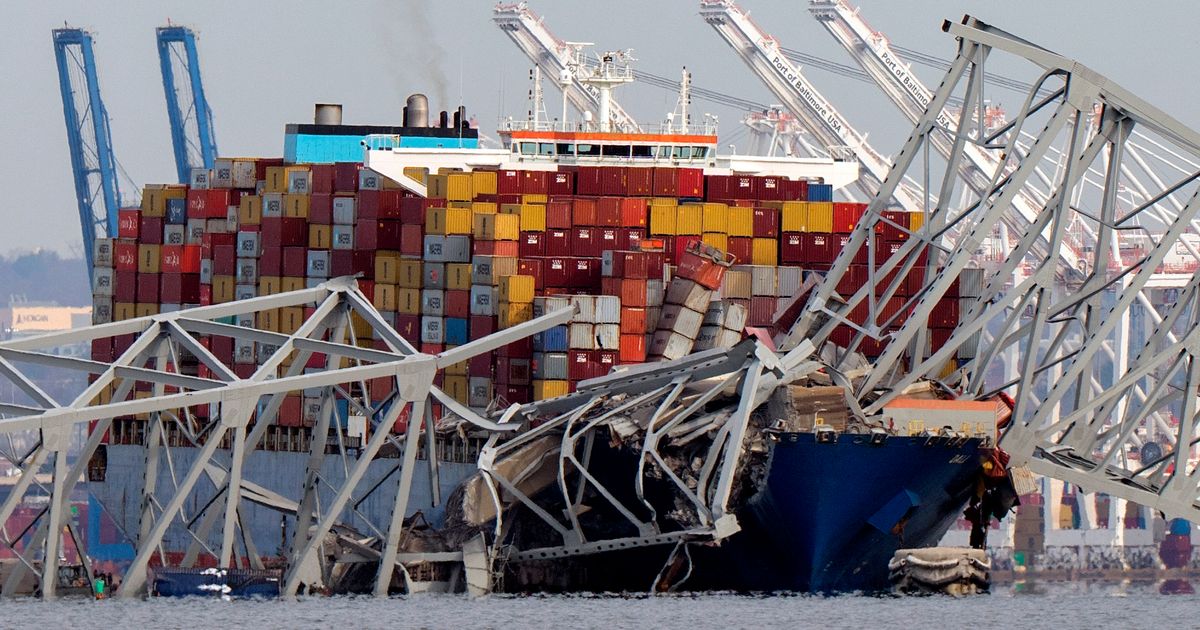
Federal prosecutors charged Synergy Marine Pte Ltd., Synergy Maritime Pte Ltd., and a key employee in the 2024 Francis Scott Key Bridge collapse, alleging conspiracy, false statements and failure to warn the U.S. Coast Guard. The crash killed six workers, shut the Port of Baltimore, and is tied to an estimated $4.3 billion to $5.2 billion replacement cost. The case adds significant legal and financial overhang for the companies, though the direct market impact is likely limited outside shipping and marine insurance.
This shifts the event from a one-off infrastructure accident to a multi-year liability overhang for any entity with vessel operations, ship management, or outsourced technical oversight. The most important second-order effect is that insurers, charterers, and port operators will now price governance failure more explicitly: premiums, deductibles, and vetting standards can tighten across container shipping and global logistics contracts for several renewal cycles.
The legal posture also raises the probability of discovery-driven spillover into counterparties that were not named initially. That matters because the path of least resistance for plaintiffs is to widen the target set toward owners, builders, class/flag interfaces, and insurers, which can keep settlement expectations moving higher for months even if criminal exposure ultimately narrows. In practice, the market usually misprices the duration of these cases; the earnings hit is rarely the headline amount, but the incremental friction in financing, insurance, and customer retention.
The bigger macro read-through is for U.S. infrastructure and municipal credit: this reinforces the asymmetry between obvious replacement capex and the harder-to-quantify economic drag from port disruption, detours, and project delays. That is supportive for contractors, engineering firms, and selective public-private infrastructure names with balance-sheet capacity, while being negative for logistics-exposed regional economies that rely on port throughput and just-in-time freight. If the legal process uncovers broader systemic maintenance or seaworthiness failures, expect regulators to press for tougher compliance standards that could increase operating costs across the fleet, especially for lower-quality operators.
Contrarian take: the equity market may overfocus on the headline criminality and underfocus on who actually bears the final economic loss. If insurance coverage and settlement mechanics absorb most of the direct damages, the lasting equity impact on shipping may be smaller than feared; the more durable trade is around higher compliance cost and a slower approvals environment, not a permanent step-change in industry liability. The opportunity is in owning the winners from replacement and remediation rather than trying to short the entire transport complex on a single legal event.
AI-powered research, real-time alerts, and portfolio analytics for institutional investors.
Request DemoOverall Sentiment
strongly negative
Sentiment Score
-0.75
