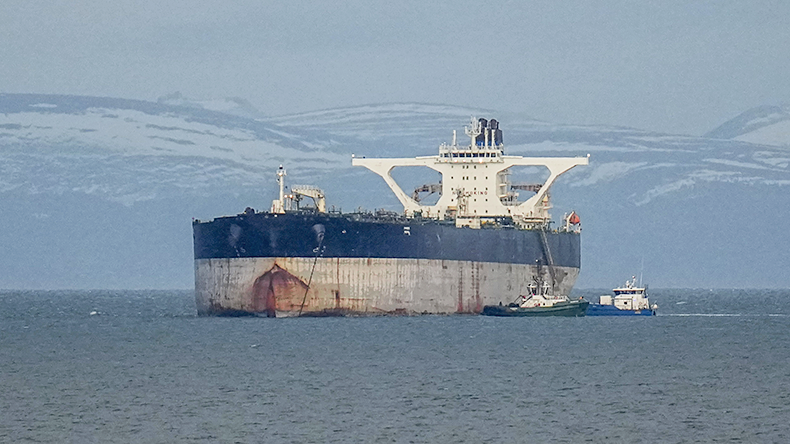
The US seizure of the Russian-flagged tanker Marinera is the key event and has effectively shattered the protective appeal of Russia's registry for shadow-fleet operators; reflagging to Russia has collapsed in 2026 with only two shadow-fleet tankers switching by late March. Coordinated UK-French (and broader EU) operations targeting stateless and falsely flagged vessels signal a stepped-up enforcement phase, raising interdiction, legal and insurance risks for clandestine tanker operators and likely increasing operational costs and routing disruption in tanker markets.
European enforcement and the US seizure change the marginal cost of operating “shadow” tonnage: higher seizure risk plus targeted interdiction raises effective voyage risk premiums and paperwork friction, which can be passed through as 20–50% higher freight/charter rates for compliant owners within 1–3 months if even 5–10% of available Aframax/VLCC capacity is rendered unusable or quarantined. Insurance and bank financing frictions are the key transmission mechanisms — expect war-risk premiums and P&I surcharges on certain routes to jump several hundred percent on affected voyages, and for undercapitalized owners of older tonnage to face immediate cashflow stress and potential forced lay-ups or scrapping within quarters.
Second-order winners are firms that supply verification, compliance and naval support: classification societies, lead insurers/reinsurers and European salvage/marine service providers see durable fee pools and pricing power over 6–18 months, while traders who relied on cheap, opaque freight to route sanctioned cargoes lose a low-cost arbitrage channel. The countervailing risk is substitution: operators can shift to other opaque registries, use ship-to-ship transfers in remote waters, or deploy more sophisticated ownership obfuscation — that would push disruption outwards in time (6–12 months) rather than eliminate it.
Tail risks: a rapid diplomatic de-escalation or a legal challenge that limits asset seizure authority could reverse the freight-tightness story in 30–90 days; conversely, an escalation that expands coordinated UK-EU interdictions to chokepoints would extend elevated rates and insurance costs into multi-year structural premiums. For portfolios, the trade-off is concentrated between asset-level idiosyncratic exposure to older shadow tonnage (high downside) and sector-wide upside from tightened seaborne flows and insurance repricing (moderate, durable upside).
AI-powered research, real-time alerts, and portfolio analytics for institutional investors.
Request DemoOverall Sentiment
mildly negative
Sentiment Score
-0.30
