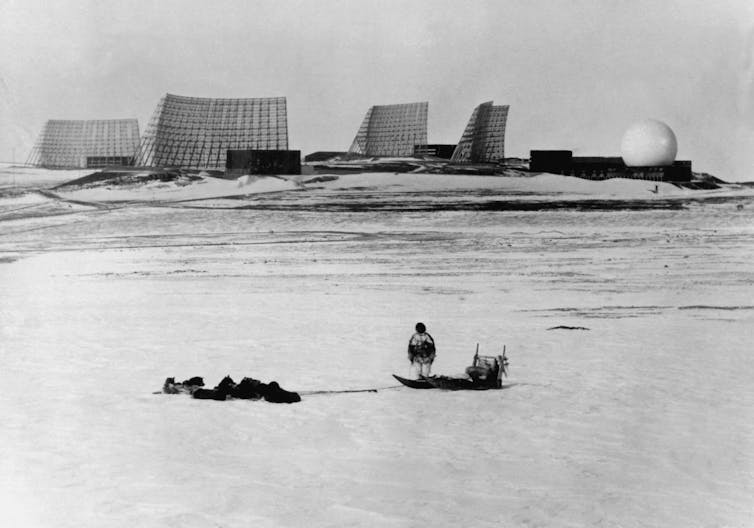
On Jan. 14, 2026 U.S., Danish and Greenlandic officials met after President Trump asserted the U.S. would acquire Greenland, prompting Danish officials to report a “fundamental disagreement” and Sen. Mitch McConnell to warn that seizing Greenland would destroy allied trust. The article reviews historical U.S. involvement — a 1941 treaty granting U.S. military access, WWII-era bases protecting a cryolite mine, Cold War-era build-out at Thule (supported by roughly 5,000 men and 280,000 tons of supplies) and the failed Camp Century/Project Iceworm — and highlights current constraints: limited commercial mining (mostly cryolite and small base metals, one anorthosite mine), major environmental liabilities from abandoned Arctic bases, infrastructure destabilization (thawing permafrost, damage at Pituffik/Thule), and systemic risk from Greenland’s ice sheet (holds enough water to raise sea level ~24 feet), implying elevated geopolitical and climate-driven downside risks with limited near-term commercial upside.
Market structure: A renewed U.S.–Greenland standoff favors defense primes (LMT, RTX, LHX) and ISR/satellite firms (MAXR) that can win basing, radar and surveillance contracts, while small-cap Arctic explorers and commodity juniors face longer timelines and political risk; expect a 6–18 month window where Western defense suppliers gain ~5–15% incremental pricing power on specialized Arctic work if DoD funding increases by $300–800m. Supply/demand: meaningful mineral supply changes are multi-year; Greenland mineral output cannot alter near-term critical-minerals tightness, so miners’ near-term revenues remain constrained and capex risk high. Cross-asset: geopolitical flare-ups will bid USD and core sovereigns at short end, push gold and oil up 3–7% in shock scenarios, and lift defense equities volatility; options IV for LMT/LHX may reprice 20–40% on budget announcements.
Risk assessment: Tail risks include a diplomatic rupture (low-probability) that triggers sanctions, NATO funding splits, or kinetic incidents around bases—these could spike defense equities +20% but crash Greenland-focused juniors -70%. Time horizons: immediate (days) sees FX/safe-haven moves; short-term (weeks–6 months) focuses on legislative funding and RFP cycles; long-term (2–10 years) is dominated by climate-driven infrastructure/cleanup liabilities (>$1bn aggregate remediation across legacy sites). Hidden dependency: thawing permafrost will create recurring remediation revenue but also unknown sovereign cleanup liabilities that could force Denmark/US budgets higher. Catalysts: DoD Arctic budget line in FY27, Greenland parliamentary votes, and Danish diplomatic statements within next 30–90 days.
Trade implications: Direct plays — establish modest long exposure to LMT (ticker LMT) and Jacobs (J) for defense/infrastructure; consider buying 12-month LMT call spreads (buy $520 / sell $620) sized to 1–2% notional for leveraged upside if Arctic funding materializes. Pair trades — long LMT or LHX vs short microcap Arctic explorers/miners (avoid equities with market cap <$500m focused on Greenland) to capture political/social-license re-rating. Hedging — buy 1–2% UUP and 1% GLD as short-duration tail hedges over 0–3 months while watching diplomatic outcomes. Entry/exit — stagger entries over 30–90 days around DoD appropriations or explicit RFPs; set stop-losses at -10% for primes, -25% for juniors.
Contrarian angles: Consensus overweights a quick mining bonanza; history (Camp Century, Project Iceworm) shows engineering/ extraction in Greenland routinely fails — miners are likely mispriced on geopolitical headlines. The market underestimates sustained remediation and construction demand; Jacobs (J) and AECOM (ACM) may be under-owned relative to defense primes and offer asymmetric upside if remediation budgets >$500m over 3 years. Unintended consequence: aggressive U.S. posture could reduce cooperation and access, hurting extractive ambitions — avoid long-duration junior miners and favor firms with secured government contracting pipelines. Trackables: FY27 DoD Arctic line, Danish parliamentary motions, and Greenland government statements in next 60 days as binary catalysts.
AI-powered research, real-time alerts, and portfolio analytics for institutional investors.
Request DemoOverall Sentiment
moderately negative
Sentiment Score
-0.45
Ticker Sentiment
