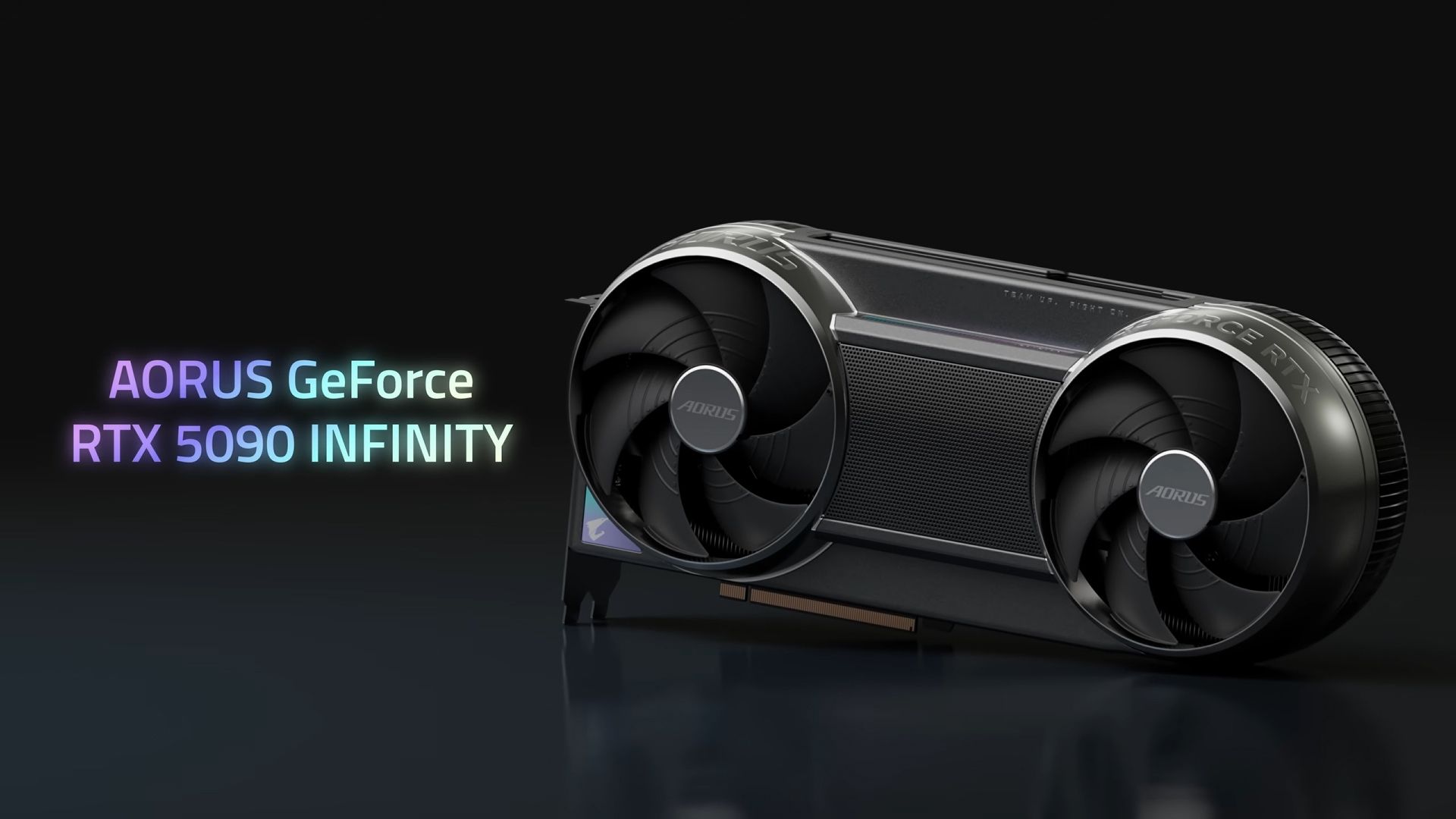
Gigabyte unveiled the Aorus GeForce RTX 5090 Infinity, a compact flagship RTX 5090 variant featuring a double flow-through design with two end fans plus a smaller center 'overdrive' fan, Windforce Hyperburst cooling, a separated PCB to enable bi-directional 'penetrating airflow', superconducting heat pipes, composite metal grease (hybrid paste/liquid metal) and server-grade thermal gel. The card measures 330 x 145 x 65 mm, uses a vertical 16-pin 12V-2x6 power connector, includes a die-cast backplate, dual-BIOS and a four-year warranty; pricing and availability are TBD but expected to command a premium (possibly above $3,000).
Market structure: Flagship AIB launches like Gigabyte’s Aorus RTX 5090 Infinity reinforce Nvidia’s (NVDA) ASP power and allow add-in-board partners (Gigabyte, Asus) to capture premium margins; expect premium RTX 5090 SKUs to price >$3,000 and represent 5–10% of unit volumes but 20–30% of GPU revenue for partners over the next 12 months. Competitive dynamics favor Nvidia’s ecosystem (NVDA) and scale suppliers (TSM, MU) while putting pressure on AMD (AMD) to defend share at lower ASPs; limited-edition runs (ROG Matrix) suggest product scarcity will sustain secondary market pricing for 2–4 quarters.
Risk assessment: Tail risks include a sudden macro consumer-spend pullback or EU/US regulatory/antitrust actions against bundling or power-draw limits that could compress margins; operational risks include thermal/quality recalls from exotic materials (liquid-metal hybrids) that would hit AIB inventory and warranty liabilities within 0–6 months. Hidden dependencies: higher demand raises wafer and HBM/GDDR consumption — TSM/TSM-backed capacity and Micron (MU) supply constraints could throttle shipments, creating 2–3 month lags and volatile options skew.
Trade implications: Direct plays — overweight NVDA (1–3% portfolio) and TSM (1–2%) for 6–12 months to capture ASP-led revenue and wafer demand; tactically long premium AIB names (ASUSTEK 2357.TW, GIGABYTE 2376.TW) 1% positions on release windows while sizing for higher warranty risk. Options — buy 3–9 month NVDA call spreads (10–25% OTM) to express upside with capped capital; consider buying short-dated calls ahead of product availability windows (2–8 weeks) to capture volatility spikes.
Contrarian angles: Consensus focuses on gamer sentiment, but enterprise/prosumer compute (AI workstation buyers) could be the larger demand driver; if Nvidia’s own Founders Edition remains competitive in efficiency, AIB premium collapse is possible — that would be a 20–30% downside to AIBs vs. NVDA. Historical parallel: 2018 RTX high-end frenzy showed brief ASP spikes then 6–9 month normalization; watch retail sell-through and wholesale channel days-of-inventory over next 8–12 weeks for an inflection.
AI-powered research, real-time alerts, and portfolio analytics for institutional investors.
Request DemoOverall Sentiment
mildly positive
Sentiment Score
0.30
