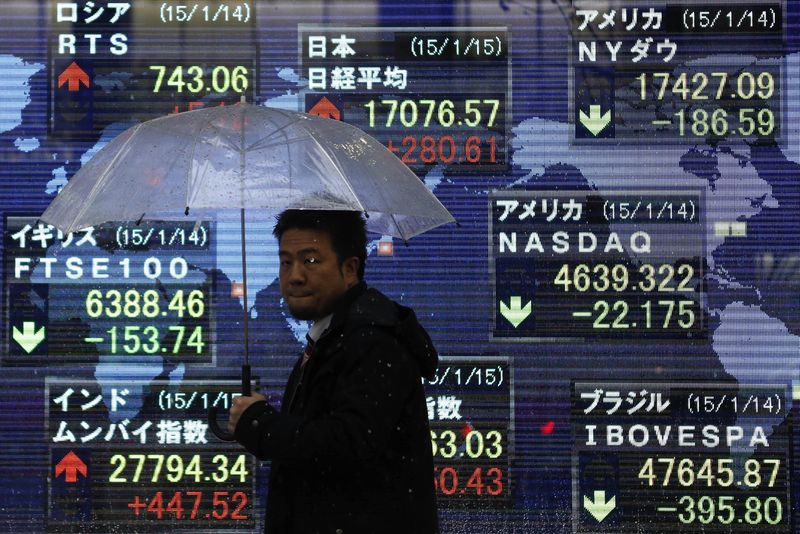
South Korea's KOSPI plunged nearly 5% and Japan's Nikkei/TOPIX slid 2.8–3.5%; Hong Kong's Hang Seng fell 3.1% and China’s CSI 300/Shanghai Composite dropped about 2% as Asian equities moved sharply lower. The rout was driven by escalating U.S.-Iran tensions after President Trump issued a 48-hour ultimatum and Iran threatened to shut the Strait of Hormuz, lifting oil prices and raising fears of stickier inflation and hawkish central banks. South Korea’s nomination of Shin Hyun-song as BOK governor increased rate-hike odds, and S&P 500 futures were down ~0.2%, underscoring broad risk-off flows.
The market move is less about permanent repricing and more about two overlapping shock channels: (1) headline-driven energy risk that transmits to inflation expectations within weeks, and (2) a liquidity/positioning shock that amplifies losses in rate-sensitive and EM assets. If oil remains elevated for 3-6 months it will mechanically add to regional CPI (order of magnitude: single-digit bps per $1/bbl sustained, compounding into ~0.05-0.15pp of core CPI per $10/bbl regionally over a few quarters) and thereby raise the marginal probability of additional central bank tightening in small open economies. That path benefits commodity producers and penalizes levered EM corporates with FX exposure.
Second-order competitive effects favor nimble North American E&P and oil services (faster capex response and higher FCF leverage) over integrated majors whose capital allocation is slower and more diversified. In EM Asia, exporters with USD revenues but domestic funding (tech manufacturers, contract manufacturers) get an asymmetric payoff: their FX revenue cushions top-line but funding and working capital stress rise if local rates spike or carry trades unwind. Banks with high household mortgage exposure in Japan/SK are a live micro risk if rates reprice faster than current markets expect.
Key catalysts and time horizons: headline escalation or credible Strait-of-Hormuz reopenings swing oil +/- $15 in days; diplomatic de-escalation is the fastest path to a relief rally, while persistent attacks push oil into a regime shift over 1-3 months that forces central banks to choose between growth and inflation. Watch: (a) short-term oil > $90 sustained for 4+ weeks, (b) BOK rate-swap steepening vs OIS as a read on hawkish pricing, and (c) net FX flows into JPY/CHF for risk-off conviction.
The consensus is underestimating the amplitude of a positioning unwind. Much of Asia’s selloff can be reversed within 1-3 weeks if futures and options gamma realign and headline risk cools; conversely, if oil and swaps move together higher, the market will reprioritize rate risk and reprice equities more structurally. That creates asymmetric trade windows both for short-term hedges and medium-term commodity exposure.
AI-powered research, real-time alerts, and portfolio analytics for institutional investors.
Request DemoOverall Sentiment
strongly negative
Sentiment Score
-0.70
Ticker Sentiment
