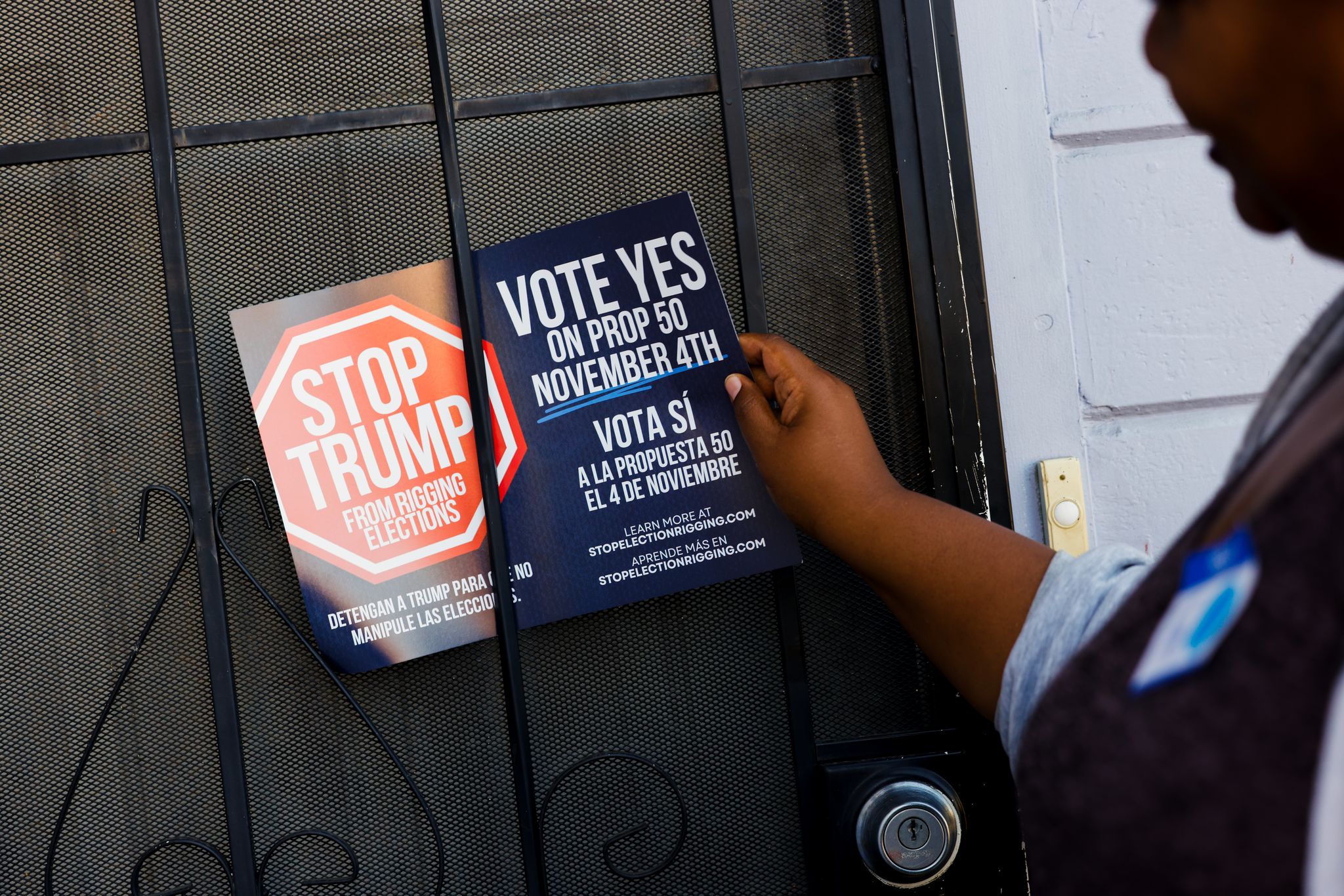
The campaign for California's Proposition 50, which seeks to redraw congressional maps to favor Democrats and flip five Republican-held seats, is marked by a significant financial disparity, with supporters raising $129 million compared to opponents' $46 million. Governor Gavin Newsom's committee has led the pro-Prop 50 fundraising, spending $77 million with backing from major Democratic donors like Tom Steyer and George Soros, alongside substantial small-dollar contributions. Opponents, largely funded by Charles Munger Jr.'s $32 million and Republican PACs, have spent $41 million, underscoring a heavily financed political contest with a clear financial advantage for the "yes" campaign.
California's Proposition 50 campaign exhibits a substantial financial disparity, with supporters raising $129 million, more than double the $46 million reported by opponents. This funding gap has widened significantly, with pro-Prop 50 groups also outspending opponents by over two-to-one. The sheer volume of contributions even caused state regulators difficulties in displaying campaign finance reports, highlighting the scale of financial mobilization.
Governor Gavin Newsom's committee leads the pro-Prop 50 fundraising, having spent $77 million primarily on television advertisements, and drawing significant support from over 102,000 small-dollar donors. Key Democratic donors like Tom Steyer ($12 million), House Majority PAC ($15 million), and George Soros's Fund for Policy Reform ($10 million) are also major contributors. Opponents are largely funded by Charles Munger Jr. ($32 million) and Republican-aligned groups such as the Congressional Leadership Fund ($7 million), with a much smaller donor base of approximately 420 individuals.
The proposition aims to replace existing congressional maps with new ones designed to flip five Republican-held seats to Democratic control, thereby strengthening Democratic influence in the U.S. House. Despite the substantial financial activity and political implications, the overall market impact is assessed as very low (0.1), with a neutral sentiment, suggesting no direct or immediate broad market repercussions from this political contest.
AI-powered research, real-time alerts, and portfolio analytics for institutional investors.
Request DemoOverall Sentiment
neutral
Sentiment Score
0.00
