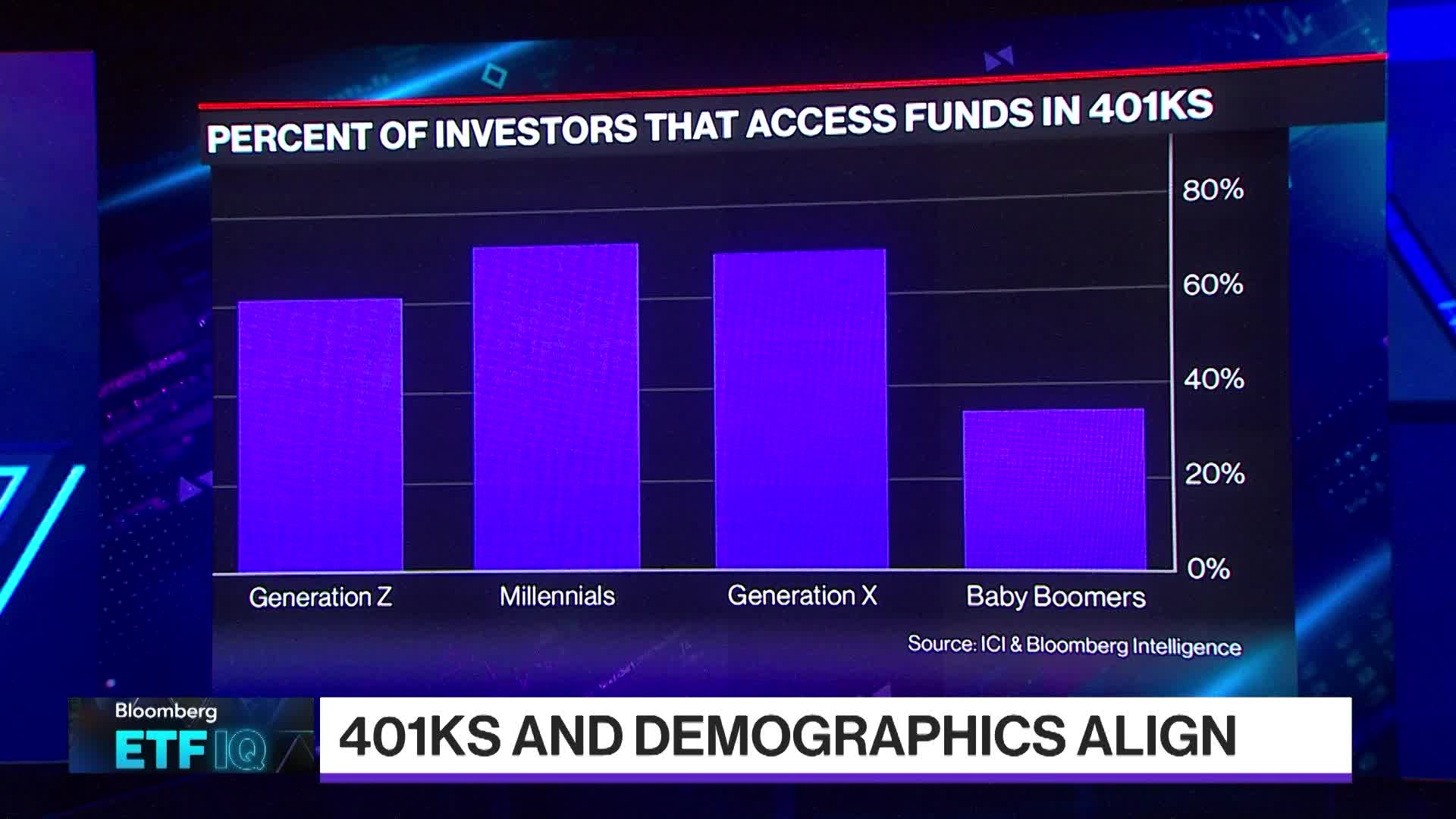
A report discussed in the article shows mutual-fund ownership among middle‑income households has risen substantially over the past ~20 years and mutual funds remain the dominant vehicle within 401(k) plans (cited roughly $5.7 trillion in mutual-fund assets versus about $3.7 trillion in 'cities'). Younger cohorts (including Gen X) access mutual funds via 401(k)s at materially higher rates (>60% vs ~35% for baby boomers), supporting continued inflows, while the planned introduction of ETF share classes for existing mutual funds in 2026 is expected to see a slow, limited rollout outside of a few firms (e.g., DFA) due to distribution and operational hurdles.
Market structure: Mutual-fund-centric asset managers, recordkeepers and firms operating collective investment trusts (CITs) are the near-term winners because automatic payroll flows into 401(k)s (estimated mutual fund share ~5.7T vs CITs ~3.7T) create sticky demand that is hard for ETF-only products to replicate. ETF share-class rollouts in 2026 look operationally constrained, so fee-bearing mutual AUM and servicing revenues remain stable; smaller managers without scale or recordkeeper relationships are the losers. Cross-asset: persistent mutual fund flows favor fixed-income and target-date allocations (supporting long-duration municipal and investment-grade credit demand) and reduce rebalancing-driven equity volatility in the near term, compressing buy-side options-gamma events.
Risk assessment: Tail risks include a DOL/SEC ruling forcing parity for ETF share classes in workplace plans or a rapid recordkeeper tech upgrade (low-probability but high-impact within 12–24 months) that could shift >10% of 401(k) flows to ETFs. Immediate (days) impact is minimal; expect event-driven moves in weeks–months around regulatory or recordkeeper announcements and structural shifts over 3–10 years as CITs and TDFs continue gaining share. Hidden dependencies: recordkeeper contract terms, plan default-menu inertia, and pricing concessions from large providers could accelerate adoption or lock in mutual fund incumbency.
Trade implications: Favor long exposure to large mutual-fund/TDF incumbents and back-end processors: T. Rowe Price (TROW) and SS&C (SSNC) are primary candidates; consider modest shorts of ETF-first, distribution-light managers (selectivity required, e.g., Invesco IVZ exposure to retail ETF pressure). Use 9–18 month call spreads on TROW/SSNC to capture AUM recovery while financing cost; pair trades (long TROW, short IVZ) play revenue mix divergence. Entry window: initiate within 30 days; re-evaluate on any DOL/SEC guidance or a major recordkeeper announcement.
Contrarian angles: The consensus that ETFs will dominate 401(k)s is likely premature — operational and distribution frictions give incumbents 2–5 years of runway to monetize fee schedules and scale CIT conversions. Mispricings: market may underprice backend processing vendors and TDF specialists; unintended consequence of slow ETF adoption is increased M&A among small managers, creating takeout candidates and positive idiosyncratic catalysts.
AI-powered research, real-time alerts, and portfolio analytics for institutional investors.
Request DemoOverall Sentiment
mildly positive
Sentiment Score
0.25
