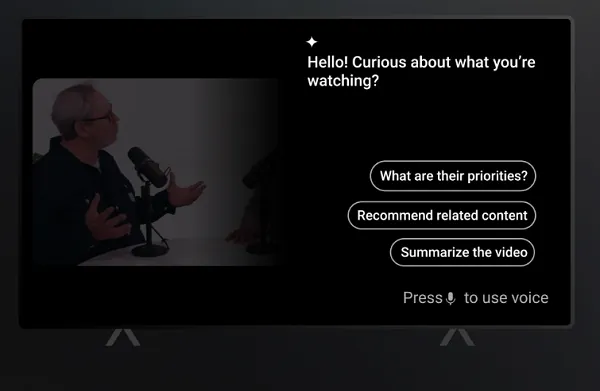
YouTube expanded its conversational AI 'Ask' chatbot to smart TVs, allowing viewers to make spoken, in-stream queries via their remote's microphone (TV testing began in February). The feature could raise connected-TV engagement and drive more on-platform information-seeking, but limited device support will constrain near-term adoption. Direct audio access raises privacy concerns and potential regulatory or reputational scrutiny, tempering upside for immediate monetization gains.
This feature is a marginal but strategically meaningful move to deepen YouTube’s engagement on the highest-attention screen: the living room. Even a low-single-digit increase in CTV session length or conversational interactions on TV can compound because CTV CPMs trade at a premium vs. mobile, so Google’s ad stack captures disproportionate upside as viewership and first-party signals migrate to TV. The bigger structural lever is a shift of incremental ad dollars away from ad-supported streaming aggregators and linear buys toward an owned-and-operated YouTube+Google pipeline on CTV, pressuring independent ad marketplaces and measurement vendors over 6–24 months.
Major second-order winners are SoC/microphone suppliers and platform owners that enable low-latency voice AI (advantaged: chipmakers that already ship secure on-device ML). Losers include ad-dependent CTV OEMs and independent ad networks if Google converts conversational queries into watch/ad minutes; that creates a feedback loop where preferred placement inside YouTube reduces the utility of third-party discovery. Key downside catalysts are regulatory or privacy-driven opt-in requirements (EU/US state privacy rules) or a sustained consumer adoption failure — if opt-in rates are <30% the monetization uplift will be negligible and reputational/legal costs could exceed incremental ad gains within 6–18 months.
Execution on monetization is binary and slow: product-level engagement metrics will matter first (weeks–months), but P&L impact shows up in quarterly ad RPMs and R&D opex over 2–4 quarters. Watch for three early indicators to horizon-time trades: (1) CTV Ask usage growth (weekly DAU/WAU), (2) incremental CTV ad RPM vs. other surfaces, and (3) regulatory filings/consumer class actions. These determine whether to favor asymmetric optionality (options spreads) vs. directional exposure to ad/SoC winners or short exposure to at-risk ad platforms.
AI-powered research, real-time alerts, and portfolio analytics for institutional investors.
Request DemoOverall Sentiment
mixed
Sentiment Score
0.05
