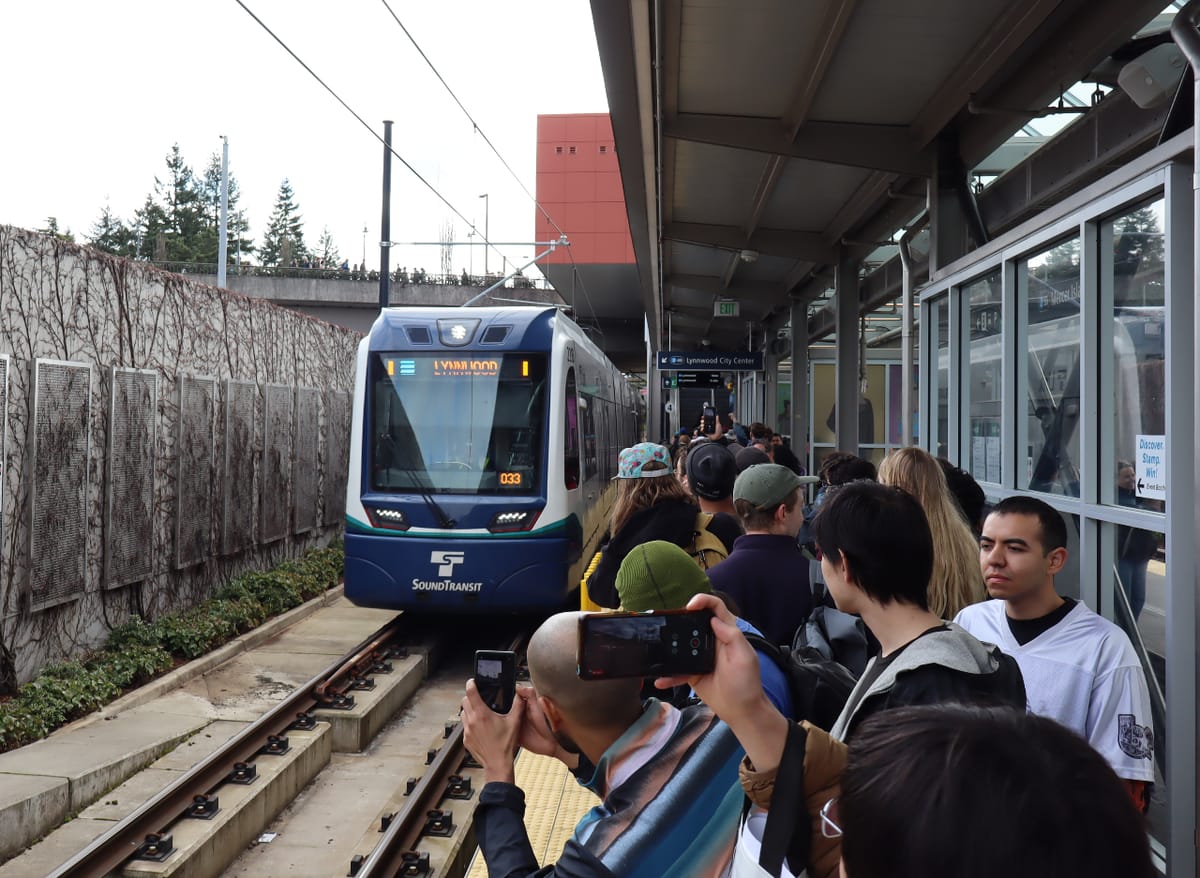
Sound Transit opened the full 2 Line, linking Redmond and Lynnwood and delivering a regional network of 50 light rail stations across 63 miles. The launch generated very high demand — crowds rivaling major events (e.g., the Super Bowl parade's ~225,000 riders) and temporary station closures — and shortens Downtown Seattle–Downtown Bellevue travel to about 20 minutes. Officials warned of a significant budget gap that could push planned station openings (Graham Street and Boeing Access Road) from 2031 further out and put the West Seattle Link (currently targeted for 2032) at risk, making project phasing and job impacts central to upcoming board decisions.
The opening is a de-risked demand signal: a single-day surge that rivaled the Super Bowl parade exposes latent daily commute volume and willingness to switch modes when transit is frequent and fast. That implies near-term revenue shifts away from employer-run shuttles, surface parking, and marginal ferry/Express bus runs — a structural flow of cash from private commuting services into public transit budgets and adjacent retail near stations within months.
For corporates, the micro effect is measurable. Large campus employers (MSFT-sized) will see an immediate reduction in effective labor-market friction within a 20–60 minute commuting radius, compressing wage premia for hard-to-recruit locations and enabling higher utilization of office real estate inside Bellevue/Redmond; expect incremental productivity/up-tick in office utilization metrics over 6–18 months, not years. Conversely, the construction pipeline now becomes binary: an active build cycle for rolling stock, systems integration and station-area development exists only so long as Sound Transit keeps funding ramps intact — deferred stations push multi-year revenue streams out and concentrate execution risk on a smaller set of contractors.
Second-order winners include office- and transit-oriented developers, local retail landlords, and transit-capable employers; losers include private commuter services, surface-park operators, and regionally exposed construction firms if ST3 scope is cut. The critical catalyst to watch is the upcoming Sound Transit board realignment over the next 3–9 months — it will determine whether this ridership momentum translates into a multi-year procurement runway or a one-off demand spike followed by budget-driven pause.
AI-powered research, real-time alerts, and portfolio analytics for institutional investors.
Request DemoOverall Sentiment
moderately positive
Sentiment Score
0.45
Ticker Sentiment
