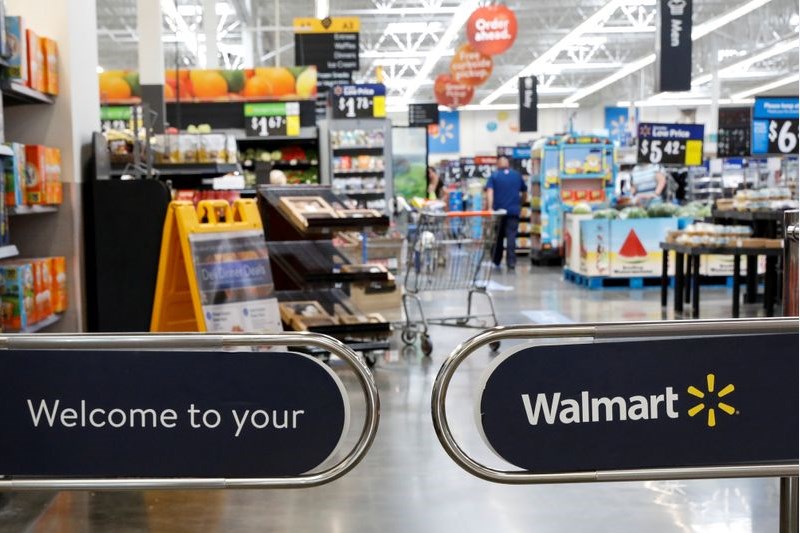
UBS reiterated a Buy on Walmart with a $147 price target, implying 11.6% upside from the current $131.69 share price. The firm expects about 4.5% U.S. comparable sales growth, led by more than 25% e-commerce growth, but sees store sales softness and pressure in pharmacy from Maximum Fair Pricing legislation and slower GLP-1 adoption. Walmart’s earnings are due May 21, with options implying a 4.1% move.
The market is still treating this as a single-name retail beat/miss, but the cleaner read is a relative-margin story: Walmart’s scale allows it to defend traffic while selectively absorbing pharmacy and health-category pressure without needing broad price investment. That is a subtle negative for mid-tier grocers and pharmacy-heavy mass merchants, because the spend Walmart loses in one pocket is likely to be recaptured through app, pickup, and marketplace conversion rather than leaked to peers. The more interesting second-order effect is on Amazon. If Walmart can sustain high e-commerce growth while keeping store economics intact, it reinforces that convenience-led share gains are now a two-horse race, but with very different economics: Walmart wins on food/necessities frequency, Amazon on discretionary breadth. That means the main vulnerability for AMZN is not losing share at the margin, but a renewed investor willingness to underwrite Walmart’s retail media and fulfillment monetization, which can compress the valuation gap between the two. The contrarian miss here is that the headline valuation debate may be backwards for the next quarter. The stock can look expensive on asset-based fair value while still being mechanically supported by stable-to-upward EPS revisions, especially if management signals that operating leverage is intact despite mix shifts. The tail risk is in health-related reimbursement changes and weaker consumer trade-down elasticity over the next 1-2 quarters; if pharmacy and wellness softness broadens into discretionary baskets, the “defensive winner” narrative loses altitude quickly. For trading, this is better expressed as a relative rather than absolute long: the catalyst window is the earnings print and the next 4-8 weeks of estimate revisions. If Walmart merely confirms high-end guidance while Amazon commentary remains opaque on retail margin, the spread can widen even without a big WMT re-rating; if Walmart disappoints on traffic or operating income, the downside is likely larger in the near term because expectations are crowded and options pricing already implies a meaningful move.
AI-powered research, real-time alerts, and portfolio analytics for institutional investors.
Request DemoOverall Sentiment
mixed
Sentiment Score
0.15
Ticker Sentiment
