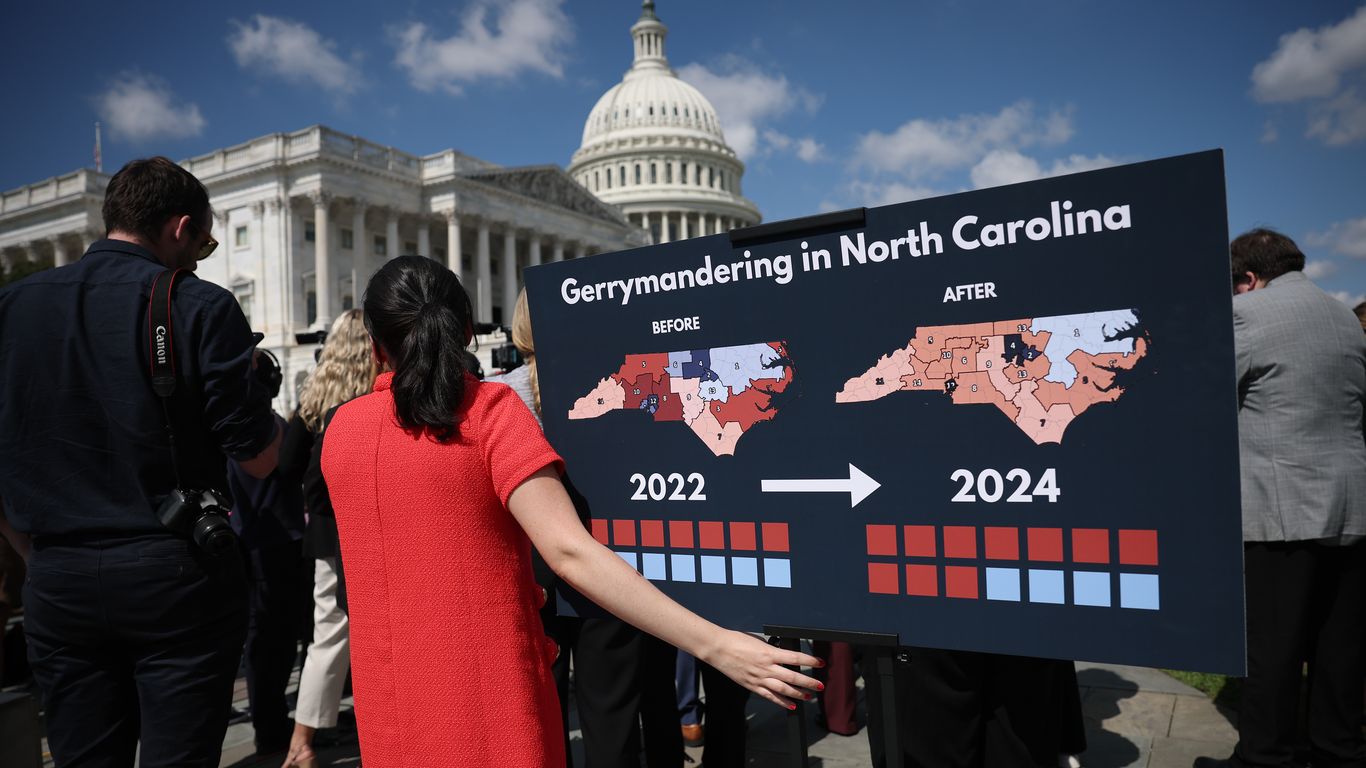
A three-judge federal panel ruled that North Carolina may use its 2025 redrawn congressional map for the 2026 midterm elections, a decision that Republicans view as improving their chances to flip a U.S. House seat and helping GOP efforts to retain control of Congress. The court found no direct evidence the redistricting violated racial discrimination laws and held that partisan-gerrymandering claims are barred from federal courts by a 2019 Supreme Court precedent; the NAACP, a plaintiff, has not yet indicated whether it will seek Supreme Court review.
Market structure: The court ruling increases the probability that North Carolina’s 2026 map will slightly favor Republican House pickup chances, which marginally boosts sectors that historically benefit from GOP control (Energy, Defense, Industrials, Financials). Expect modest re-pricing in single-digit percent ranges in policy-sensitive names as market participants shift 3–6‑month exposures toward firms with upside from looser environmental/regulatory policy and stable defense budgets. Cross-asset: a sustained GOP House narrative can be dollar‑positive and modestly bearish for long-duration Treasuries if it raises odds of fiscal consolidation or gridlocked spending fights; oil/commodity prices would be supported if regulatory headwinds to fossil fuels recede.
Risk assessment: Tail risks include a Supreme Court reversal or state-level injunctions that would negate the map (low prob but >0), and second-order political feedback (intensified national litigation and voter mobilization) that could swing sentiment violently into 2026. Immediate impact (days) should be muted; short-term (weeks–months) move markets by 1–4% in exposed sectors; long-term (2026+) risks hinge on Senate/presidential composition—House control alone is necessary but not sufficient to change fiscal policy. Hidden dependencies: fundraising, AG enforcement priorities, and macro cyclical forces will dominate outcomes.
Trade implications: Favor overweight Energy (XOM, CVX) and Defense (LMT, RTX) with 12–24 month horizons via call spreads/equity buys sized 2–4% of portfolio; underweight high-valuation tech (GOOGL, AMZN) and clean-energy names (ENPH, TSLA) that depend on Democratic policy. Use options to cap downside: buy 12–18 month call spreads on XOM/CVX and 9–12 month protective puts on GOOGL/AMZN sized to limit drawdowns to 1–2% portfolio risk. Entry: scale in 25% now, 50% on 1) mid-2025 polling gap >5% favoring GOP nationally or 2) state-level certainties.
Contrarian angles: The market may overstate the economic policy impact of a single-state map — a GOP House without Senate or presidency yields more hearings than law changes; historical parallels (post‑2010) show regulatory shifts were incremental and markets often rallied on tax certainty. The obvious energy/defense trade could be overbought; watch litigation catalysts and mid-2025 fundraising/primary outcomes as higher-value triggers that could reverse positions quickly.
AI-powered research, real-time alerts, and portfolio analytics for institutional investors.
Request DemoOverall Sentiment
neutral
Sentiment Score
0.00
