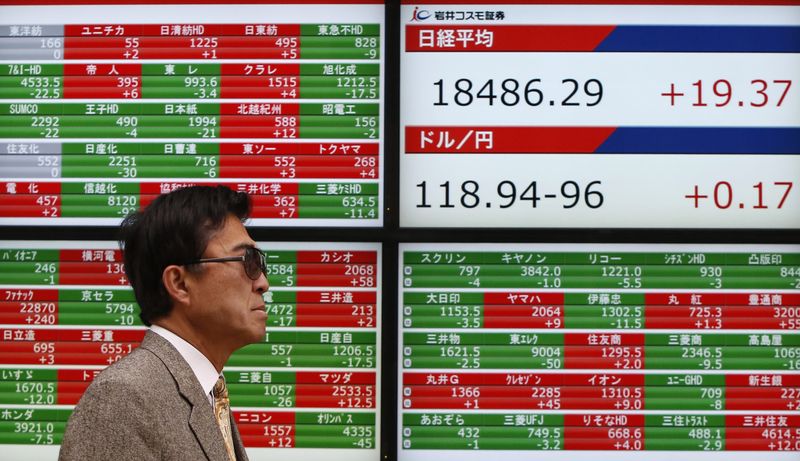
Asian stocks traded mixed amid geopolitical tensions surrounding the Iran-Israel conflict and anticipation of central bank decisions, particularly from the Bank of Japan (BOJ), which is expected to hold rates steady at 0.5%. Despite a positive lead from Wall Street, S&P 500 Futures dipped following renewed conflict and warnings from the U.S., while Japanese stocks gained ahead of the BOJ announcement, with investors eyeing potential hawkish signals from Governor Ueda amid rising inflation. Broader Asian markets remained rangebound, with upcoming rate decisions from the Federal Reserve, Swiss National Bank, Bank of England, and People’s Bank of China adding to market uncertainty.
Asian equity markets demonstrated a predominantly cautious tone, trading within a flat-to-low range as investors grappled with heightened geopolitical tensions surrounding the Iran-Israel conflict and awaited a series of pivotal central bank interest rate decisions. Renewed concerns were stoked by U.S. President Donald Trump's call for Tehran's evacuation, contributing to a 0.6% decline in S&P 500 Futures during Asian hours, despite White House officials clarifying that the U.S. was not planning direct military involvement and that ceasefire negotiations were underway. Japanese equities, however, diverged positively, with the Nikkei 225 and TOPIX advancing 0.5% and 0.2% respectively, supported by gains in technology stocks and a depreciating yen benefiting exporters, as markets anticipated the Bank of Japan's (BOJ) policy announcement. While the BOJ is expected to maintain its current 0.5% interest rate, investor focus is on Governor Kazuo Ueda's commentary for any hawkish indications, fueled by recent data showing rising Japanese inflation and economic resilience, with a potential rate hike anticipated in July. Elsewhere in Asia, Chinese indices, including the Shanghai Shenzhen CSI 300 and Shanghai Composite, each declined by approximately 0.3%, and Hong Kong's Hang Seng fell 0.4%, reflecting broader regional apprehension. South Korea's KOSPI bucked the trend with a 0.5% gain, primarily driven by strength in its technology sector and expectations of increased political stability. Singapore's Straits Times Index also managed a 0.4% rise, even as May's non-oil export data revealed an unexpected contraction, which halved the nation's trade surplus. The general market sentiment is characterized as mildly negative with an uncertain tone, reflecting the significant market impact of these unfolding events and the upcoming decisions from the Federal Reserve, Swiss National Bank, Bank of England, and the People’s Bank of China.
AI-powered research, real-time alerts, and portfolio analytics for institutional investors.
Request DemoOverall Sentiment
mildly negative
Sentiment Score
-0.25
Ticker Sentiment
