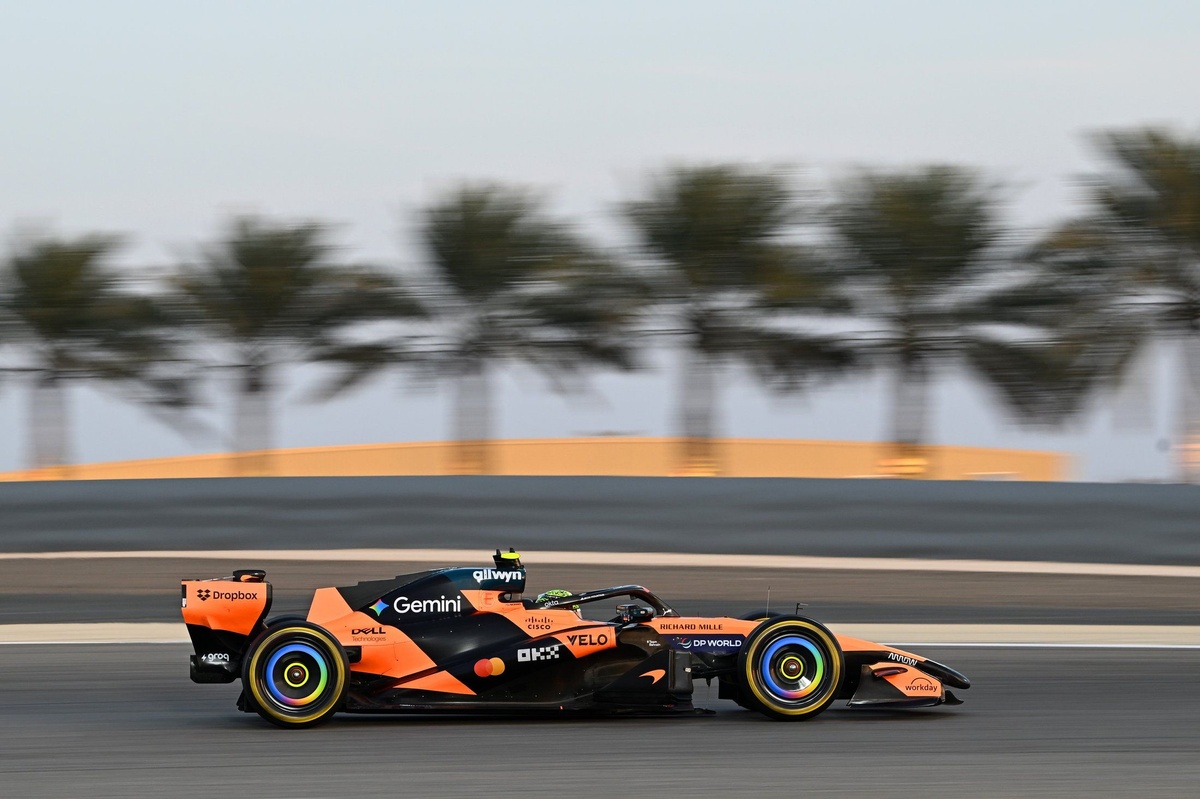
At Bahrain pre-season testing McLaren logged heavy mileage but team lead Lando Norris said the MCL40 currently trails Red Bull and Ferrari, citing a deployment and energy-harvesting advantage evident in GPS traces; Norris completed a 149-lap day and finished roughly 0.5s off Charles Leclerc's top morning time. Technical director Neil Houldey expressed confidence Mercedes HPP can deliver the additional electric deployment needed, but McLaren acknowledges a clear efficiency gap that must be closed over the remaining test days.
Market structure: Testing implies a narrow leadership cluster (Red Bull/Ford, Ferrari, Mercedes-linked teams) with Ford (F) as a visible beneficiary of Red Bull’s apparent deployment edge and Ferrari (RACE) as a close rival. Equity impact is likely idiosyncratic and headline-driven—expect 3–7% directional moves around the first 3 races (March–April 2026) rather than durable market-share shifts in OEM sales this quarter. Supply-demand: the signal is greater near-term demand for high-efficiency power electronics and HPP software services, favoring suppliers of inverters, MCUs and ERS components over commoditized OEMs.
Risk assessment: Tail risks include an FIA technical clampdown on energy deployment (policy risk), a reliability crisis in a new power unit (operational), or a PR/marketing reversal if Mercedes reveals a performance advantage (informational). Time horizons: days (testing headlines volatility), weeks/months (season-opening races set narrative), quarters/years (PU tech trickle-down to road vehicles). Hidden dependency: midfield teams’ performance is contingent on manufacturer software updates and energy-management IP licensing, not just hardware.
Trade implications: Tactical, headline-driven trades work best. Favor small, event-timed positions: directional exposure to F to capture halo/brand and potential supplier re-rating; selective longs in RACE if on-track performance persists. Use option spreads to control downside and exploit short-term IV; overweight component suppliers (power electronics/battery management) for a multi-quarter thematic play.
Contrarian angle: The market may overpay for testing flash—histor precedent (2014 hybrid era) shows early leaders can fade once reliability and race strategy matter. If Mercedes telemetry or FIA guidance flips within 2–4 weeks, sentiment can reverse quickly; set quantitative triggers (see trades) to avoid being caught on momentum alone.
AI-powered research, real-time alerts, and portfolio analytics for institutional investors.
Request DemoOverall Sentiment
mildly negative
Sentiment Score
-0.25
Ticker Sentiment
