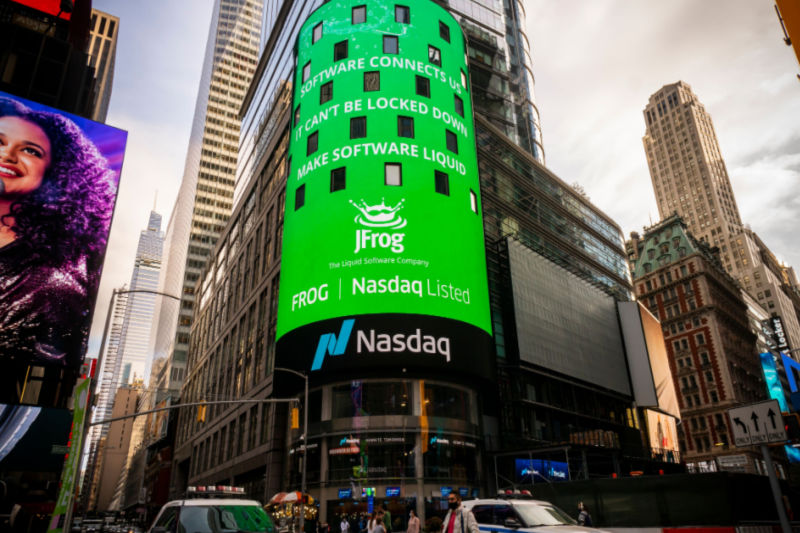
Truist reiterated a Buy on JFrog with a $70 price target and UBS upgraded to Buy ($60) while TD Cowen and Guggenheim reaffirmed Buy ratings with $80 and $60 targets; shares trade around $45.57 after a ~30% decline since early December. JFrog reported revenue up 24% over the last 12 months to $532M with a 77% gross margin, and analysts project the company will be profitable this year. Firms cited recent open-source supply-chain attacks as catalysts likely to increase demand for JFrog’s Curation and Xray security products, and JFrog launched a JFrog Agent Skills Registry integrated with NVIDIA for AI agent governance. Combined analyst activity, product launches, and security tailwinds are likely to move the stock at the single-digit percentage level.
Recent supply-chain infections and AI-augmented adversary trajectories create a durable, multi-year uplift for vendors that can productize provenance, policy gating and runtime governance — not just static scanning. Expect procurement to shift dollars from one-off consulting and incident response line items into recurring, platformized bundles (registry + runtime controls + telemetry) over 6–24 months, amplifying CLTV for winners but lengthening initial sales cycles by another quarter or two.
Second-order winners are firms that can stitch model provenance into software provenance: vendors who integrate MLOps registries with package governance gain a differentiated TAM (models + packages), while pure-play perimeter hardware vendors face margin compression as inspection migrates closer to dev pipelines and cloud-native runtimes. Cloud hyperscalers could also internalize parts of the stack; their native registries and policy engines are the biggest latent competition over a 12–36 month horizon.
Primary risks are adoption and procurement timing mismatches, and a single high-profile false positive or performance regression that stalls rollouts across large customers. Regulatory or insurer-driven mandates (carve-outs or minimum controls) would be a binary positive; conversely, an open-source community solution or hyperscaler-built free registry could structurally limit pricing power. Monitor deal RFP cadence, ARR expansion metrics, and partner motions into MLOps as near-term read-throughs.
AI-powered research, real-time alerts, and portfolio analytics for institutional investors.
Request DemoOverall Sentiment
moderately positive
Sentiment Score
0.45
Ticker Sentiment
