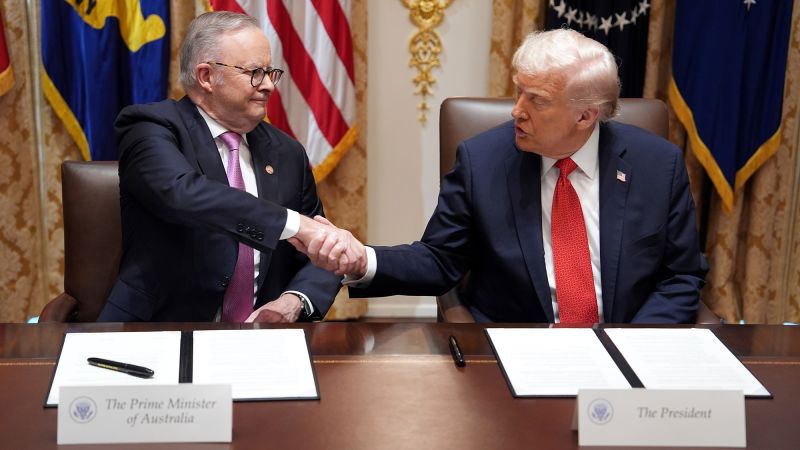
The U.S. is aggressively moving to counter China's dominance in rare earths, critical minerals vital for technology, by entering an $8.5 billion agreement with Australia. This deal involves substantial government and Export-Import Bank financing for Australian rare earth projects and a gallium refinery, aiming to diversify supply chains amid China's near-monopoly and its use of these resources as a trade leverage. While President Trump projects rapid self-sufficiency, experts largely contend that building a robust, independent supply chain will likely take a decade or more due to high costs, environmental hurdles, and the necessity of establishing new industrial infrastructure, despite Australia's significant reserves and existing projects seeking final financing. This initiative underscores the escalating geopolitical competition for critical resources and the considerable investment required to mitigate supply chain vulnerabilities.
The United States is actively countering China's near-monopoly on rare earth elements, which comprise over 90% of global refined output and are critical for technologies like iPhones. The US, dependent on China for 70% of its rare earth imports (2020-2023), has initiated an $8.5 billion agreement with Australia. This deal includes an intended $3 billion government investment over six months, projected to yield $53 billion in critical minerals projects, alongside $2.2 billion in Export-Import Bank financing and a Pentagon-backed gallium refinery.
This strategic move addresses significant supply chain vulnerabilities, as Goldman Sachs estimates a mere 10% disruption in rare earth production could erase $150 billion from US economic output. China's weaponization of its rare earth dominance through export controls has already caused global shortages, underscoring the high stakes for global manufacturing and the broader economy.
Despite President Trump's optimistic projection of rare earth abundance within a year, experts are highly skeptical, anticipating a decade or more to establish a robust, independent supply chain. Challenges include high energy costs, environmental concerns, and a shortage of skilled labor, even with Australia's significant deposits and leading position in rare earth exploration investment. Building this industry requires substantial long-term planning and investment.
AI-powered research, real-time alerts, and portfolio analytics for institutional investors.
Request DemoOverall Sentiment
mixed
Sentiment Score
-0.05
Ticker Sentiment
