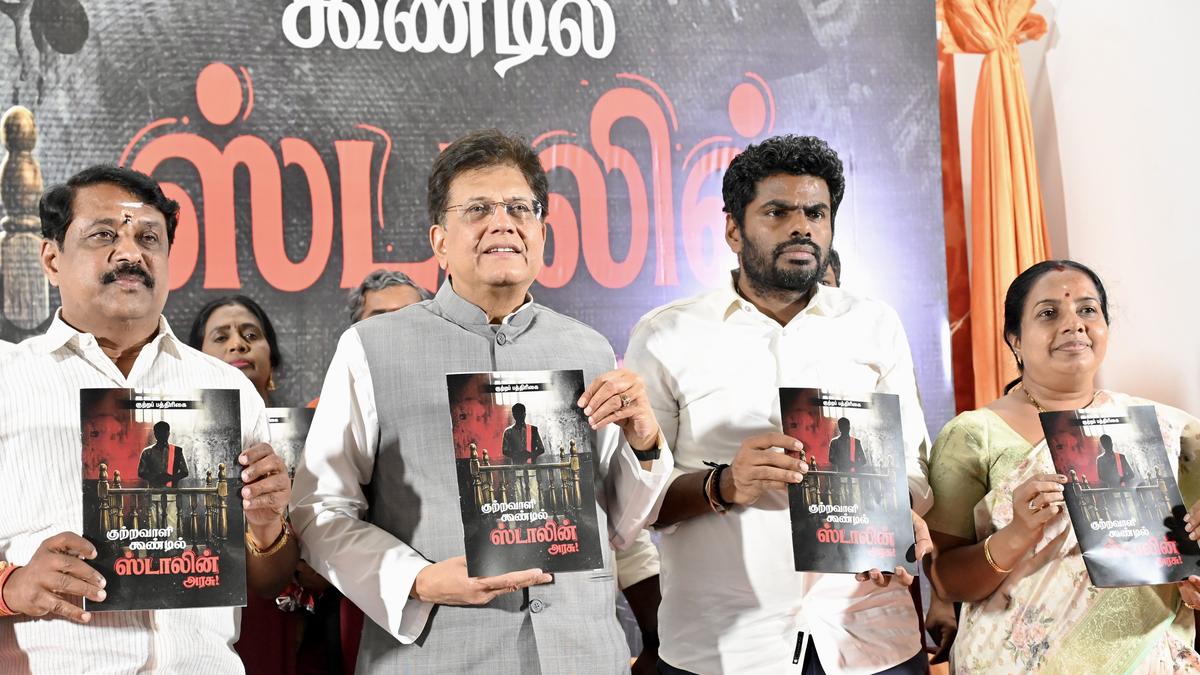
Union Minister Piyush Goyal released a BJP 'chargesheet' claiming Tamil Nadu's total debt exceeds ₹10 lakh crore, GST compensation of ₹50,700 crore was not transferred to local bodies, and only ~12% of the State budget is allocated to capital expenditure amid a rising revenue deficit. He accused the DMK government of corruption, family rule, and failing to deliver electoral promises, framing the upcoming Assembly election as a turning point and backing AIADMK leader Edappadi K. Palaniswami as an alternative. Implications: heightened political risk for state governance and fiscal management, potential for increased central-state friction, and risks to infrastructure/MSME/farmer-related spending and project execution.
Election-season fiscal accusations against a large state raise a localized sovereign-credit and funding-cost loop that typically plays out over 0–12 months. If Tamil Nadu’s capital spending stays depressed and transfers to local bodies are constrained, expect a near-term squeeze in cashflow for municipal contractors, MSME suppliers and NBFCs lending into the State economy, which can raise non-performing loans concentrated in regional portfolios within 1–3 quarters.
The immediate market transmission channel is higher state-level yield premia and bank/credit-spread widening rather than a sudden national sovereign crisis; rating agencies and bank asset-quality reviews take 1–3 months to materialize, while RBI/centre fiscal support decisions can reverse moves within days. A change of government is the binary catalyst — an NDA victory likely triggers a re-opening of transfers and a capex acceleration benefiting engineering & construction and heavy-equipment suppliers over 6–12 months, whereas continuity of the incumbent with continued fiscal slippage makes spreads and short-term funding costs drift higher.
Second-order winners from a fiscal reset: larger pan-India EPC and heavy-capex contractors and listed NBFCs with limited regional concentration (they benefit if transfers resume). Losers in the downside scenario include small regional NBFCs, municipal contractors and autos with high sales concentration in Tamil Nadu; downside is magnified if central agencies escalate fiscal conditionality or ratings heads towards a watch-list within the next quarter.
AI-powered research, real-time alerts, and portfolio analytics for institutional investors.
Request DemoOverall Sentiment
mildly negative
Sentiment Score
-0.35
